Heavy Industrial Air Filtration: Dust, Fume, Mist Control
Summary
“From CFM calculations to MERV and HEPA ratings, this guide covers everything plant managers need to know about heavy industrial air filtration in 2026, including compliance, sizing, and maintenance.”
Airborne hazards are one of the most expensive problems a factory can ignore. Fine dust damages worker lungs, weld fumes carry toxic metals, and a single cloud of combustible dust can level a production hall. On top of the human cost, regulators are watching. OSHA citations, EPA emission penalties, and failed audits all trace back to the same root cause: poor air filtration.
What Is Heavy Industrial Air Filtration?
Heavy industrial air filtration is the process of capturing and removing hazardous particles such as dust, fumes, and mist from factory air using high capacity mechanical systems. These systems pull contaminated air through filter media, trap the particulate matter, and return clean air to the workspace or release it outside within legal emission limits.
Every filtration program serves three goals at once: worker safety, environmental compliance, and explosion prevention. The hardware falls into two broad categories. Source capture systems pull contaminated air at the point of generation, through hoods, fume arms, or machine enclosures, before it spreads. Ambient systems clean the general shop air through ceiling mounted or floor standing units. Most plants need both.
Why Industrial Air Filtration Matters
Worker Health and Safety
Particles smaller than 10 microns (PM10) reach deep into the lungs, and particles under 2.5 microns (PM2.5) can enter the bloodstream. Respirable crystalline silica from cutting and grinding causes silicosis, an incurable lung disease. Weld fumes from stainless steel contain hexavalent chromium, a known carcinogen, along with manganese, which attacks the nervous system. NIOSH links these exposures to lung cancer, COPD, and occupational asthma. Respirators help, but OSHA’s hierarchy of controls puts engineering controls above PPE for a reason: filtration removes the hazard from the air itself instead of relying on each worker to wear a mask correctly for eight hours.
Environmental Compliance
Under the Clean Air Act, the EPA limits how much particulate matter a facility can release, and state agencies often add stricter permit conditions. Exceed your limits and the penalties stack up fast, and repeat violations can pause your operating permit entirely. A correctly specified system keeps stack emissions measurable, documented, and inside the line.
Explosion Prevention
Wood dust, grain, aluminum fines, coal dust, sugar, and many plastics are combustible. A dust explosion needs five elements at once, known as the combustible dust pentagon: fuel, oxygen, ignition, dispersion, and confinement. Remove any one and the explosion cannot happen. Dust collection attacks the fuel and dispersion legs directly. NFPA 652 requires facilities handling combustible dust to complete a Dust Hazard Analysis (DHA), and the collector itself needs explosion vents, isolation valves, and spark arrestors, because the highest dust concentration in the plant is inside the collector.
Types of Heavy Industrial Air Filtration Systems
No single system covers every application. The right choice depends on particle size, dust load, moisture, temperature, and whether the dust is combustible.
Baghouse Dust Collectors
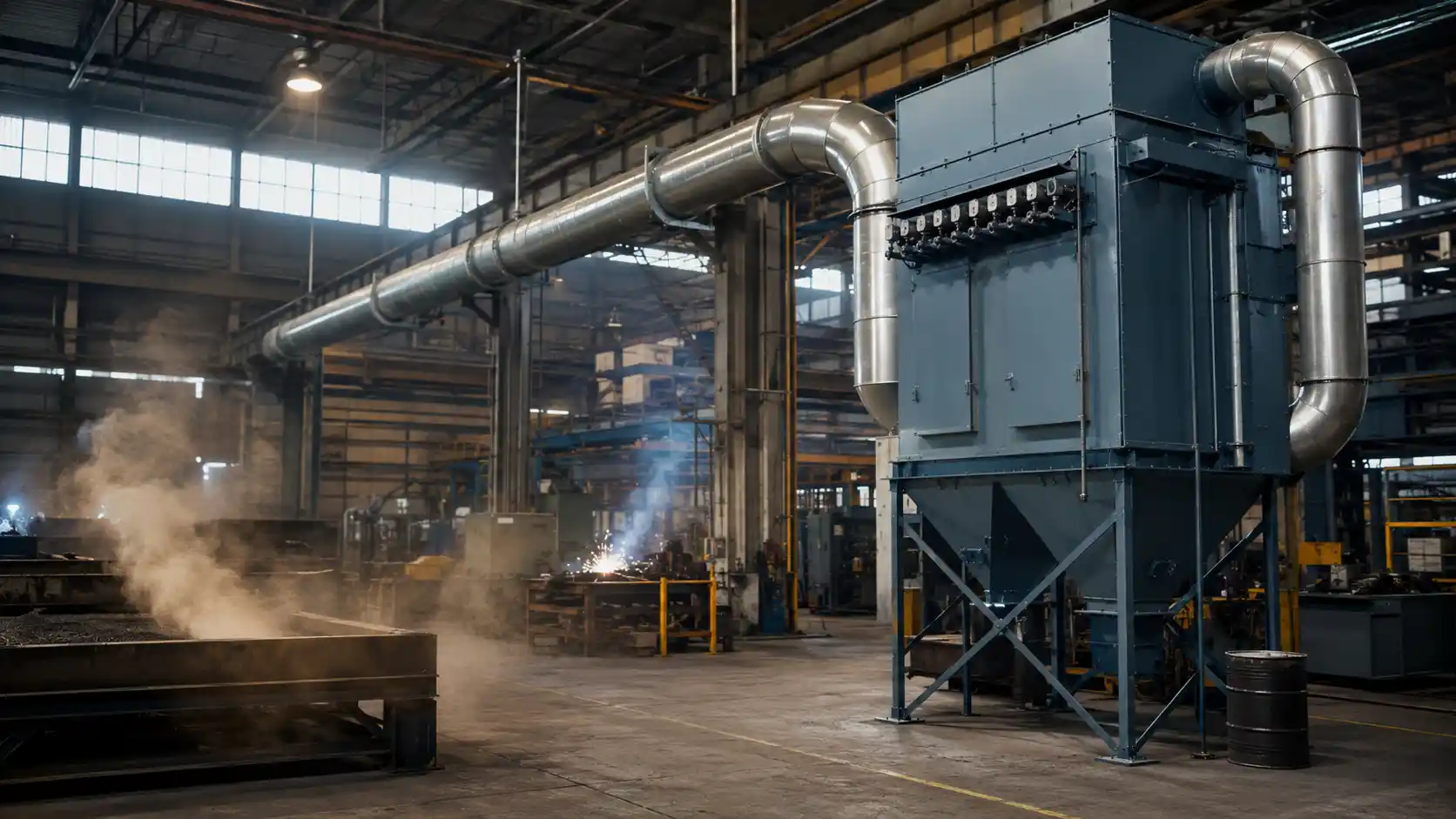
A baghouse uses long fabric filter bags hung inside a steel housing. Dirty air passes through the fabric, dust cakes on the surface, and a pulse jet cleaning system blasts compressed air through the bags to knock the cake into a hopper. Baghouses handle very high dust loads and high temperatures, making them the standard in steel processing, cement, foundries, and woodworking. Efficiency commonly exceeds 99 percent on coarse and medium dust.
Cartridge Dust Collectors
Cartridge collectors use pleated filter elements instead of bags. The pleats pack far more media surface into a smaller footprint, which improves capture of fine dust below 10 microns. They suit metalworking, plasma cutting, powder coating, and pharmaceutical applications where space is tight and particles are fine. Cartridges are easier to change than bags but cost more per element.
Wet Scrubbers
Wet scrubbers pull contaminated air through a curtain or spray of water. The liquid captures particles and certain gases, then carries them away as slurry. Scrubbers are the safest option for highly explosive metal dusts such as aluminum and titanium, because the wet process removes the ignition risk. The trade off is wastewater handling and higher operating cost.
Electrostatic Precipitators
An electrostatic precipitator (ESP) charges particles electrically and collects them on oppositely charged plates. ESPs handle enormous airflow with very low pressure drop, which is why power plants and large boilers use them. High capital cost keeps them out of most general manufacturing.
Cyclone Separators
A cyclone spins incoming air so centrifugal force throws heavy particles against the wall and down into a bin. Cyclones alone reach only 70 to 90 percent efficiency, so they work best as pre-filters that remove coarse material before a baghouse or cartridge unit handles the fines, extending filter life.
Table 1: Filtration System Comparison
| System | Best For | Particle Size Range | Typical Efficiency | Relative Cost |
|---|---|---|---|---|
| Baghouse | High dust loads, high heat | 1 to 100+ microns | 99%+ | Medium |
| Cartridge Collector | Fine dust, tight spaces | 0.3 to 10 microns | 99.9% with HEPA after-filter | Medium |
| Wet Scrubber | Explosive metal dust, sticky dust | 1 to 50 microns | 90 to 99% | Medium to High |
| Electrostatic Precipitator | Very high airflow, boilers | 0.01 to 10 microns | 99%+ | High |
| Cyclone Separator | Pre-filtration, coarse dust | 10+ microns | 70 to 90% | Low |
Dust, Fume, and Mist: Matching the System to the Hazard
Dust, fume, and mist behave differently in the air, so they need different capture strategies.
Combustible Dust Control
If your process creates wood, grain, sugar, metal, or plastic dust, assume it is combustible until testing proves otherwise. A Kst test measures how violently the dust explodes, and that value drives the explosion protection design under NFPA 654. Housekeeping matters just as much, because most catastrophic incidents are secondary explosions, where a small blast shakes settled dust off rafters into the air and that larger cloud ignites. A dust layer thicker than a paperclip on overhead surfaces is enough fuel.
Weld Fume Extraction
Weld fume particles are often under 1 micron, so they bypass coarse filters and human defenses alike. Source capture is the rule: fume arms, extraction guns, or hooded tables that grab the fume within inches of the arc, before it reaches the welder’s breathing zone. Stainless steel work demands special attention because of hexavalent chromium, where OSHA’s permissible exposure limit is just 5 micrograms per cubic meter over an 8 hour shift.
Oil Mist Collection for CNC Operations
CNC machines running coolant at high spindle speeds throw fine oil mist into the shop air. That mist settles on floors as a slip hazard, coats electronics, and irritates workers’ lungs. Dedicated oil mist collectors mount on the machine enclosure and use multi stage coalescing filters, often finished with a HEPA stage, to strip the mist before air returns to the shop.
Table 2: Hazard vs Recommended Solution
| Airborne Hazard | Common Source | Primary Risk | Recommended System |
|---|---|---|---|
| Combustible dust | Woodworking, grain, metal powder | Explosion, fire | Baghouse or cartridge with NFPA explosion protection |
| Weld fume | Welding, plasma cutting | Hexavalent chromium, manganese | Source capture fume extraction with cartridge filters |
| Oil mist | CNC machining, cold heading | Respiratory irritation, slip hazards | Machine mounted oil mist collector with HEPA stage |
| Silica dust | Cutting, grinding, blasting | Silicosis, lung cancer | Cartridge collector with high efficiency media |
| Pharmaceutical powder | Tablet pressing, blending | Cross contamination, potent compound exposure | HEPA filtration with bag-in bag-out housings |
Compliance Standards You Cannot Ignore
OSHA sets permissible exposure limits (PELs) for hundreds of substances, including respirable silica at 50 micrograms per cubic meter. NFPA 652 is the umbrella combustible dust standard and makes the Dust Hazard Analysis mandatory, while NFPA 654 covers system design for dust handling equipment. The EPA enforces particulate emission limits through Clean Air Act permits.
Filter performance is rated under separate systems. MERV ratings (1 to 16) under ASHRAE 52.2 cover general ventilation filters, while ISO 16890 classifies filters by PM1, PM2.5, and PM10 capture. True HEPA filters must remove 99.97 percent of particles at 0.3 microns, the standard required in pharmaceutical air handling. Keep your DHA current, retain exposure monitoring and filter change records, and design toward the tighter limit when OSHA and ACGIH values differ.
Table 3: Key Compliance Standards
| Standard | Governing Body | What It Covers | Applies To |
|---|---|---|---|
| PELs (29 CFR 1910) | OSHA | Worker exposure limits | All US workplaces |
| NFPA 652 | NFPA | Combustible dust fundamentals, DHA requirement | Any facility with combustible dust |
| NFPA 654 | NFPA | Dust system design and protection | Dust handling equipment |
| Clean Air Act | EPA | Stack and vent emission limits | Permitted facilities |
| ISO 16890 / HEPA | ISO / IEST | Filter efficiency classification | Filter selection and validation |
How to Size an Industrial Air Filtration System
Sizing starts with airflow, measured in cubic feet per minute (CFM). Two numbers matter most. The first is capture velocity at each hood or pickup point, and those individual requirements add up to the total system CFM. The second is the air-to-cloth ratio, the total airflow divided by the total filter media area. Push too much air through too little media and filters blind quickly, pressure drop spikes, and capture suffers.
For ambient systems, work from air changes per hour (ACH). A general fabrication shop targets 4 to 6 ACH, while heavy welding areas need 8 to 12. A quick worked example: a 10,000 square foot welding shop with 20 foot ceilings holds 200,000 cubic feet of air. At 10 air changes per hour, that is 2,000,000 cubic feet per hour, or roughly 33,300 CFM, delivered by one large unit or several smaller units over the work zones.
Ductwork matters as much as the collector. Undersized ducts choke airflow, while oversized ducts let dust settle inside, creating a fire risk. Keep conveying velocity between 3,500 and 4,500 feet per minute for most dusts, and choose source capture over ambient filtration wherever the process allows, because removing a contaminant at the source always beats diluting it across the building.
Maintenance and Monitoring
The single most useful indicator is differential pressure, the pressure difference across the filters. A slow rise is normal loading. A sudden spike signals blinded media, a failed pulse valve, or a duct blockage. A sudden drop is just as serious, because it usually means a torn bag or cracked cartridge letting dirty air pass straight through.
Modern systems add automated air quality monitoring that tracks particle counts in real time and alerts staff before exposure limits are approached. Check pulse valves and compressed air weekly, empty hoppers before they bridge, inspect door seals quarterly, and replace filters on condition rather than a fixed calendar. Log everything, because that log is the first thing an OSHA inspector will ask to see.
Conclusion
Heavy industrial air filtration is not one purchase, it is a system built around three goals: protecting your workers, staying inside emission limits, and preventing dust explosions. Match the technology to the hazard, size it on real CFM numbers, and maintain it with pressure monitoring rather than guesswork.
Mekantra Technologies supplies industrial air filtration control systems with HEPA grade efficiency and automated air quality monitoring, sourced direct from vetted factories and inspected before shipping. Request a quote and our engineering team will match a system to your facility’s exact specs.
Frequently Asked Questions
What is the difference between a baghouse and a cartridge dust collector?
A baghouse uses fabric bags and handles heavy dust loads and high temperatures. A cartridge collector uses pleated elements that capture finer particles in a smaller footprint. Choose by particle size and dust load.
Do I need explosion protection on my dust collector?
If the dust is combustible, yes. NFPA 652 requires a Dust Hazard Analysis, and collectors handling combustible dust need explosion vents and isolation devices.
What does HEPA mean in industrial filtration?
A HEPA filter removes at least 99.97 percent of particles at 0.3 microns. It is mandatory in pharmaceutical manufacturing and common as a final stage on fume and mist collectors.
How often should industrial filters be replaced?
Replace on condition, guided by differential pressure readings. Most cartridge filters last 1 to 2 years in normal service, but heavy dust loads shorten that significantly.

Mekantra Engineering Team
The technical voice of Mekantra. Our team consists of sourcing specialists, mechanical engineers, and logistics experts dedicated to providing transparent insights and high-performance solutions for the global manufacturing sector.
Mekantra Engineering Team
The technical voice of Mekantra. Our team consists of sourcing specialists, mechanical engineers, and logistics experts dedicated to providing transparent insights and high-performance solutions for the global manufacturing sector.