Tray vs Packed Columns: Efficiency in Chemical Separation
Summary
“Choosing column internals is not a matter of preference it directly affects tray efficiency, HETP values, turndown ratio, and corrosion resistance. This guide gives chemical and process engineers a practical framework for selecting tray or packing in refinery applications.”
Inside an oil refinery, distillation columns run continuously 24 hours a day, 365 days a year. The hardware installed inside those columns, whether trays or packing, determines how cleanly crude oil fractions separate, how much energy the reboiler consumes, and how long the column runs before the next scheduled shutdown.
Roughly half of all industrial distillation columns globally use trays the other half use packing. Neither is universally better.
The wrong choice drives up pressure drop, accelerates corrosion, causes downcomer flooding, and forces expensive mid-cycle re-traying. The right choice reduces energy consumption, extends run lengths, and keeps separation efficiency within design targets.
How Both Column Types Work
Both tray and packed columns achieve separation through the same core mechanism: vapor-liquid contact. The more surface area available for that contact, and the longer the two phases interact, the more complete the separation.
The fundamental difference lies in how that contact is created.
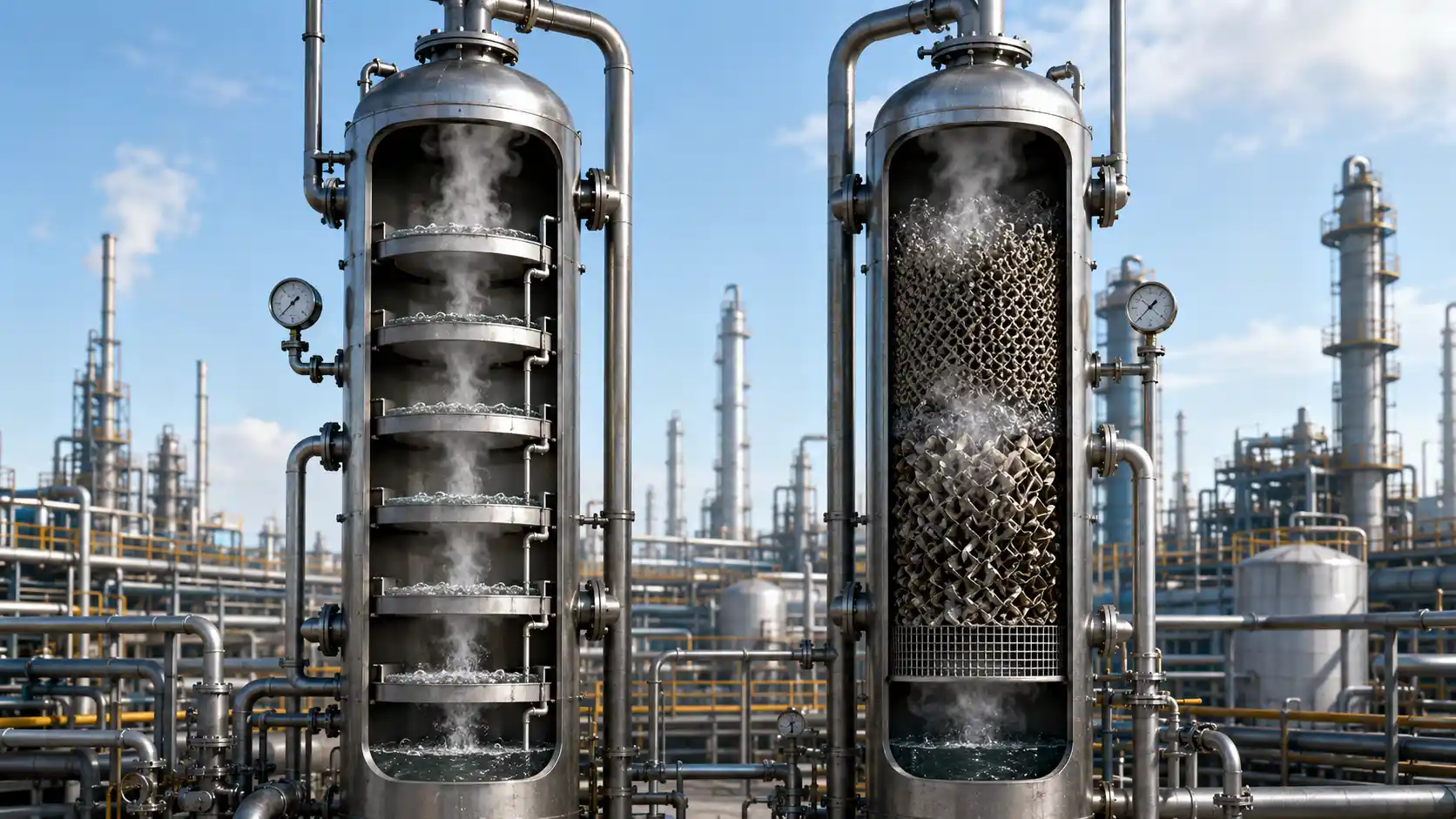
Tray columns use a series of horizontal plates (trays) stacked inside the column shell. Liquid flows across each tray and down through downcomers to the tray below. Vapor rises upward through perforations or valves in each tray, bubbling through the liquid sitting on the tray deck. Separation occurs stage by stage each tray represents one discrete equilibrium stage.
Packed columns fill the column shell with packing material either randomly dumped or structured in an ordered geometry. Liquid flows down over the packing surface while vapor rises upward through the void spaces. Contact between vapor and liquid is continuous and differential throughout the packed bed height, not stage-by-stage.
This distinction leads to two different ways of measuring separation performance:
- Tray columns are evaluated in theoretical stages the number of ideal equilibrium contacts needed to achieve a target separation.
- Packed columns are evaluated using HETP (Height Equivalent to a Theoretical Plate) the height of packing that achieves the same separation as one theoretical tray stage. Lower HETP means more efficient packing.
Key concept: A packed column with an HETP of 0.3 m achieves the same separation in 3 meters of packing as 10 theoretical tray stages. A tray column with 0.6 m tray spacing needs 6 meters for the same 10 stages.
Types of Trays Used in Refinery Columns
Three cross-flow tray designs dominate industrial distillation in oil refineries and chemical plants. Each has specific strengths, weaknesses, and preferred applications.
Sieve Trays
Sieve trays are perforated flat plates the simplest and lowest-cost tray design. Vapor rises straight up through fixed holes in the tray deck, then bubbles through the liquid layer above.
Strengths: Low cost, easy to fabricate, easy to clean, lower pressure drop than bubble cap trays, straightforward maintenance during turnaround.
Weakness: No positive vapor-liquid seal. At low vapor flow rates, liquid drops (“weeps”) back through the perforations instead of flowing across the tray to the downcomer. This weeping bypasses vapor-liquid contact and reduces tray efficiency.
Best suited for: High-throughput services with stable, consistent vapor rates. Dirty or fouling services where easy cleaning matters. Sieve trays are the most widely specified tray in new refinery columns where feed conditions are well-characterized.
Valve Trays
Valve trays add movable or fixed valve discs over each perforation. As vapor flow increases, the valves lift and open wider. As vapor flow decreases, the valves partially close, maintaining vapor velocity through the reduced opening preventing weeping.
Strengths: Better turndown ratio than sieve trays. Handles variable feed compositions and fluctuating vapor loads efficiently. Valve opening adjusts automatically to operating conditions no manual intervention required.
Weakness: Moving valve legs experience cyclic mechanical stress, which accelerates corrosion in chloride or H₂S environments. Moving valves accumulate fouling deposits faster than fixed-perforation sieve trays.
Best suited for: Columns requiring wide operating range atmospheric crude fractionators, FCC main fractionators, columns with seasonal throughput variation. Valve trays are the most common tray type in modern refineries.
Bubble Cap Trays
Bubble cap trays use a riser-and-cap assembly over each opening. Vapor travels up through the riser, reverses direction under the cap, and exits through slots cut into the cap’s perimeter dispersing directly into the liquid layer.
Strengths: Positive liquid seal at all vapor flow rates no weeping possible, even at very low vapor velocities. Widest stable operating range of any tray type.
Weakness: Highest pressure drop per tray. Most expensive to fabricate and most difficult to clean. Not suitable for fouling services where cap slots can plug.
Best suited for: Vacuum distillation, batch operations, services with very low or highly variable vapor rates, and certain corrosive services where the stable liquid seal justifies the higher cost.
Tray Type Comparison at a Glance
| Feature | Sieve Tray | Valve Tray | Bubble Cap Tray |
|---|---|---|---|
| Cost | Low | Medium | High |
| Pressure Drop | Low–Medium | Medium | High |
| Turndown Ratio | Low | High | Very High |
| Weeping Risk | High at low load | Low | None |
| Fouling Resistance | High | Medium | Low |
| Maintenance Ease | Easy | Moderate | Difficult |
| Best Application | Stable high-throughput | Variable load, wide range | Low vapor rate, vacuum |
Types of Packing Used in Distillation Columns
Packed columns use two broad categories of packing, each with different performance characteristics and cost profiles.
Random Packing
Random packing consists of individual packing elements Raschig rings, Pall rings, Berl saddles, IMTP rings dumped loosely into the column shell. The irregular arrangement creates a tortuous flow path for both vapor and liquid, generating turbulent vapor-liquid contact throughout the packed bed.
Random packing installs faster and costs less than structured packing or trays. It is available in ceramic, polypropylene (PP), and PVDF as well as stainless steel making it the preferred choice for corrosive services where metal trays would require expensive alloy upgrades.
Key limitation: Liquid tends to migrate toward the column wall rather than distributing evenly across the packed bed cross-section. This “wall flow” effect reduces effective mass transfer. High-quality liquid distributors at the top of each packed section are mandatory to minimize maldistribution.
Structured Packing
Structured packing uses corrugated metal sheets or wire gauze arranged in a precise, ordered geometry inside the column. The uniform channel structure creates very high surface area with very low resistance to vapor flow.
Key advantages: Lowest pressure drop of any column internal critical in vacuum distillation where high ΔP would distort the boiling point curve and reduce separation. Lowest HETP values achievable more theoretical stages per meter of column height than any other internal type.
Limitation: Higher purchase cost than random packing. Still requires precision liquid distributors and redistributors for columns taller than 6–8 meters of packing per section. Not suitable for fouling services structured packing beds are extremely difficult to clean.
Head-to-Head: Tray vs. Packed Column Performance
Tray vs. Packed Column Performance Comparison
| Parameter | Tray Column | Packed Column | Winner |
|---|---|---|---|
| Pressure Drop per Stage | Higher | Lower | Packed |
| Mass Transfer per Unit Height | Lower | Higher | Packed |
| High Liquid Load Handling | Excellent | Limited | Tray |
| Corrosive Service (acid, H₂S) | Good (alloy MOC) | Excellent (ceramic/PP) | Packed |
| Fouling / Solids Service | Excellent | Poor | Tray |
| Turndown Ratio | High (valve trays) | Moderate | Tray |
| Capital Cost (large diameter) | Higher | Lower | Packed |
| Predictability and Scale-Up | High | Moderate | Tray |
| Vacuum Operation | Possible | Preferred | Packed |
| Maintenance Access | Easy | Harder | Tray |
Pressure Drop
Packed columns carry a decisive advantage here. Every tray in a tray column adds pressure drop for a tall atmospheric fractionator with 40 trays, total ΔP accumulates significantly and increases reboiler duty. In vacuum distillation units (VDU), even moderate pressure drop distorts the vapor-liquid equilibrium and reduces the column’s ability to separate heavy gas oil from residue. Structured packing reduces column ΔP by 60–75% compared to an equivalent tray column, which is why vacuum towers almost exclusively use structured packing in modern refinery designs.
Mass Transfer Efficiency
Packed columns particularly structured packing provide more vapor-liquid interfacial area per meter of column height than tray columns. For the same number of theoretical separation stages, a packed column can be shorter than a tray column. However, tray efficiency (measured as Murphree tray efficiency) is well-characterized and highly predictable from decades of industrial data. Packed column HETP can vary with liquid rate, vapor rate, and distributor quality making scale-up from pilot to commercial scale less predictable.
High Liquid Load Service
Tray columns handle high liquid throughput better. At high liquid rates, packed columns risk channeling liquid flows preferentially through certain paths in the packing bed rather than distributing evenly, dramatically reducing mass transfer. Trays, by contrast, maintain a defined liquid pool on each tray deck regardless of liquid rate the downcomer simply routes excess liquid to the tray below.
Corrosion Resistance
This is where packed columns earn a significant advantage in chemical processing. Refinery streams contain hydrogen sulfide (H₂S), organic chlorides, naphthenic acids, and sulfur compounds all corrosive to carbon steel. Tray columns can be fabricated from 316 stainless steel, duplex stainless, or Hastelloy C-276 for severe service, but alloy trays carry a major cost premium. Ceramic or plastic (PP, PVDF) random packing handles strongly corrosive fluids at a fraction of the cost of equivalent alloy trays. Material selection for both column types must follow NACE MR0175 / ISO 15156 in sour service applications.
Additionally, moving-valve tray legs experience cyclic mechanical stress as valves open and close in chloride environments this can initiate stress corrosion cracking (SCC), a failure mode that packed columns do not face.
Fouling and Solids Handling
Tray columns are the clear winner. Sieve tray perforations are large enough to pass small solid particles. Trays can be water-washed or steam-cleaned in-situ. Packing beds are especially structured to trap fines, coke particles, and polymerization deposits between packing surfaces. Once fouled, packing must be removed from the column entirely, inspected, and replaced a major turnaround cost. For services involving coke fines (FCC main fractionator), suspended solids, or heavy fouling crude, packed columns are not a practical option.
Corrosion Resistance A Critical Factor in Column Selection
Corrosion drives some of the most costly refinery failures; column shells, trays, and packing all operate in contact with corrosive hydrocarbon and aqueous streams continuously.
For tray columns:
- Standard material: carbon steel (CS) for non-corrosive service
- Upgrade path: 304 SS → 316 SS → 317L SS → Duplex 2205 → Hastelloy C-276 for increasing corrosion severity
- Moving valve trays face additional risk: cyclic stress on valve legs promotes fatigue cracking, which accelerates in chloride or H₂S-rich environments
- Tray decks in crude fractionators are particularly vulnerable to under-deposit corrosion if ammonium chloride salts deposit under liquid pools
For packed columns:
- Random packing material options: carbon steel, stainless steel, ceramic, polypropylene, PVDF. Matching material to service chemistry is straightforward
- Ceramic packing handles concentrated acids and high-temperature corrosive streams that would destroy metal internals
- Structured packing is almost exclusively metallic (SS, Monel, Titanium), with fewer options for highly aggressive chemistry
Material selection must be tied to actual stream composition, operating temperature, H₂S partial pressure, and chloride concentration. For sour service (H₂S above threshold concentrations), both column hardware and packing material selection must comply with NACE MR0175 / ISO 15156 to prevent sulfide stress cracking (SSC).
Selection Decision Framework
Choose tray columns when:
- Column diameter exceeds 1.2 m, trays scale well at large diameters; large-diameter packed columns require expensive multi-pass liquid distributors
- Feed stream contains suspended solids, coke fines, or significant fouling potential
- High liquid load service liquid rates that would cause channeling in packed beds
- Wide turndown ratio required columns processing feeds that vary significantly in rate or composition
- Multiple side draws, or intermediate feeds, chimney trays, and draw-off trays integrate naturally into tray column designs
- Predictable scale-up from pilot or pilot-plant data is a project requirement
Choose packed columns when:
- Pressure drop must be minimized in vacuum towers, heat-sensitive products, and energy-intensive columns, where reboiler duty reduction has direct operating cost value
- Corrosive service where ceramic or plastic packing provides better resistance than available alloy trays at a lower cost
- Small-diameter columns (< 0.6 m) packing is more cost-effective and performs better at a small scale
- Low liquid rate, high-purity separations, structured packing achieves low HETP values that tray columns cannot match at equivalent height
- Foaming service packing handles foaming systems better than tray downcomers, which can flood when foam prevents liquid disengagement
Hybrid columns trays in the rectifying (upper) section and packing in the stripping (lower) section, or vice versa, are increasingly common in refineries where different sections of the same column face different operating conditions.
Real-World Refinery Applications
| Refinery Unit | Typical Column Internal | Reason |
|---|---|---|
| Crude Distillation Unit (CDU) Atmospheric Tower | Valve trays / Sieve trays | High throughput, wide boiling range, fouling potential from crude salts |
| Vacuum Distillation Unit (VDU) | Structured packing | Pressure drop critical ΔP directly impacts cut point separation |
| Amine Gas Treating Column (H₂S removal) | Structured packing | Low ΔP, excellent mass transfer at low liquid rates |
| Sour Water Stripper | Sieve trays | Fouling-tolerant; handles dirty aqueous streams |
| FCC Main Fractionator | Valve trays | High liquid load, coke fines fouling service |
| Isomerization / Alkylation Column | Structured packing | High-purity separation, low liquid rates |
| Atmospheric Crude Fractionator | Valve trays with chimney trays | Multiple side draws, wide vapor/liquid flow range |
Cost Considerations: CAPEX vs. OPEX
Capital cost: Random packing installs at a lower cost than trays for small to medium columns. But for large-diameter columns, packed columns require multi-pass liquid distributors and redistributors every 6–8 meters of packing height these are precision components that close the cost gap with trays significantly.
Operating cost: Packed columns especially vacuum towers using structured packing carry lower energy consumption due to reduced pressure drop. Every 1 kPa reduction in column ΔP translates directly to lower reboiler steam consumption. Over a refinery’s 20–30 year operating life, this energy saving can justify the higher cost of structured packing even where tray capital cost is lower.
Maintenance cost: Tray columns allow targeted inspection and replacement of individual trays during turnaround without disturbing the rest of the column internals. Packed columns require full bed removal to access the lower sections, significantly increasing turnaround labor hours, especially in fouling services.
Total cost of ownership (TCO): For clean service, large-diameter atmospheric columns and tray columns often win TCO. For vacuum, corrosive, or small-diameter columns, packed columns win.
Conclusion
Tray vs. packed columns is not a universal decision it is a service-specific engineering call that depends on column diameter, feed service conditions, pressure requirements, corrosion environment, and required operating range.
In large-scale refinery applications, valve trays remain the standard choice for atmospheric fractionators, proven, maintainable, and reliable at high throughput. Structured packing dominates vacuum towers and amine treating units where pressure drop and mass transfer efficiency are the controlling factors. For corrosive chemical processing services, random packing in ceramic or plastic materials often provides better resistance at lower cost than equivalent alloy trays.
The highest-performing refinery columns are increasingly hybrid designs combining the strengths of both technologies where each section of the column demands it.
Mekantra Technologies supplies pressure vessels, distillation column internals, and separation equipment engineered for oil refinery and chemical processing services. Our equipment is designed and fabricated to meet ASME, NACE, and API specifications for the most demanding process environments.

Mekantra Engineering Team
The technical voice of Mekantra. Our team consists of sourcing specialists, mechanical engineers, and logistics experts dedicated to providing transparent insights and high-performance solutions for the global manufacturing sector.
Mekantra Engineering Team
The technical voice of Mekantra. Our team consists of sourcing specialists, mechanical engineers, and logistics experts dedicated to providing transparent insights and high-performance solutions for the global manufacturing sector.