Iron & Steel Processing: EAF vs Blast Furnaces
Summary
“A Iron and steel processing covers a wide chain of thermal, mechanical, and metallurgical operations. From electric arc furnaces to cold rolling mills, each stage determines final product quality and yield. This guide covers the key equipment, methods, and performance benchmarks used in modern steel plants.”
Steel plants do not all operate the same way. Two facilities can produce identical grades of structural steel and yet run on completely different smelting technologies, with different raw materials, different energy sources, and different cost structures. The choice between an electric arc furnace and a blast furnace is one of the most consequential decisions in steel plant design.
This is not a question with a universal answer. It depends on your feedstock availability, output targets, energy costs, and the product mix your customers demand. This post breaks down both technologies across the variables that matter most to plant engineers and procurement teams.
What Is an Electric Arc Furnace?
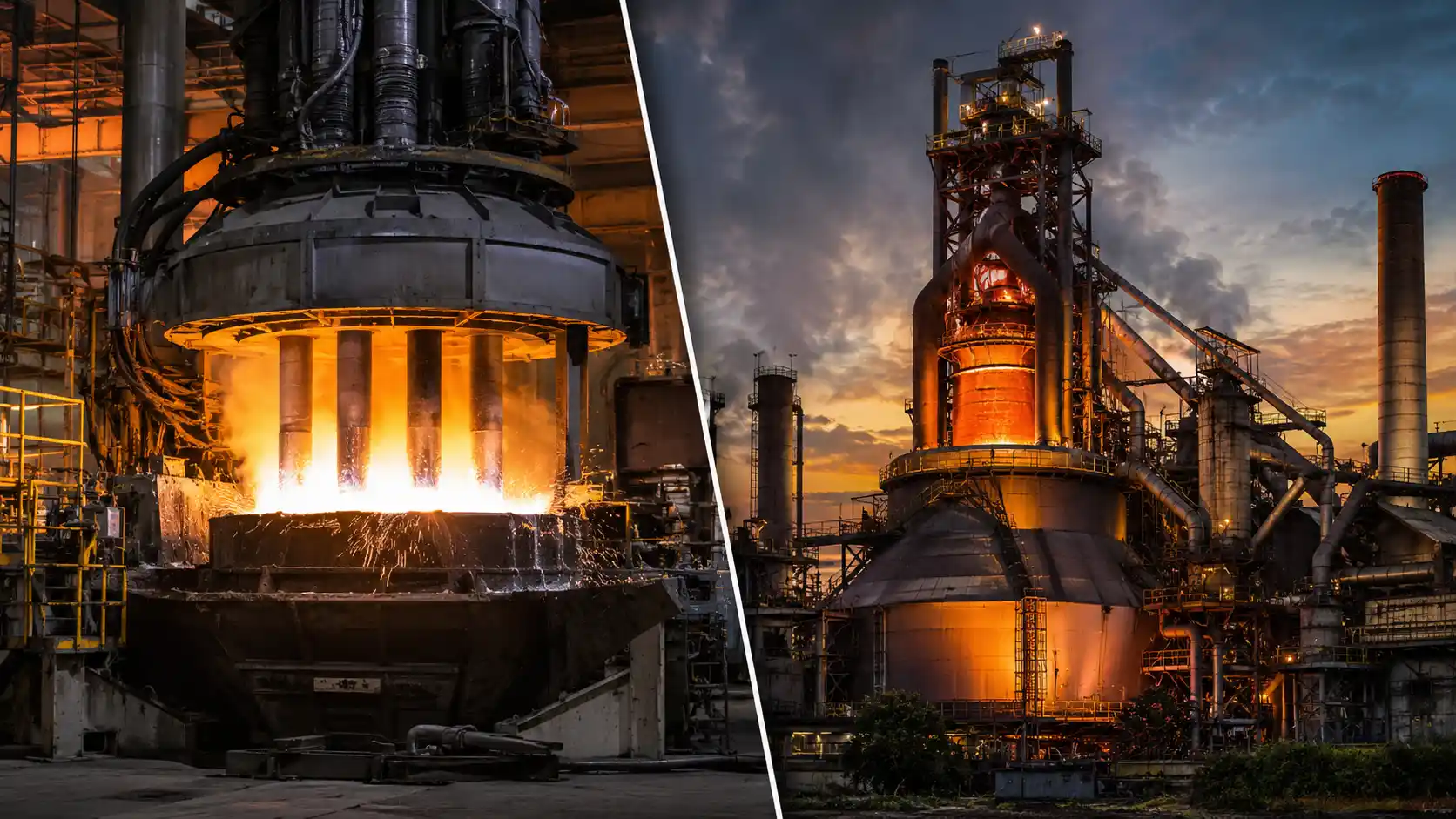
An electric arc furnace (EAF) generates heat by passing a high-current electric arc between graphite electrodes and the metallic charge. The arc temperature reaches approximately 3,500°C, which is more than sufficient to melt steel scrap or direct reduced iron (DRI).
EAFs are the core smelting unit in mini mill operations. They are designed around scrap-based steelmaking, which means they do not require coke ovens, sintering plants, or blast air systems. The furnace body can be tilted for tapping and slag removal, and the entire tap-to-tap cycle runs between 40 and 75 minutes depending on furnace size and charge composition.
Modern EAFs use several efficiency-enhancing technologies:
- Eccentric bottom tapping (EBT): Reduces slag carryover to the ladle during tapping, improving downstream metallurgical control.
- Coherent jet oxygen lancing: Delivers supersonic oxygen deep into the melt to accelerate decarburization and improve bath stirring without excessive skull formation.
- Foamy slag practice: Carbon and oxygen injection creates CO bubbles in the slag layer, which shields the arc and reduces heat loss through the furnace shell. This alone can reduce electrode consumption by 10-15%.
- Scrap preheating: Finger shaft and Consteel-type systems use off-gas heat to preheat incoming scrap, cutting electrical energy consumption by 50-100 kWh per ton.
A 100-ton EAF at full operation consumes roughly 350-420 kWh per ton of liquid steel when scrap preheating is active. Without it, consumption sits between 420 and 550 kWh per ton.
What Is a Blast Furnace?
A blast furnace (BF) is a continuously operating shaft furnace that reduces iron ore to liquid pig iron using coke as both a fuel and a chemical reductant. Hot air, enriched with oxygen, is injected through tuyeres at the base of the furnace. The reduction reactions produce molten iron and a calcium-silicate slag that floats on top.
Blast furnaces are the foundation of integrated steel plants. They sit at the start of a long process chain: BF → basic oxygen furnace (BOF) → continuous caster → rolling mill. Shutting down a blast furnace is a multi-day, high-cost operation, which means integrated plants run continuously and rely on stable, long-term raw material supply chains.
Key characteristics of blast furnace operations:
- Raw materials: Iron ore (sinter or pellets), metallurgical coke, limestone flux, and pulverized coal injection (PCI) as a partial coke substitute.
- Output scale: Modern large blast furnaces produce 5,000 to 10,000 tons of hot metal per day. Smaller furnaces in developing markets produce 1,500 to 3,000 tons per day.
- Tapping: Hot metal is tapped every 4-6 hours through the taphole into torpedo ladles or open-top ladles for transfer to the BOF.
- Coke rate: A well-optimized blast furnace with high PCI injection operates at a coke rate of 280-320 kg per ton of hot metal. Without PCI, the rate climbs to 450-500 kg/ton.
- Slag rate: Approximately 200-300 kg of slag is produced per ton of hot metal, which is typically granulated and sold as a cement substitute.
Side-by-Side Comparison
| Parameter | Electric Arc Furnace (EAF) | Blast Furnace (BF) |
|---|---|---|
| Primary Input | Scrap steel / DRI / HBI | Iron ore + metallurgical coke |
| Heat Source | Electric arc (graphite electrodes) | Coke combustion + hot blast |
| Typical Output | 50-400 t per heat | 1,500-10,000 t/day |
| Tap-to-Tap Time | 40-75 minutes | Continuous |
| Energy Consumption | 350-550 kWh/ton (electrical) | 17-20 GJ/ton (full system) |
| CO2 Emissions | 0.4-0.8 t CO2/t steel (grid-dependent) | 1.8-2.1 t CO2/t steel |
| Capital Cost | Lower (no ancillary plant needed) | Higher (requires full integrated complex) |
| Startup / Shutdown | 30-45 minutes | Multi-day ramp-up, costly |
| Minimum Viable Scale | 30,000-200,000 t/year | 1M+ t/year |
| Residual Tramp Elements | Higher risk (from scrap) | Not applicable |
| Best Product Range | Long products, merchant bar, some flat products | Flat products, automotive, heavy plate |
Energy Efficiency: Where Each Technology Stands
Energy cost is the single largest operating variable in EAF steelmaking. In regions where electricity is expensive (above $80-90/MWh), EAF economics are under pressure unless scrap prices are significantly lower than hot metal costs. In regions with cheap electricity or strong carbon pricing, the EAF has a clear structural advantage.
Blast furnace systems consume energy across a wider footprint: coke ovens, sintering plants, hot stoves for blast heating, and the BOF converter. The total system energy is 17-20 GJ per ton of liquid steel, of which roughly 30% is recoverable as top gas (BFG) for on-site power generation or process heating.
A direct comparison on energy alone is misleading without including the full system boundary. The table below presents an apples-to-apples comparison using a full system energy boundary for both routes:
| Energy Component | EAF Route (kWh/t liquid steel) | BF-BOF Route (kWh/t liquid steel) |
|---|---|---|
| Primary smelting energy | 400-550 (electric) | 4,700-5,500 (coke + coal) |
| Oxygen production | 30-50 | 80-120 |
| Ladle furnace (LF) refining | 30-60 | 30-60 |
| Casting and rolling (shared) | 200-350 | 200-350 |
| Recoverable off-gas credit | Minimal | (500-800) credit |
| Net system energy (approx.) | 660-1,010 kWh/t | 4,510-5,230 kWh/t |
The EAF route is substantially more energy-efficient on a per-ton basis. The gap narrows when scrap preheating is absent or when the EAF is processing cold DRI charges, which require higher electrical input.
Steel Quality and Product Range
The blast furnace route has a traditional advantage in producing low-residual steel for demanding applications. Automotive exposed panels, tinplate, and electrical steel grades require very low levels of copper, tin, and nickel, which are common tramp elements in steel scrap. Blast furnace hot metal is essentially free of these elements because it is produced from virgin iron ore.
EAF producers have addressed this in several ways:
- DRI/HBI blending: Replacing 30-60% of the scrap charge with direct reduced iron dilutes tramp element concentration significantly.
- Scrap sorting and grading: Premium-grade scrap (busheling, bundles) contains lower residuals than shredded or obsolete scrap.
- Secondary metallurgy: Ladle furnace (LF) and vacuum degassing (VD/VOD) units allow chemistry fine-tuning after the EAF tap.
Modern EAF operations running 40%+ DRI in the charge consistently produce steel meeting automotive and cold-rolled flat product specifications.
Operational Flexibility
This is where the EAF has a clear structural advantage. An EAF can be shut down over a weekend and restarted on Monday morning with no major cost penalty. A blast furnace cannot. Once a blast furnace is lit, it must run continuously for its entire campaign life, which typically spans 10-20 years before a major reline is needed. A temporary shutdown (even a few days) causes freeze-up risk and significant refractory damage.
This flexibility has real financial implications. During periods of low steel demand, EAF-based mini mills can reduce output or idle without destroying asset value. Integrated BF-BOF plants must either continue producing (and stockpiling) or accept very high idling costs.
For steel producers operating in volatile demand markets construction, infrastructure, oil and gas the EAF offers a lower-risk operational profile.
Which Technology Should You Choose?
There is no single correct answer, but the decision framework is relatively straightforward:
Choose an EAF if:
- Scrap or DRI is available at competitive cost in your region
- Your grid electricity cost is below $70-80/MWh
- Your production volume is under 1.5 million tons per year
- You need operational flexibility to respond to market demand
- You are producing long products or merchant bar grades
- Environmental regulations or carbon pricing is a factor
Choose a Blast Furnace (BF-BOF route) if:
- You are building a large-scale integrated facility above 2 million tons per year
- You need ultra-low residual steel for automotive or electrical grades
- You have secure, low-cost access to iron ore and metallurgical coke
- You produce a wide range of flat-rolled products
- You are operating in a market where hot metal supply is more reliable than scrap
Many modern steelmakers do not choose one exclusively. Hybrid facilities run a blast furnace for hot metal production and use EAF units for scrap-based heats, blending both streams for specific product grades.
Role of Secondary Metallurgy in Both Routes
Regardless of whether liquid steel originates from an EAF or a blast furnace, it passes through secondary metallurgy before casting. This stage includes:
- Ladle furnace (LRF/LF): Heating, alloying, and desulfurization. Target sulfur levels of 0.003-0.010% are achievable with calcium treatment and synthetic slag.
- Vacuum degassing (VD/VOD/RH): Removes hydrogen and nitrogen; essential for high-strength structural and pipeline grades.
- Wire injection: Calcium, aluminum, or cored wire for inclusion shape control.
Secondary metallurgy is where the final chemistry and cleanliness of the steel is set. It is also where the differences between EAF and BF liquid steel converge. A well-operated ladle furnace can bring EAF steel to the same cleanliness specification as BF-BOF steel for most grades.
Key Takeaways
The EAF and blast furnace are not competing technologies fighting for the same market. They serve different scales, different raw material realities, and different product portfolios. The global steel industry is currently shifting toward more EAF capacity as scrap availability increases and carbon pricing tightens. New greenfield integrated plants are still being built, but predominantly in regions with large iron ore reserves and limited scrap supply.
For plant operators and procurement teams evaluating iron and steel processing equipment, the smelting decision is the starting point for everything downstream: the caster design, the rolling configuration, the refining equipment, and the energy infrastructure all follow from it.
Mekantra Technologies supplies iron and steel processing equipment across the full plant chain, from smelting and casting through to rolling and finishing systems. If you are evaluating furnace technology or downstream processing equipment for a new facility or capacity expansion, contact our team for sourcing and technical specification support.

Mekantra Engineering Team
The technical voice of Mekantra. Our team consists of sourcing specialists, mechanical engineers, and logistics experts dedicated to providing transparent insights and high-performance solutions for the global manufacturing sector.
Mekantra Engineering Team
The technical voice of Mekantra. Our team consists of sourcing specialists, mechanical engineers, and logistics experts dedicated to providing transparent insights and high-performance solutions for the global manufacturing sector.