Stenter Machines: Heat Setting & Textile Finishing Guide
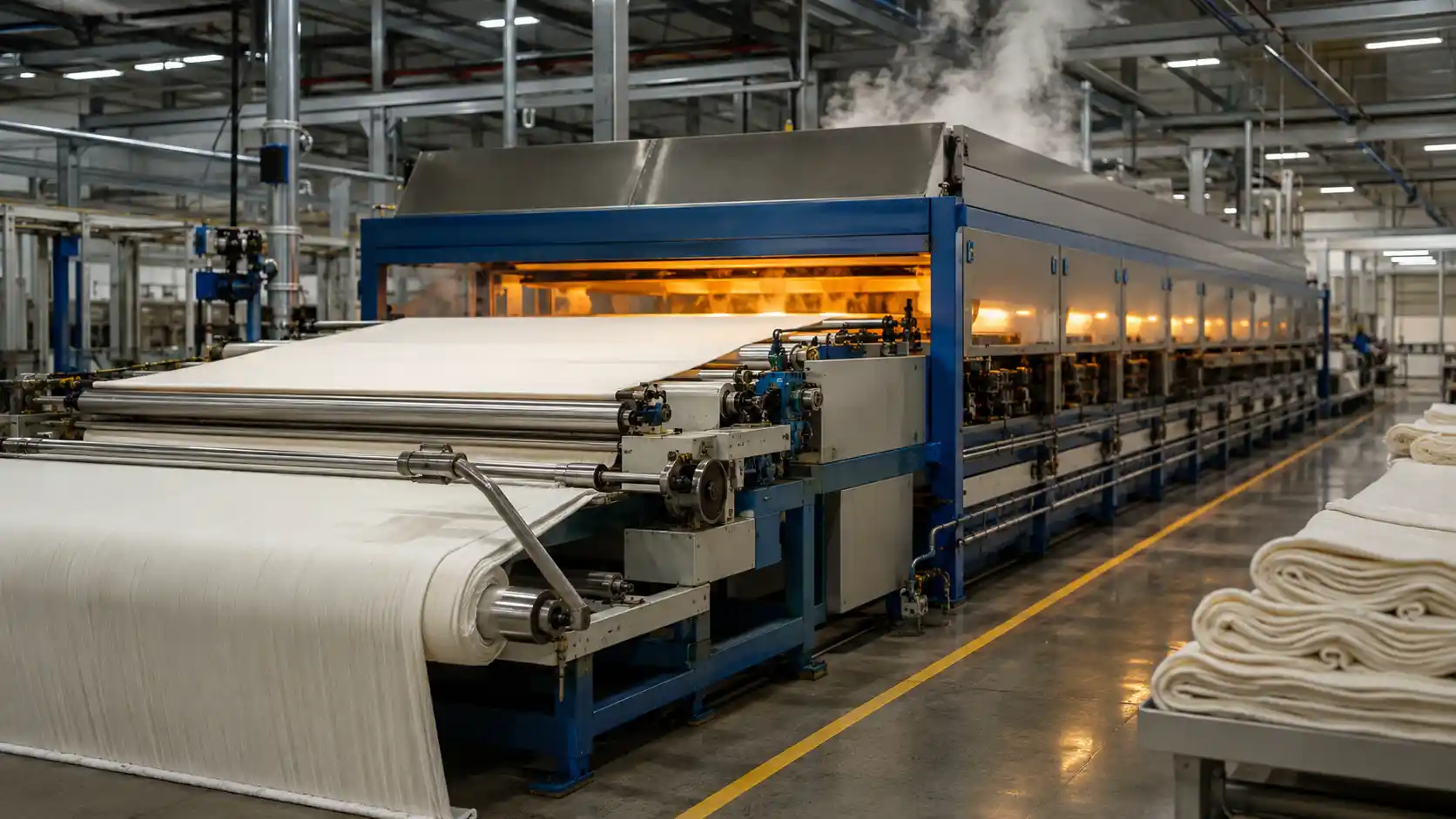
In modern textile manufacturing, turning raw knitted or woven gray fabric into high-value consumer material depends heavily on the finishing phase. Among all industrial machinery deployed in the finishing house, stenter machines (also known as tenter frames) stand as the central workhorse.
Stenter machines perform crucial tasks including drying, heat setting, width adjustment, grain alignment, and chemical finish application. Without precise stenter processing, fabrics suffer from irregular shrinkage, skewing, shade variation, and poor dimensional stability after domestic washing.
For textile operations across North America where rising energy costs and stringent environmental regulations govern production, optimizing stenter performance is both a quality requirement and an operational necessity.
What Is a Stenter Machine?
A stenter machine is an open-width textile finishing oven equipped with a continuous mechanical transportation chain. The machine grips the fabric edges using specialized pins or clips, transporting the web through heated drying chambers under controlled longitudinal (warp) and lateral (weft) tension.
Process Flow of a Stenter Line:
Fabric Entry -> Padding Mangle -> Weft Straightener -> Pinning/Clipping -> Heat Setting Chambers -> Cooling Zone -> Outlet & Batching
Core Functions of an Industrial Stenter
- Drying & Evaporation: Rapidly removes water content applied during wet processing, bleaching, or dyeing.
- Heat Setting (Thermofixation): Heats synthetic fibers (polyester, nylon, spandex) above their glass transition temperature (Tg) to permanently set fiber structure, width, and weight (GSM).
- Dimensional Stabilization: Eliminates internal structural stresses accumulated during spinning, weaving, or circular knitting.
- Chemical Application: Impregnates functional finishes such as water repellents, flame retardants, softeners, and anti-static agents via an inline padding mangle.
- Grain Alignment: Corrects fabric distortion (bowing and skewing) before thermal fixation.
Mechanical Components of a Stenter Machine
To understand how a stenter machine delivers consistent fabric finishing, process engineers evaluate its primary mechanical sub-assemblies. Sourcing high-grade parts and equipment from verified textile machinery suppliers ensures operational efficiency, precise temperature control, and extended machinery lifespan across all finishing operations.
| Component | Engineering Role | Key Operational Variable |
| Padding Mangle | Applies chemical liquor to open-width fabric via high-pressure squeeze rollers. | Expression ratio (%), nip pressure (bar) |
| Weft Straightener | Uses optical sensors and skewed/bowed rollers to realign crooked threads. | Skew angle (deg), bow deflection (mm) |
| Overfeed Roller Unit | Feeds fabric onto chains faster than chain speed to allow controlled relaxation. | Overfeed percentage (-10% to +50%) |
| Transport Chain (Pin/Clip) | Holds fabric selvages securely throughout the drying and heating chambers. | Chain speed (m/min), track width expansion |
| Drying & Heating Chambers | Circulates heated air or thermal oil over upper and lower fabric surfaces. | Temperature (C / F), nozzle air velocity |
| Cooling & Batching Zone | Reduces fabric temperature rapidly below Tg to lock in dimensions before rolling. | Chilled water circulation, air blowers |
The Heat Setting Mechanism Explained
Heat setting is a thermal process applied to synthetic and blended textiles. During synthetic fiber production (e.g., polyester or polyamide), polymer chains are stretched, creating internal mechanical stress. If exposed to hot water or domestic ironing without prior thermofixation, these fibers contract unpredictably, resulting in severe garment distortion.
Phase 1: Glass Transition (Tg)
When the fabric enters the heated stenter chambers, thermal energy disrupts secondary intermolecular bonds (hydrogen bonds and van der Waals forces) within the amorphous regions of the polymer. The temperature must cross the specific glass transition point (Tg) of the synthetic component.
Phase 2: Structural Realignment
Under controlled transverse tension (maintained by the stenter chain tracks) and longitudinal allowance (managed by the overfeed feed rollers), polymer chains realign into stable, strain-free configurations.
Phase 3: Recrystallization & Cooling
As the fabric exits the heating zones and enters the cooling chamber, new intermolecular bonds form in the relaxed orientation. Rapid cooling locks this alignment into place permanently, providing superior dimensional stability, wrinkle resistance, and consistent surface appearance.
Stenter Heat Setting Temperature & Dwell Time Reference
| Fiber Type | Heat Setting Temp | Dwell Time | Target Outcome |
| Polyester (PET) | 190°C – 210°C | 20 – 30 sec | Shrinkage < 1% |
| Polyamide (Nylon) | 175°C – 190°C | 15 – 25 sec | Shape Retention |
| Spandex Blends | 180°C – 195°C | 15 – 20 sec | Elastic Recovery |
| Acrylic | 160°C – 180°C | 15 – 30 sec | Soft Hand Feel |
| Cotton/Poly (CVC) | 180°C – 195°C | 20 – 30 sec | Crease Resistance |
Overfeed and Fabric Grain Alignment
Controlling fabric density (grams per square meter or GSM) and distortion requires precise manipulation of the stenter entry parameters.
Overfeed Control
Overfeed occurs when the feed roll speed exceeds the transport chain speed.
- Positive Overfeed (+10% to +40%): Allows fabric shrinkage in the warp direction during drying. This increases fabric weight (GSM), improves stretch recovery in knits, and minimizes residual laundering shrinkage.
- Negative Overfeed / Underfeed (-2% to -5%): Stretches the fabric longitudinally to increase length yield, though it increases subsequent washing shrinkage risk if over-applied.
Bowing and Skewing Correction
Mechanical stresses during circular knitting or jet dyeing often distort the wet fabric matrix.
- Bowing: Center portion of the weft yarns lags behind or leads the selvages (forming an arc).
- Skewing: One selvage advances faster than the opposite side (forming an angled parallelogram).
Modern stenters feature integrated electro-optical weft straighteners before the pinning point. Optical sensors detect thread angles and automatically actuate hydraulic tilting and bending rollers to restore perfectly orthogonal warp-weft alignment before heat fixation.
Energy Efficiency & Water Reduction in Stenter Operations
Stenter machines rank among the highest consumers of thermal energy and fossil fuel in the textile finishing house. A standard 8-chamber stenter requires substantial heat input to evaporate moisture and bring fabric up to thermofixation temperatures.
Implementing sustainable finishing practices requires balancing thermal performance with resource conservation:
1. High-Efficiency Mangle Dewatering
Before fabric enters the stenter chamber, mechanical dewatering at the padding mangle must be optimized. Increasing mechanical squeeze efficiency reduces residual moisture content (RMC) from 80% down to 50% on cotton fabrics.
Key Rule: Removing 1 kg of water mechanically via high-expression mangles requires less than 1% of the thermal energy needed to evaporate the same water inside a heating chamber.
2. Moisture Control Systems
Over-drying fabric wastes thermal energy and degrades fiber quality. Installing exhaust air moisture sensors ensures exhaust dampers adjust dynamically, maintaining humidity levels at 15–20% water vapor by volume.
3. Exhaust Heat Recovery Heat Exchangers
Stenter exhaust air exits at temperatures between 140°C and 180°C (284°F–356°F). Air-to-air or air-to-water heat exchangers capture this waste heat to preheat fresh incoming process air or supply hot water to dyeing machines.
Estimated Thermal Energy Savings in Modern Stenter Lines
| Efficiency Strategy | Potential Energy / Cost Reduction |
| High-Expression Mangle Optimization | 20% – 30% Thermal Load Reduction |
| Air-to-Air Heat Exchanger | 15% – 25% Gas/Fuel Savings |
| Automated Moisture Sensors | 10% – 15% Electricity & Heat Savings |
| Chamber Insulation Upgrades | 5% – 8% Radiation Loss Reduction |
Troubleshooting Common Stenter Finishing Defects
| Defect Name | Visual Symptom | Root Cause | Corrective Action |
| Pin Marks / Torn Selvage | Pin punctures or tears along fabric edges. | Incorrect brush wheel angle, excessive width tension, worn pins. | Adjust pinning brushes, calibrate width control, replace pin bars. |
| Shade Variation (Left-Center-Right) | Temperature or moisture gradient across fabric width. | Uneven mangle nip pressure, clogged air nozzles. | Recalibrate pneumatic mangle pressure, clean air nozzles. |
| Yellowing / Thermal Degradation | White or pastel fabrics turning yellowish. | Chamber temperature too high, extended dwell time, excess gas fumes. | Reduce temperature, increase line speed, inspect gas burner combustion. |
| Edge Curling | Knitted fabric edges rolling inward continuously. | Lack of gumming device application or steam conditioning. | Apply edge gumming (polyvinyl alcohol), adjust uncurling units. |
| Residual Shrinkage Failure | Garment shrinks excessively post-laundering. | Insufficient overfeed, temperature below Tg. | Increase positive overfeed percentage, re-verify chamber heat profile. |
Future Trends in Textile Stenter Technology
- Digital Twin Integration & Smart Sensors: Real-time monitoring of fabric temperature using non-contact infrared pyrometers allows direct feedback loops, dynamically adjusting line speed to maintain exact dwell times.
- Hybrid Heating Technologies: Integration of infrared (IR) pre-heating zones before convection chambers accelerates drying speed while shrinking total footprint requirements.
- Low-Emission Gas Burners: Ultra-low NOx gas burners ensure compliance with strict regional environmental regulations (such as US EPA and state-level air quality standards).
- Automated Width Control Systems: Motorized width adjustments driven by digital style recipes enable rapid style changes with zero machine downtime.
Key Takeaways for Plant Managers
- Match Process Parameters to Fiber Type: Heat setting success relies on achieving precise glass transition temperatures (Tg) and dwell times without over-exposing delicate elastomeric components.
- Optimize Pre-Dewatering: Mechanical moisture extraction at the padding mangle yields significant thermal energy savings.
- Control Grain Alignment Early: Correcting bowing and skewing before the fabric enters the heating chambers avoids setting structural distortions permanently.
- Implement Waste Heat Recovery: Capturing high-temperature exhaust air delivers measurable fuel savings and reduces carbon emissions across finishing facilities.

Mekantra Engineering Team
The technical voice of Mekantra. Our team consists of sourcing specialists, mechanical engineers, and logistics experts dedicated to providing transparent insights and high-performance solutions for the global manufacturing sector.
Mekantra Engineering Team
The technical voice of Mekantra. Our team consists of sourcing specialists, mechanical engineers, and logistics experts dedicated to providing transparent insights and high-performance solutions for the global manufacturing sector.