Hydraulic Press vs Mechanical Press: How Do They Work and What Are the Differences?
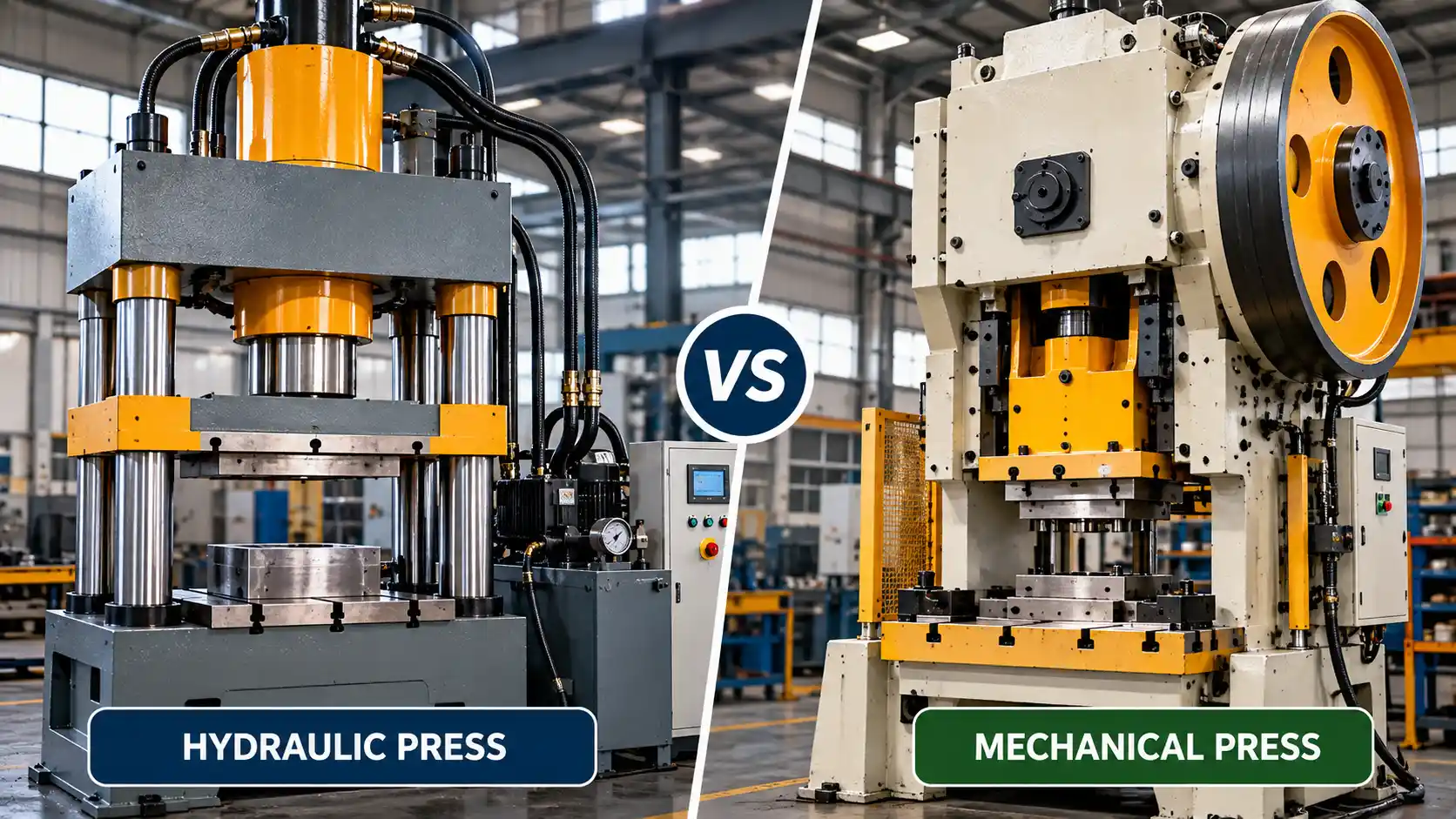
Choosing between a hydraulic press and a mechanical press depends on the material being processed, the required forming force, production speed, and the type of operation. Both machines are widely used in manufacturing, metal fabrication, stamping, and industrial forming, but they generate and deliver force differently. Understanding the differences between a hydraulic press vs mechanical press helps manufacturers select equipment that matches their production requirements.
A hydraulic press uses pressurized fluid to move a piston and generate force, while a mechanical press uses a motor-driven mechanical system to move a slide or ram. These differences influence stroke characteristics, force control, cycle time, energy consumption, and maintenance requirements. Although both machines can perform certain overlapping operations, each has advantages for particular applications.
What Is a Hydraulic Press?
A hydraulic press is an industrial machine that uses pressurized fluid to generate force and move a piston or ram. It can apply substantial pressure to a workpiece for operations such as forming, compression, straightening, and deep drawing.
Hydraulic presses operate according to the principle that pressure applied to a confined fluid is transmitted through that fluid. The resulting force depends on the pressure acting on the effective piston area.
Common components of a hydraulic press include:
- Hydraulic pump: Moves fluid through the hydraulic circuit.
- Fluid reservoir: Stores the hydraulic oil.
- Hydraulic cylinder: Converts fluid pressure into linear movement.
- Piston and ram: Transfer force to the workpiece or tooling.
- Control valves: Regulate fluid flow and pressure.
- Press frame: Supports the machine and withstands operating loads.
- Control system: Manages machine movement and operating parameters.
The design and configuration of these components vary depending on the press’s size, intended application, and level of automation.
Hydraulic Press Working Principle
The hydraulic press working principle involves converting hydraulic pressure into mechanical force.
First, the hydraulic pump moves fluid through the system. When the control system directs pressurized fluid into the cylinder, the fluid acts on the piston, causing it to move. The piston transfers force through the ram to the die, tool, or workpiece.
The theoretical force generated by a hydraulic cylinder can be calculated using:
Force = Pressure × Effective Piston Area
For example, if a cylinder operates at a pressure of 20 MPa and has an effective piston area of 0.01 m², the theoretical force is:
20,000,000 Pa × 0.01 m² = 200,000 N
This is equivalent to approximately 200 kN of force, before accounting for system losses and other practical factors.
Actual press output depends on the machine’s rated capacity, hydraulic pressure limits, cylinder configuration, friction, and overall system design.
Hydraulic presses can also be designed to control ram speed, pressure, and stroke movement. Some applications require the press to maintain force for a specified period, while others require carefully controlled movement during forming.
Advantages of Hydraulic Presses
Hydraulic presses offer several advantages for industrial manufacturing.
Flexible force control: Hydraulic pressure can be regulated to suit different operations, provided the machine is designed for the required control range.
Controlled forming movement: Suitable hydraulic systems can adjust ram speed and movement during the working stroke.
Full-force capability across much of the stroke: Many hydraulic presses can deliver substantial force throughout a large portion of their working travel, subject to their rated capacity and pressure settings.
Suitability for deep drawing: Controlled force and movement can make hydraulic presses useful for forming operations that require material to flow into a die.
Versatility: A suitably configured hydraulic press can perform forming, compression, straightening, assembly, and other pressing operations.
Adjustable operating parameters: Depending on the machine, operators may be able to configure pressure, speed, stroke, and dwell time for different production requirements.
Limitations of Hydraulic Presses
Hydraulic presses also have limitations that manufacturers should consider.
- Cycle time: Many conventional hydraulic presses operate more slowly than comparable mechanical presses in high-speed stamping applications.
- Fluid maintenance: Hydraulic oil, filters, seals, hoses, pumps, and valves require inspection and servicing.
- Heat generation: Hydraulic systems can generate heat during operation, especially when energy is lost through throttling or other inefficient operating conditions.
- Leakage risk: Damaged seals, hoses, or connections can cause hydraulic fluid leaks.
- Energy consumption: Conventional hydraulic systems may consume energy while maintaining pressure or operating pumps, depending on their design and control strategy.
- System complexity: Pumps, valves, cylinders, and associated controls require suitable maintenance expertise.
Modern variable-speed and servo-hydraulic systems can reduce some traditional limitations, so performance should be evaluated using the specifications of the actual machine.
What Is a Mechanical Press?
A mechanical press is an industrial machine that converts motor-driven mechanical motion into the movement of a slide or ram. It is commonly used for high-volume manufacturing operations such as stamping, blanking, punching, and forming sheet metal.
Unlike a hydraulic press, which uses pressurized fluid to generate cylinder force, a conventional mechanical press relies on a drive mechanism to move the slide along a defined path.
Typical components include:
- Electric motor: Supplies power to the drive system.
- Flywheel: Stores rotational energy in many conventional designs.
- Clutch and brake: Control engagement and stopping of the drive mechanism where fitted.
- Crankshaft or eccentric mechanism: Converts rotary motion into reciprocating movement.
- Connecting rod: Transfers movement to the slide.
- Slide or ram: Moves the tooling toward the workpiece.
- Press frame: Supports the machine and its operating loads.
- Control and safety systems: Coordinate operation and help protect operators.
Mechanical presses are available in different configurations, including crank, eccentric, and other drive arrangements. Their operating characteristics depend on the mechanism and machine design.
Mechanical Press Working Principle
The mechanical press working principle involves converting rotational energy into linear movement.
In a conventional crank-driven press, an electric motor drives the flywheel or associated transmission. When the drive mechanism engages, the crankshaft rotates and moves the connecting rod, causing the slide to travel up and down.
The tooling attached to the slide then performs the intended operation, such as cutting, punching, or forming material against a die.
The available force depends on the press mechanism, its rated capacity, and the slide’s position during the stroke. Conventional mechanical presses generally have a defined motion profile rather than the same degree of independently adjustable movement available on many hydraulic systems.
Mechanical presses are particularly useful when a production process requires repetitive movements and short cycle times.
Advantages of Mechanical Presses
High production speed: Many mechanical presses are well suited to repetitive, high-volume stamping and punching.
Consistent motion: The drive mechanism provides a repeatable stroke profile for compatible operations.
Production-line integration: Mechanical presses can be integrated into automated systems involving coil feeding, part transfer, and progressive dies.
Efficient repetitive operation: Their operating characteristics can make them suitable for large production runs with established tooling.
Strong performance in stamping: Mechanical presses are widely used for blanking, punching, and forming sheet metal when the tooling and press capacity match the application.
Limitations of Mechanical Presses
Mechanical presses also have constraints.
- Stroke characteristics: Conventional designs have a motion profile determined largely by the drive mechanism.
- Force availability: Rated press capacity does not mean that maximum force is available at every point in the stroke.
- Application requirements: Some forming processes require a different force or movement profile from the one provided by a conventional mechanical press.
- Tooling requirements: Dies and production setups must be compatible with the press’s stroke, capacity, and operating speed.
- Mechanical maintenance: Bearings, gears, drive mechanisms, clutches, brakes, and lubrication systems require regular inspection where applicable.
- Setup considerations: Incorrect tooling, feeding, or operating settings can affect part quality and create safety risks.
Specialized mechanical and servo-driven designs can offer different motion profiles, so the limitations of a conventional press should not be applied automatically to every machine in this category.
Hydraulic Press vs Mechanical Press: How Force Is Generated
The main difference between these press types is how they generate and transmit force.
A hydraulic press uses fluid pressure acting on a piston. A mechanical press uses a motor-driven mechanism to transfer energy to the slide and tooling.
Force Generation in a Hydraulic Press
In a hydraulic system, pressure acts on the effective area of a cylinder piston. Increasing the pressure or piston area increases the theoretical force, subject to the machine’s design limits.
Hydraulic pressure can be regulated to meet the requirements of a forming operation. This makes hydraulic presses useful when a process requires controlled force or when material must be formed gradually.
Force Generation in a Mechanical Press
In a conventional mechanical press, the drive mechanism determines how motion and force are transmitted to the slide.
The mechanical advantage changes with the mechanism’s position. As a result, the force available at the workpiece depends on where the slide is within its stroke.
Many conventional mechanical presses provide their highest rated force near the bottom of the stroke. Manufacturers specify a rated capacity and a corresponding point in the stroke at which that capacity is available.
Why Force Characteristics Matter
Consider two operations:
- A deep-drawing process requires controlled material flow as a sheet is drawn into a die.
- A high-volume blanking operation requires a rapid, repeatable stroke to cut many identical parts.
A hydraulic press may be suitable for the first operation because its pressure and movement can be controlled to match the forming process. A mechanical press may be more suitable for the second because of its ability to perform repetitive, high-speed strokes.
The correct choice depends on the required force profile, tooling, material properties, stroke, and production volume—not just the press’s rated tonnage.
Stroke Characteristics and Force Control
A press stroke is the distance the slide or ram travels during an operating cycle. Stroke length, speed, and force characteristics influence the quality and efficiency of the manufacturing process.
Hydraulic Press Stroke Characteristics
Hydraulic presses can often provide flexible control over ram movement, depending on the hydraulic circuit and control system.
Some machines allow operators to adjust the approach speed, working speed, pressure, stroke position, and dwell time. This can be beneficial when a forming operation requires the material to deform gradually or remain under pressure for a specified period.
However, not every hydraulic press offers the same level of programmability. The available adjustments depend on the machine’s controls and hydraulic design.
Mechanical Press Stroke Characteristics
A conventional mechanical press follows a stroke profile determined largely by its drive mechanism.
The slide movement is linked to the rotation of the crankshaft or another mechanical drive component. This provides a predictable motion pattern that can be useful for repetitive stamping and punching operations.
Some specialized mechanical presses offer advanced motion control, but conventional machines generally provide less independent control over the stroke than suitably equipped hydraulic presses.
Which Press Offers Better Force Control?
Hydraulic presses often offer more flexible control over pressure and force during the working stroke.
Mechanical presses, meanwhile, can provide highly repeatable motion and fast cycling for operations compatible with their force profile.
Neither approach is automatically better for every application. The required material deformation, tool design, production rate, and machine specifications should determine the choice.
Speed and Cycle Time
Cycle time is the time required to complete one production cycle. In press operations, it may include tool movement, material feeding, forming, return movement, and any required loading or unloading.
Hydraulic Press Speed
Many conventional hydraulic presses have longer cycle times than comparable mechanical presses used for high-volume stamping.
The time required to move fluid, extend and retract the cylinder, and control the forming process can influence overall speed.
However, hydraulic press performance varies considerably. Modern hydraulic systems can use high-flow circuits, accumulators, variable-speed pumps, or advanced controls to improve cycle times.
Hydraulic presses may still be preferable when controlled movement and force are more important than achieving the highest possible number of strokes per minute.
Mechanical Press Speed
Mechanical presses are often selected for high-speed, repetitive manufacturing operations.
Their drive mechanisms can support short cycle times when the tooling, feeding equipment, material, and production process are properly matched to the machine.
This makes them suitable for operations such as progressive-die stamping and repetitive punching.
However, actual production speed depends on stroke length, press capacity, material handling, tooling, and the requirements of the part.
Practical takeaway: Mechanical presses often have an advantage in high-volume stamping, while hydraulic presses can be more suitable for applications that prioritize controlled forming movement.
Energy Use and Operating Efficiency
Energy consumption is an important consideration when evaluating industrial press equipment. However, the difference between hydraulic and mechanical presses depends on their design and operating cycle.
Hydraulic Press Energy Consumption
A conventional hydraulic press uses a pump to circulate fluid and generate the required pressure.
Energy may be consumed while moving the ram, maintaining pressure, and overcoming losses in the hydraulic system. Heat generated through inefficient fluid flow can also affect overall energy performance.
Modern variable-speed pumps and servo-hydraulic systems can reduce energy use by adjusting pump operation to match demand.
For this reason, manufacturers should compare the energy consumption of specific hydraulic press models rather than assume that all hydraulic systems are inefficient.
Mechanical Press Energy Consumption
Mechanical presses transfer energy through their drive mechanisms. In conventional designs, a flywheel may store rotational energy and release it during the working stroke.
The motor replenishes the energy used during the operation, while losses occur through friction, transmission components, and other parts of the system.
Energy performance depends on the drive technology, production cycle, operating speed, and the amount of time the machine spends running.
How to Compare Energy Efficiency
A meaningful comparison should consider:
- Energy consumed per production cycle.
- Number of parts produced per hour.
- Idle and standby consumption.
- Pump or drive-system efficiency.
- Material thickness and forming requirements.
- Tooling and automation requirements.
- Energy used by auxiliary systems.
The best comparison is often energy consumed per acceptable finished part, rather than the rated motor power alone.
Maintenance Requirements
Maintenance affects press reliability, operating costs, production availability, and workplace safety.
Both press types require preventive maintenance, but the components needing attention differ.
Hydraulic Press Maintenance
Typical maintenance tasks include:
- Checking hydraulic oil level and condition.
- Inspecting hoses, seals, fittings, and connections for leakage.
- Replacing filters according to the manufacturer’s schedule.
- Inspecting pumps, valves, and cylinders.
- Monitoring operating temperature and pressure.
- Checking control systems and safety devices.
- Inspecting the press frame and tooling.
Hydraulic fluid contamination can affect valve performance, pump life, and system reliability. Maintaining fluid cleanliness and following the correct service intervals are therefore important.
Mechanical Press Maintenance
Typical maintenance tasks include:
- Inspecting bearings and drive components.
- Checking lubrication systems.
- Examining gears, crankshafts, connecting rods, and related mechanisms where fitted.
- Inspecting clutch and brake systems where applicable.
- Checking slide alignment and guiding components.
- Inspecting fasteners and structural components.
- Verifying controls and safety devices.
Mechanical wear, inadequate lubrication, or problems with drive components can affect motion accuracy and machine performance.
For both types, maintenance intervals should follow the manufacturer’s instructions and account for operating hours, load, environment, and production conditions.
For a broader maintenance strategy, read Mekantra Technologies’ article on preventive vs predictive maintenance in industrial machinery. It explains how scheduled servicing and condition monitoring can help manufacturers manage equipment reliability.
Hydraulic Press vs Mechanical Press for Metal Forming
Both hydraulic and mechanical presses can perform metal forming operations, but their suitability depends on how the material needs to deform and how the production process is organized.
Deep Drawing and Controlled Forming
Deep drawing transforms a flat metal blank into a three-dimensional shape using a punch and die.
Hydraulic presses can be suitable for deep drawing because their force and ram movement can often be controlled throughout the forming process. Certain applications also require control over blank-holder force to manage material flow and reduce defects.
Mechanical presses can also perform deep drawing when their stroke profile, tooling, and force characteristics suit the operation.
Stamping and Punching
Stamping and punching are widely used to produce sheet metal components, holes, cutouts, and formed features.
Mechanical presses are commonly used for high-volume stamping because they can deliver fast, repetitive strokes and integrate with automated feeding systems.
Hydraulic presses can also perform stamping and punching when the machine is designed for the required load, stroke, speed, and tooling.
Compression and Straightening
Hydraulic presses are often used for compression molding, straightening, component assembly, and applications that require controlled pressure.
For example, a workshop may use a hydraulic press to straighten a suitable metal component or apply force during an assembly process.
The correct machine must be selected according to the required force, material behavior, tooling, and safety requirements.
How Presses Fit into a Manufacturing Process
Pressing is only one part of many manufacturing workflows. A factory may cut sheet material, form it into shape, machine selected features, and then assemble the finished components.
Mekantra Technologies’ guide to mechanical manufacturing machinery explains how different types of equipment serve distinct manufacturing functions.
Understanding the complete production process helps manufacturers select machinery that works efficiently with the rest of the production line.
Hydraulic Press vs Mechanical Press: Comparison Table
The following table summarizes the main differences between the two technologies.
| Comparison Factor | Hydraulic Press | Mechanical Press |
|---|---|---|
| Working principle | Uses pressurized fluid and a cylinder | Uses a motor-driven mechanical transmission |
| Force generation | Pressure acts on the effective piston area | Force is transmitted through the drive mechanism |
| Force characteristics | Can provide controlled force across much of the working stroke, depending on design | Available force depends on the mechanism and slide position |
| Stroke control | Often offers flexible speed, pressure, and movement control | Conventional designs follow a defined mechanical stroke profile |
| Production speed | Often slower in conventional high-volume stamping applications | Often suited to fast, repetitive production |
| Energy use | Depends on pump design, pressure requirements, and operating cycle | Depends on drive technology, production cycle, and mechanical losses |
| Maintenance | Fluid, filters, seals, hoses, pumps, and valves | Drive components, bearings, lubrication, and clutch or brake systems where fitted |
| Deep drawing | Often suitable when controlled movement and force are required | Suitable when its stroke and force profile match the process |
| Stamping and punching | Suitable when designed for the application | Commonly used for high-volume repetitive operations |
| Main advantage | Flexible force and movement control | Fast, repeatable operation for compatible processes |
| Main limitation | Cycle time and hydraulic-system maintenance can be concerns | Stroke and force characteristics can limit process suitability |
The table describes common tendencies rather than universal rules. Machine design, control technology, tooling, and operating conditions can significantly affect performance.
How to Choose Between a Hydraulic and Mechanical Press
Selecting a press requires more than comparing rated force or purchase price. Manufacturers should assess the entire operation, including the material, tooling, production volume, and quality requirements.
1. Identify the Required Force
Determine the force needed for the intended forming, punching, or stamping operation.
Consider the material’s strength, thickness, part geometry, tooling, and safety margins. Verify that the selected machine can provide the required force at the relevant point in the stroke.
2. Evaluate the Stroke and Movement Requirements
Consider how far the ram must travel and how the material needs to deform.
Processes that require carefully controlled movement or a dwell period may benefit from a suitable hydraulic press. Repetitive operations that match a conventional mechanical press’s stroke profile may benefit from its predictable movement.
3. Estimate Production Volume
High-volume operations often favor mechanical presses when short cycle times and repeatable strokes are essential.
Hydraulic presses may be more appropriate when flexibility, controlled forming, or the requirements of the part outweigh the need for maximum production speed.
4. Consider Tooling and Automation
Check whether the press can accommodate the required dies, feeding equipment, safety systems, and material handling.
For automated production, compatibility between the press, tooling, feeding system, and downstream equipment is essential.
5. Compare Energy and Maintenance Costs
Evaluate energy consumption per part, expected maintenance requirements, spare-part availability, and the technical skills needed to service the machine.
A lower purchase price does not necessarily mean a lower total operating cost.
6. Review Safety and Operating Requirements
Confirm that the machine has appropriate guarding, controls, safety systems, and operating procedures for the intended task.
Operators must be trained to use the equipment safely and follow the manufacturer’s requirements.
Ultimately, the right press is the one that meets the application’s force, motion, production, quality, and safety requirements at an acceptable total operating cost.
Frequently Asked Questions
What is the main difference between a hydraulic press and a mechanical press?
A hydraulic press uses pressurized fluid acting on a piston to generate force. A mechanical press uses a motor-driven mechanical system to move a slide or ram. This difference affects force characteristics, stroke control, cycle time, and suitable applications.
Which press is faster, hydraulic or mechanical?
Mechanical presses are often faster in repetitive, high-volume stamping and punching applications. However, actual speed depends on the machine design, stroke, material, tooling, and production requirements.
Is a hydraulic press better for deep drawing?
A hydraulic press can be well suited to deep drawing because it may provide controlled force and movement throughout the forming process. However, the best choice depends on the material, die design, required production rate, and machine specifications.
Are mechanical presses suitable for stamping?
Yes. Mechanical presses are widely used for stamping, blanking, and punching because many designs provide fast, repeatable strokes and support automated production.
Which press uses less energy?
Neither type is always more energy-efficient. Consumption depends on the machine’s drive system, operating cycle, production rate, and auxiliary equipment. Comparing energy per finished part provides a more useful assessment.
What maintenance does a hydraulic press require?
Hydraulic press maintenance commonly includes checking fluid condition, inspecting hoses and seals, replacing filters, and examining pumps, valves, cylinders, and safety systems. Maintenance intervals should follow the manufacturer’s recommendations.
Can a hydraulic press perform punching operations?
Yes. A hydraulic press can perform punching if its rated capacity, speed, tooling, control system, and safety features are appropriate for the operation.
What maintenance does a hydraulic press require?
Hydraulic press maintenance commonly includes checking fluid condition, inspecting hoses and seals, replacing filters, and examining pumps, valves, cylinders, and safety systems. Maintenance intervals should follow the manufacturer’s recommendations.
Can a hydraulic press perform punching operations?
Yes. A hydraulic press can perform punching if its rated capacity, speed, tooling, control system, and safety features are appropriate for the operation.
Conclusion
Hydraulic and mechanical presses serve important roles in modern manufacturing, but their operating principles make them suitable for different production requirements. Hydraulic presses often provide greater flexibility in force and movement control, making them useful for deep drawing, compression, straightening, and other controlled forming applications. Mechanical presses are often advantageous for high-volume stamping and punching where fast, repeatable strokes are required.
Before choosing either technology, manufacturers should evaluate the required force, stroke characteristics, production rate, tooling, energy consumption, maintenance needs, and safety requirements. Comparing these factors helps ensure that the selected press supports reliable production and consistent part quality.
For businesses evaluating industrial machinery and manufacturing equipment, Mekantra Technologies provides machinery sourcing solutions for a range of industrial applications.

Mekantra Engineering Team
The technical voice of Mekantra. Our team consists of sourcing specialists, mechanical engineers, and logistics experts dedicated to providing transparent insights and high-performance solutions for the global manufacturing sector.
Mekantra Engineering Team
The technical voice of Mekantra. Our team consists of sourcing specialists, mechanical engineers, and logistics experts dedicated to providing transparent insights and high-performance solutions for the global manufacturing sector.