3 Axis 4 Axis 5 Axis CNC: Machine Movements Explained
If you are expanding your manufacturing facility, upgrading your shop floor, or researching a 5 axis cnc machine for sale, you have undoubtedly encountered the terms 3-axis, 4-axis, and 5-axis. For machinists, engineers, and production managers, deciding between a 3 axis 4 axis 5 axis CNC machine is one of the most critical foundational choices for any manufacturing business.
The number of axes on a machine directly dictates its machining capabilities, the complexity of the geometry it can produce, and the overall efficiency of your production cycle. However, before investing heavy capital into new equipment, it is essential to understand exactly how these machines differ in their physical movements.
What is an Axis in CNC?
In the realm of Computer Numerical Control (CNC) machining, an “axis” refers to a specific, measurable direction of motion that either the cutting tool or the workpiece can travel along. The number of axes a CNC machine possesses determines the machine’s range of motion and its ability to maneuver around the raw material (the workpiece) to cut it into a finished product.
Modern CNC machines operate on the Cartesian coordinate system. This is a mathematical framework used to map exact, pinpoint locations in three-dimensional space. By following programmed G-code generated by CAD/CAM (Computer-Aided Design/Computer-Aided Manufacturing) software, the machine’s motors drive the cutting tool along these axes. The machine calculates the exact coordinates hundreds of times per second to remove material with micrometer precision.
To fully grasp the 3 axis 4 axis 5 axis CNC differences, we must first look at the foundational linear movements.
The CNC X Y Z Axis Explained
The foundation of all CNC milling, routing, and turning is built upon three primary linear axes. These represent straight-line movements across three dimensions:
- X-Axis: This represents horizontal movement. On a standard vertical machining center (VMC), the X-axis controls the movement of the machine table (which holds the workpiece) from left to right.
- Y-Axis: This represents lateral, or transverse, movement. The Y-axis moves the machine table forward and backward, parallel to the operator standing in front of the machine doors.
- Z-Axis: This represents vertical depth movement. The Z-axis controls the up-and-down motion of the machine’s spindle, which holds the rotating cutting tool.
Every CNC milling machine, at its absolute minimum, utilizes these three linear directions to carve three-dimensional parts out of solid blocks of metal, plastic, or wood.
The 3 Axis CNC Machine
A 3 axis CNC machine is the most widely utilized and universally understood piece of equipment in the manufacturing industry. As the name explicitly states, it operates strictly along the foundational X, Y, and Z axes.
How It Works
In a standard 3-axis setup, the raw material is clamped securely to the machine table using a vise or custom workholding fixture. The spindle rotates the cutting tool at high speeds and moves down (Z-axis) into the material while the table moves side-to-side (X-axis) and front-to-back (Y-axis) to carve out the programmed shape.
The defining characteristic of a 3-axis machine is that the cutting tool always remains completely vertical and perpendicular to the workpiece. It cannot tilt, angle, or rotate around the part. It can only cut from a top-down perspective.
The Challenge of Part Repositioning
Because the cutting tool only points in one fixed downward direction, a 3 axis CNC machine can only machine the side of the part that is facing upward toward the spindle.
If your blueprint requires holes drilled into the side of the part, or undercuts on the bottom, the machine must be completely stopped. The CNC operator must open the doors, manually unclamp the part, flip or rotate it to expose the un-machined side, re-clamp it, and set new zero-point coordinates before resuming the program.
This manual part repositioning presents several massive challenges for manufacturers:
- Increased Setup Time: Every manual flip takes time, pausing production and reducing machine throughput.
- Tolerance Stacking: Every time a part is unclamped and re-clamped, a tiny margin of error is introduced. Doing this multiple times can cause the final dimensions to drift out of strict tolerances.
- Fixture Costs: Holding a part at a weird angle on a 3-axis machine often requires machinists to design and mill custom “soft jaws” or complex fixtures, adding to the total cost of production.
Typical Parts Produced
Despite its limitations regarding highly complex geometry, a 3 axis CNC machine remains incredibly efficient and cost-effective for a vast majority of industrial components. It is the ideal machine for:
- Prismatic Parts: Box-like or block-like structures requiring flat surfaces.
- 2.5D Milling: Routing out flat pockets, slots, keyways, and drilling holes.
- Basic 3D Surfacing: Creating gentle, sweeping curves (like a computer mouse) using small step-overs with a ball-nose endmill.
- Common Hardware: Automotive mounting brackets, basic enclosures, and tooling plates.
What is the Fourth Axis? (The 4 Axis CNC Machine)
A 4 axis CNC machine takes the basic X, Y, and Z linear movements of a 3-axis machine and introduces one additional degree of freedom: a rotary axis CNC movement.
How It Works
In CNC machining terminology, rotary axes are designated by the letters A, B, and C. The fourth axis added to a machine is almost universally the A-axis.
The A-axis rotates around the X-axis. To visualize this, imagine a rotisserie chicken spinning on a spit over a fire. The spit runs horizontally (the X-axis), and the chicken rotates around it (the A-axis).
In a real-world shop environment, this is achieved by bolting a rotary table or an indexing head to the right side of the machine’s X-axis table. The workpiece is clamped into this rotary unit, allowing the machine to spin the material autonomously.
Indexing vs. Continuous 4-Axis Machining
It is crucial to note that 4-axis machining can be performed in two distinct ways:
- Indexing 4-Axis (Also known as 3+1 Machining): The machine rotates the A-axis to a specific angle (e.g., 90 degrees), locks a brake to hold it rigidly in place, and then uses the standard X, Y, and Z axes to machine that face. Once finished, it unlocks, rotates to another angle, and locks again. This effectively eliminates manual part repositioning for up to four sides of a part.
- Continuous 4-Axis Machining: The machine rotates the A-axis workpiece while the cutting tool is simultaneously moving and cutting along the X, Y, and Z axes. This allows the cutting tool to wrap toolpaths seamlessly around a cylinder.
Typical Parts Produced
The addition of the A-axis makes a 4 axis CNC machine perfect for parts that require machining on the sides of a cylinder, or parts that need multiple flat faces machined without human intervention.
- Camshafts and crankshafts for the automotive industry.
- Helical gears, splines, and complex pulleys.
- Cylindrical medical devices and surgical instruments.
- Oil and gas drilling components.
What Changes with Five Axes? (The 5 Axis CNC Machine)
When analyzing the 3 axis vs 4 axis vs 5 axis CNC debate, making the jump to five axes represents a monumental leap in manufacturing capability. A 5 axis CNC machine utilizes the three standard linear axes (X, Y, Z) and adds two rotary axes simultaneously.
How 5 Axis CNC Works
The two additional rotary axes are typically the A-axis (rotating around the X-axis) combined with either the B-axis (rotating around the Y-axis) or the C-axis (rotating around the Z-axis).
The exact physical configuration depends entirely on how the machine is engineered. The two most common builds are:
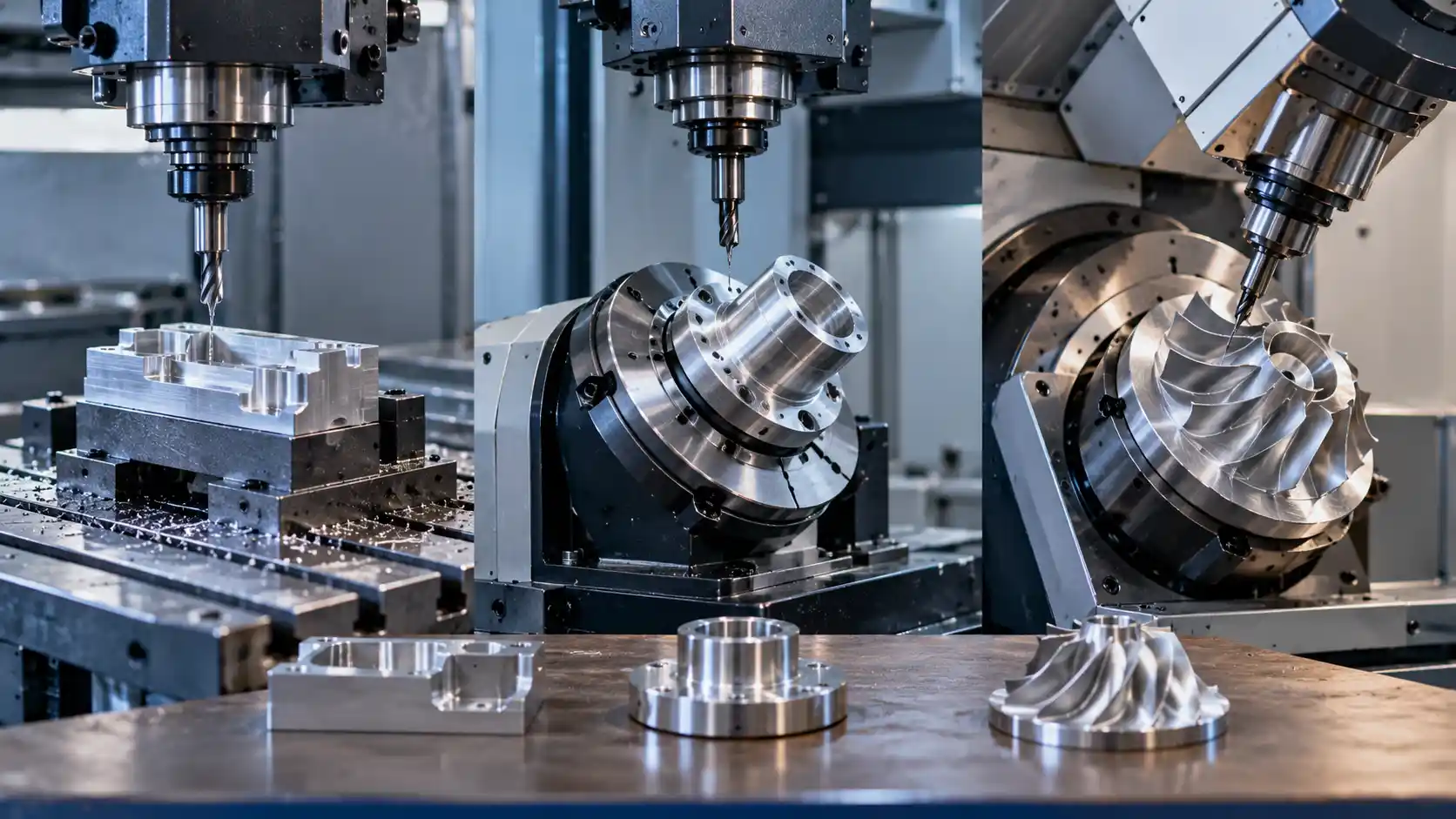
- Trunnion Style: The workpiece is mounted on a tilting, spinning table. The table itself rocks back and forth (A-axis) and spins in a circle (C-axis) while the spindle only moves linearly.
- Swivel Head Style: The workpiece remains stationary on a flat table, while the machine’s massive spindle head tilts and swivels (B-axis and C-axis) around the part.
Regardless of the configuration, the result is the same: the cutting tool can approach the workpiece from practically any conceivable angle in a 3D hemisphere. Instead of being locked into a rigid vertical position, the machine can present five sides of a rectangular block to the cutter automatically.
Simultaneous 5-Axis Machining vs. Positional (3+2) Machining
Just like with 4-axis machines, not all 5-axis operations are the same. Programming software dictates how these machines move.
- 3+2 Machining (Positional 5-Axis): The machine uses its two rotary axes to tilt and spin the workpiece into a highly specific compound angle. It locks the rotary axes into a rigid position. Then, the standard 3 axes (X, Y, Z) perform the cutting. This is the ultimate solution for reducing setup times, as it machines five sides of a part without moving it.
- Simultaneous 5-Axis Machining: This is the pinnacle of CNC technology. All five axes (X, Y, Z, plus the two rotary axes) move continuously and simultaneously while the tool is engaged in the metal. The tool and the table dynamically adjust their tilt, angle, and position in real-time. This is strictly required for machining true organic shapes, sweeping aerodynamic curves, and deep internal cavities.
Complex Geometry and Rigid Tooling Benefits
The most significant advantage of a 5 axis CNC machine is its ability to produce extreme complex geometry in a single, automated setup—a concept known in the industry as “Done-in-One” machining.
By eliminating manual part repositioning, manufacturers drastically slash lead times, eliminate the need for dozens of expensive custom fixtures, and achieve superior volumetric accuracy because the part never leaves its original zero-point coordinate.
Furthermore, because a 5-axis machine can tilt the spindle directly toward the surface being cut, machinists can use much shorter, thicker, and more rigid cutting tools. On a 3-axis machine, reaching the bottom of a deep cavity requires a long, thin tool, which causes vibration (chatter), poor surface finishes, and frequent tool breakage. A 5-axis machine tilts into the cavity, allowing a short tool to do the work, resulting in incredible surface finishes and allowing for much faster cutting speeds.
Typical Parts Produced
5-axis machines are the required backbone for advanced, high-tolerance industries. If you are looking at a 5 axis cnc machine for sale, it is usually to service these specific, high-paying sectors:
- Aerospace: Jet engine turbine blades, impellers, blisks, and structural titanium brackets.
- Medical: Complex organic implants like artificial knees, hip joints, and specialized prosthetics.
- Automotive/Motorsport: 5-axis ported engine cylinder heads, mold making, and fluid dynamic components.
- Defense: High-precision radar components and munitions guidance housings.
Simple Movement Illustrations: Understanding the Axes
To easily visualize how these machines differ, reference this simplified breakdown of CNC machine axes explained:
| Axis Designation | Movement Type | Description of Motion | Found On Which Machine? |
|---|---|---|---|
| X-Axis | Linear | Moves Left and Right | 3-Axis, 4-Axis, 5-Axis |
| Y-Axis | Linear | Moves Front to Back | 3-Axis, 4-Axis, 5-Axis |
| Z-Axis | Linear | Moves Up and Down | 3-Axis, 4-Axis, 5-Axis |
| A-Axis | Rotary | Rotates around the X-Axis | 4-Axis, 5-Axis |
| B-Axis | Rotary | Rotates around the Y-Axis | 5-Axis (Configuration dependent) |
| C-Axis | Rotary | Rotates around the Z-Axis | 5-Axis (Configuration dependent) |
3-Axis vs 4-Axis vs 5-Axis CNC: Comparison Table
To help you synthesize this information and apply it to your business needs, we have compiled a comprehensive comparison matrix. This chart outlines the practical differences you will experience on the shop floor when comparing 3 axis 4 axis 5 axis CNC setups.
| Feature / Capability | 3 Axis CNC Machine | 4 Axis CNC Machine | 5 Axis CNC Machine |
|---|---|---|---|
| Number of Moving Axes | 3 (X, Y, Z) | 4 (X, Y, Z, + A) | 5 (X, Y, Z, + A, B/C) |
| Part Repositioning | High Frequency (Requires manual operator flips for multiple sides) | Reduced (Can automatically access up to 4 sides of a part) | Minimal to None (Machines up to 5 sides in one single setup) |
| Machining Capability | 2D/2.5D profiling, basic 3D surfaces, flat work | Continuous cylinder machining, multi-face angular indexing | Simultaneous dynamic contouring, extreme complex geometry |
| Tool Length Requirement | Long, vibration-prone tools required for deep pockets | Medium length tools | Short, highly rigid tools (machine tilts to avoid collisions) |
| Surface Finish Quality | Standard / Moderate | High on rotational parts | Exceptional (continuous toolpath alignment to the surface) |
| Operator Skill Level | Low to Medium (Standard G-code programming) | Medium (Requires understanding of rotary coordinates) | High (Requires advanced CAM software knowledge & simulation) |
| Setup Time per Part | High (Multiple setups, multiple zero points, custom fixtures) | Medium | Very Low (Done-in-One processing with minimal fixturing) |
| Cost of Equipment | Most Affordable (Great entry-level investment) | Moderate Investment | Highest Investment (Yields the highest ROI for complex parts) |
Choosing the Right Machine for Your Manufacturing Needs
Understanding the technical definitions of CNC machine axes explained is highly educational, but applying that knowledge to your operational strategy is what drives revenue. When deciding which machine is right for your facility, consider the complexity of the parts you bid on, your production volume, and your labor constraints.
When to Choose a 3-Axis CNC
If your shop primarily handles high-volume production runs of simple, flat, or prismatic parts, a 3 axis CNC machine is likely all you need. If your blueprints don’t require multi-sided machining, investing in a 3-axis machine is incredibly cost-effective. They are easy to program, fast to set up for flat work, and require less specialized operator training.
When to Choose a 4-Axis CNC
If you are currently running a 3-axis machine but find your operators spending hours building custom angle plates, or stopping the machine to manually flip parts to drill side-holes, a 4 axis CNC machine is your next logical step. By integrating a rotary axis CNC setup, you bridge the gap between simple milling and complex production, making it ideal for shops transitioning into automotive or cylindrical part manufacturing.
When to Choose a 5-Axis CNC
When manufacturers search for a 5 axis cnc machine for sale, it is usually because they have hit a production bottleneck that traditional machines cannot solve. If your business is targeting high-value, tight-tolerance industries like aerospace, medical implants, or advanced energy sectors, a 5 axis CNC machine is strictly non-negotiable.
While the initial investment is higher, the ability to utilize simultaneous 5-axis machining pays for itself rapidly. By eliminating manual setups, reducing fixture costs, extending tool life through rigid setups, and unlocking the ability to machine organic complex geometry, a 5-axis machine transforms a standard machine shop into an advanced manufacturing facility.
Conclusion
The evolution from a standard 3 axis CNC machine to a 4 axis CNC machine and ultimately to a powerful 5 axis CNC machine is a journey of increasing manufacturing efficiency, precision, and geometric capability.
- 3-Axis provides the essential, rigid X, Y, and Z linear movements required for standard top-down milling.
- 4-Axis introduces the rotary A-axis, allowing for continuous machining of cylindrical parts and automated multi-sided access.
- 5-Axis adds a second rotary axis, enabling tool tilting, dynamic multi-axis contouring, and the ability to machine incredibly complex parts in a single, un-interrupted setup.
At Mekantra Technologies, we are dedicated to helping manufacturers navigate these technological leaps. Whether you need a robust 3-axis workhorse to rapidly churn out simple hardware, or you are ready to modernize your shop floor with a high-performance 5-axis machining center, understanding these axes is the foundation of your success.
Ready to upgrade your production capabilities? Visit us at Mekantra Technologies to explore our cutting-edge CNC solutions, view our current machinery inventory, and connect with our engineering experts to find the perfect CNC machine for your specific manufacturing goals.

Mekantra Engineering Team
The technical voice of Mekantra. Our team consists of sourcing specialists, mechanical engineers, and logistics experts dedicated to providing transparent insights and high-performance solutions for the global manufacturing sector.
Mekantra Engineering Team
The technical voice of Mekantra. Our team consists of sourcing specialists, mechanical engineers, and logistics experts dedicated to providing transparent insights and high-performance solutions for the global manufacturing sector.