CNC Machines Every Workshop Should Consider Today
Summary
What separates a productive workshop from a limited one? Often, it is the CNC equipment in place. This post covers the machines that matter most, the jobs they handle, and how to match them to your actual workflow.
Manual cutting and shaping have hard limits. They are slow, inconsistent, and expensive to scale once production demand grows. CNC machines remove those limits. They execute pre-programmed tool paths with accuracy that no manual operator can replicate across a full shift, let alone a full production run. For any workshop serious about output quality and operational consistency, investing in the right CNC equipment is not optional it is the baseline. This guide covers every major machine type worth considering, what each one does best, the specifications that actually matter, and how to match the right cutting machines to your specific workflow.
What Are CNC Machines and How Do They Work?
CNC stands for Computer Numerical Control. It is a method of automating machine tools through pre-written programs most commonly G-code that direct every movement of the cutting tool with exact coordinates and feed rates.
The process starts with a digital part design in CAD software. That design is then processed through CAM software, which generates the tool path the exact route the cutting tool follows to shape the workpiece. The CNC controller reads that program and drives the machine’s motors along its axes, whether that is three axes (X, Y, Z) for standard work or four to five axes for complex contoured components.
The result is a machine that can produce the same part, to the same tolerance, hundreds or thousands of times without deviation. There is no fatigue, no inconsistency between operators, and no need to re-measure between cuts. CNC machines work across a wide range of materials metals, wood, foam, plastics, and composites which is why they appear in nearly every production environment. The spindle type, axis configuration, and controller brand vary by machine, but the core logic stays the same: the program runs, the machine cuts, the part comes out right.
Core Types of CNC Machines Every Workshop Should Know
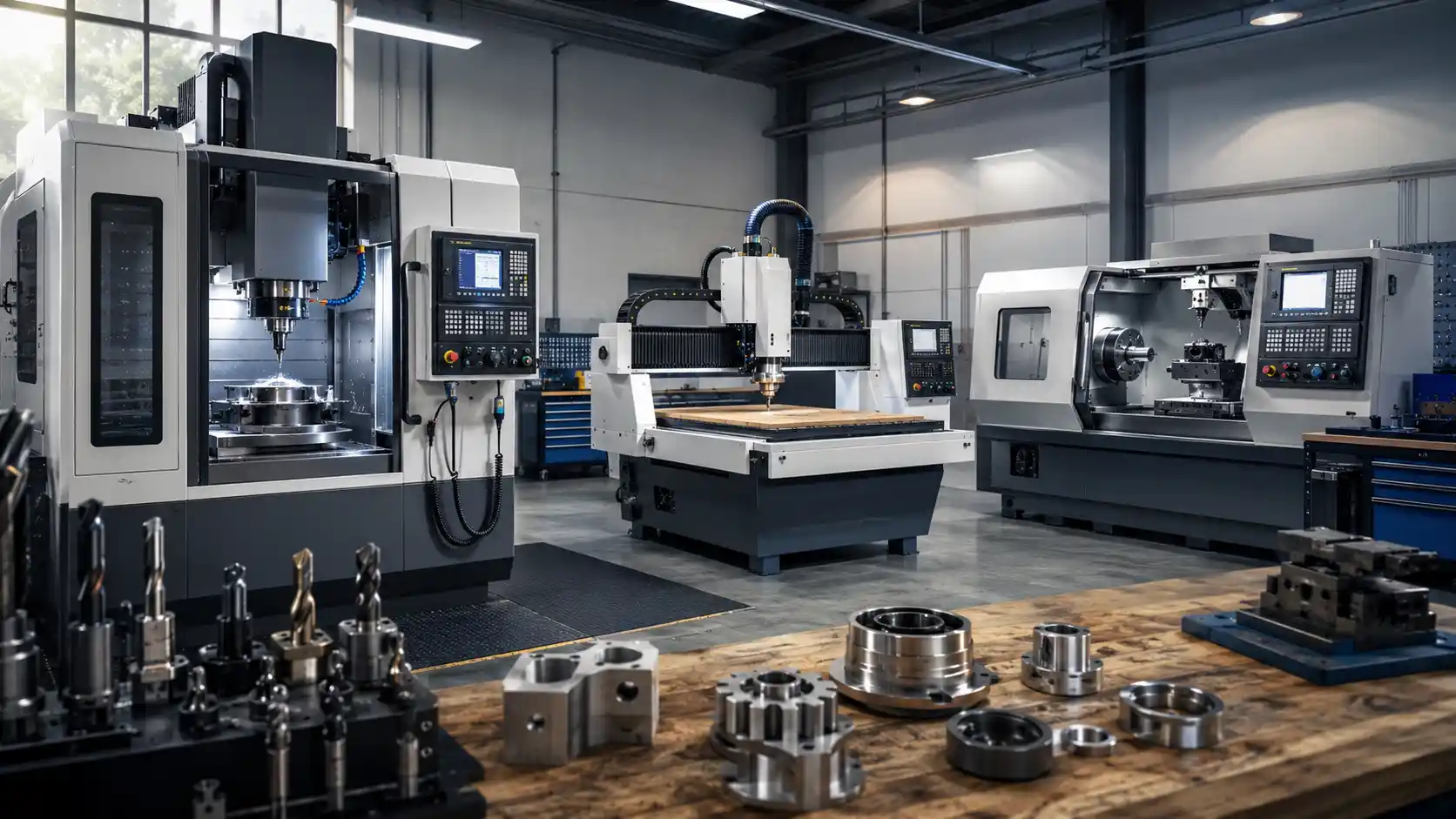
Not every CNC machine is interchangeable. Each type is built around a specific cutting method and material range. Using the wrong machine for a job does not just produce poor results it creates unnecessary wear, longer cycle times, and avoidable scrap. Here is a breakdown of the six primary machine types and where each one belongs.
1. CNC Milling Machine
A CNC milling machine uses rotating cutters to remove material from a stationary workpiece. It handles complex geometries pockets, slots, holes, stepped surfaces, and three-dimensional contours that are impossible to achieve with simpler cutting tools.
Milling machines are available in 3-axis, 4-axis, and 5-axis configurations. A 3-axis mill moves along the X, Y, and Z planes. A 5-axis machine adds rotational movement, allowing the tool to approach the workpiece from virtually any angle in a single setup. This dramatically reduces the number of fixturing changes needed for complex parts.
Key specs to evaluate include spindle speed (measured in RPM), the work envelope (the XYZ travel range, which defines the maximum part size the machine can handle), the number of axes, and the tool changer capacity for shops running varied operations.
CNC milling machines are the primary workhorse for automotive components, aerospace structural parts, mold cavities, and precision prototypes. If your workshop deals in metal components with tight tolerances, a CNC milling machine belongs on your floor.
2. CNC Router
A CNC router operates on the same axis-driven principle as a milling machine but is designed for flat-bed, large-format work at higher speeds and lower cutting forces. The spindle travels over the material rather than the material moving under the tool, which makes routers ideal for sheet goods.
CNC routers handle wood, MDF, plywood, foam, plastics, and soft metals like aluminum. A standard router table runs at 4×8 feet, though larger formats exist for industrial furniture and panel production. Spindle power (measured in kW), feed rate (mm/min), and vacuum table strength are the specs that determine output quality and speed.
The CNC router is one of the most accessible entry points for small-to-mid workshops. The cost is lower than a full milling machine, the material range is broad, and the learning curve for setup and operation is manageable. Woodworking shops, signage producers, and furniture manufacturers rely on CNC routers as their core cutting machines.
3. CNC Laser Cutter
A CNC laser cutter uses a focused, high-intensity beam of light to cut or engrave material. Because the laser has no physical contact with the workpiece, there is zero tool wear, and the cut edges are clean with minimal post-processing.
Two laser types dominate the market. CO2 lasers handle non-metals acrylic, wood, leather, rubber, and fabric. Fiber lasers cut metals steel, stainless, brass, copper, and aluminum at speeds and thicknesses that make them the standard choice for metal sheet fabrication. This distinction matters before purchasing. A CO2 machine cannot efficiently cut metal, and using the wrong type means underperformance regardless of the operator’s skill.
Key specs include laser power (watts), cutting speed (mm/s), focal length, and the working area. Higher wattage allows cutting thicker material at faster speeds. For workshops cutting intricate profiles in sheet metal or producing detailed engraved components, a CNC laser cutter delivers precision that plasma and mechanical cutting tools cannot match at thin gauges.
4. CNC Plasma Cutter
Where laser cutters excel at fine detail and thin material, CNC plasma cutters dominate in heavy-section metal cutting. A plasma cutter runs an electrically conductive gas through a nozzle and ignites it into plasma a superheated state that melts through electrically conductive metals at speed.
For steel plate above 6mm, plasma is faster and significantly cheaper to operate than laser. The amperage rating, cutting thickness capacity, torch height control system, and table size are the critical specs to compare. Torch height control (THC) automatically adjusts the torch distance from the material surface during cutting, which is essential for consistent cut quality on warped or uneven plate.
CNC plasma cutters are the standard cutting machines in structural steel fabrication, shipbuilding yards, HVAC duct manufacturing, and heavy equipment repair shops. If your operation regularly processes thick steel plate, plasma cutting equipment will outperform every alternative at that thickness range.
5. CNC Lathe (Turning Center)
A CNC lathe works differently from all the machines above. Instead of moving a tool over a stationary workpiece, the lathe rotates the workpiece at high speed while a stationary cutting tool removes material from the outside surface. This is called turning, and it is the primary method for producing cylindrical, conical, and threaded components.
Modern CNC lathes often called turning centers include live tooling capability, meaning the machine can also drill, mill, and tap the rotating workpiece without re-fixturing. Multi-axis CNC lathes combine turning and milling into a single setup, which dramatically reduces production time for complex rotational parts.
Chuck size, spindle bore diameter, maximum turning diameter, and live tooling capability are the specs that define what a lathe can and cannot produce. Workshops manufacturing shafts, bushings, hydraulic fittings, bolts, and engine components depend on CNC lathes as core production equipment.
6. CNC EDM (Electrical Discharge Machining)
CNC EDM machines shape material using controlled electrical sparks rather than physical cutting force. This method works on hardened steel, exotic alloys, and materials that resist conventional machining. The spark erodes the workpiece surface at a microscopic level, creating extremely precise geometries with surface finishes that other methods cannot achieve.
EDM comes in two primary forms: wire EDM, which uses a thin electrode wire to cut profiles through the material, and sinker EDM, which sinks a shaped electrode into the workpiece to create a cavity or pocket. Wire diameter, dielectric fluid type, and the Ra surface finish rating are the key technical parameters.
Mold and die makers, medical device manufacturers, and aerospace suppliers use EDM for components where tight tolerances and hard materials rule out any other process. EDM is not for general fabrication it is a specialist process for situations where nothing else can achieve the required result.
CNC Machine Comparison at a Glance
| Machine Type | Primary Use | Material Range | Precision | Est. Cost Range |
| CNC Milling Machine | Complex 3D parts | Metals, plastics | ±0.005 mm | $15,000 – $500,000+ |
| CNC Router | Sheet cutting / engraving | Wood, MDF, soft metals | ±0.1 mm | $3,000 – $50,000 |
| CNC Laser Cutter | Precision cutting / engraving | Metals, acrylic, wood | ±0.05 mm | $5,000 – $300,000 |
| CNC Plasma Cutter | Heavy metal plate cutting | Steel, aluminum, copper | ±0.5 mm | $2,000 – $80,000 |
| CNC Lathe | Cylindrical / threaded parts | Metals, plastics | ±0.005 mm | $10,000 – $200,000 |
| CNC EDM | Hard material shaping | Hardened alloys | ±0.002 mm | $20,000 – $500,000+ |
* Cost ranges are estimates. Final pricing varies by axis count, brand, controller, and configuration.
How to Choose the Right CNC Equipment for Your Workshop
Knowing the machine types is step one. Matching the right machine to your actual workflow is where most workshops make mistakes. Here is a practical decision framework.
Start with your material. Every CNC machine has a material sweet spot. Running steel on a CNC router damages the spindle and produces poor results. Running thin acrylic on a plasma cutter is wasteful. Before evaluating any machine, define the primary materials your shop processes and let that narrow your options.
Define your tolerance requirement. High-precision output aerospace brackets, medical implants, injection molds demands machines rated to ±0.005 mm or tighter. General structural fabrication tolerates ±0.5 mm. Buying an underpowered machine for tight-tolerance work costs more in scrap and rework over time.
Match axis count to part complexity. Three-axis CNC machines handle the majority of workshop output efficiently. Parts with complex contoured surfaces or undercuts require 4-axis or 5-axis capability. More axes raise the machine cost but reduce setups per part, lowering labour cost and cycle time at volume.
Account for floor space and utilities. CNC laser cutters and plasma cutters require adequate ventilation and fume extraction. EDM machines need a dielectric fluid management system. CNC routers with large beds need clear floor space and overhead clearance. Match the machine’s physical footprint and utility demands to what your facility can support.
Factor in maintenance cost over the machine’s life. Spindle replacement cycles, filter changes, controller software updates, and spare part availability all affect total cost of ownership. Machines from brands with established service networks carry lower long-term risk than lower-cost alternatives with limited support.
Mekantra Technologies sources factory-verified CNC machines directly from manufacturers and manages global freight, inspection, and delivery. For shops that also need iron & steel processing equipment or mechanical machinery alongside CNC, coordinated sourcing from one supplier reduces procurement complexity.
Industries That Depend on CNC Machines Daily
The reach of CNC machines extends across nearly every manufacturing sector. In automotive manufacturing, CNC milling machines and turning centers produce engine components, transmission housings, and suspension parts at the tolerances and volumes that assembly lines demand. Aerospace operations rely on 5-axis milling centers and EDM equipment to shape structural components from titanium and hardened alloys where no other process meets the required precision.
Woodworking and furniture manufacturers run CNC routers as their primary production equipment cutting panels, carving profiles, and engraving surfaces at speeds that manual routing cannot approach. Metal fabrication shops use CNC plasma cutters and laser cutters to process structural steel and sheet metal for construction, transport, and industrial equipment. Medical device producers depend on high-precision CNC lathes and EDM machines for implants and surgical instruments where dimensional accuracy is non-negotiable.
| Industry | CNC Equipment Most Used |
| Automotive | CNC milling, CNC lathe |
| Aerospace | 5-axis CNC mill, EDM |
| Woodworking & Furniture | CNC router |
| Metal Fabrication | CNC plasma, laser cutter |
| Medical Devices | EDM, high-precision CNC lathe |
| Signage & Display | CNC router, laser cutter |
| Electronics | CNC laser, micro-milling |
| Oil & Gas | CNC lathe, heavy-duty milling |
Signage and display companies, electronics enclosure manufacturers, and oil and gas equipment suppliers all maintain CNC equipment as a core part of their industrial machinery infrastructure.
Key Specifications to Check Before Buying CNC Equipment
The spec sheet on any CNC machine can run to several pages. Most of it is secondary. The specifications that actually determine whether a machine fits your operation are a short list.
Spindle speed and power determine how fast the machine removes material and what surface finish it can achieve higher spindle speed is not always better; it depends on the material and tooling. The work envelope (XYZ travel dimensions) defines the largest part the machine can process without repositioning. Repeatability and accuracy ratings tell you whether the machine can hold tolerance across a full production run, not just on the first part. Axis count determines part complexity capability.
The CNC controller brand Fanuc, Siemens, and Mitsubishi being the most widely supported affects how easy the machine is to program, service, and integrate with existing CAD/CAM software. Feed rate and rapid traverse rate directly impact cycle time and therefore output per shift. Tool changer capacity (ATC) matters for workshops running varied parts a 20-tool ATC reduces manual intervention between operations. Finally, the coolant and chip management system determines how cleanly the machine handles metal removal and how much post-cutting cleanup the operator must manage.
Get the spec sheet, compare against your tolerance requirements and material range, and request a test cut or factory acceptance test before finalising any purchase.
The Right CNC Machine Changes What Your Workshop Can Take On
There is no single best CNC machine for every workshop. The right choice depends entirely on what you cut, how precisely, at what volume, and within what floor space. A woodworking shop and a steel fabrication floor have opposite requirements, even if both benefit from CNC automation.
The decision framework is straightforward: match machine type to material, match precision rating to output requirements, and match axis count to part complexity. Get those three right, and the investment pays for itself in reduced scrap, shorter cycle times, and the ability to take on work that previously required outsourcing. Mekantra Technologies supplies factory-direct CNC machines to workshops and manufacturing operations globally from initial specification through inspection, freight, and delivery. If you are evaluating CNC equipment for your operation, contact the team with your material scope and production requirements for a direct quote.

Mekantra Engineering Team
The technical voice of Mekantra. Our team consists of sourcing specialists, mechanical engineers, and logistics experts dedicated to providing transparent insights and high-performance solutions for the global manufacturing sector.
Mekantra Engineering Team
The technical voice of Mekantra. Our team consists of sourcing specialists, mechanical engineers, and logistics experts dedicated to providing transparent insights and high-performance solutions for the global manufacturing sector.