DPF Cleaning vs Replacement Guide for Heavy-Duty Trucks
Summary:
“For heavy-duty fleets running Class 7–8 rigs, DPF failure leads to severe derate modes, costly roadside service calls, and missed delivery schedules. Knowing when to utilize advanced aqueous or pneumatic cleaning versus full filter replacement saves thousands in total cost of ownership (TCO). Read on to review critical failure indicators, ROI models, and step-by-step diagnostic workflows.”
Managing a commercial fleet of Class 7 and Class 8 heavy-duty trucks requires constant vigilance over operating costs, emissions compliance, and vehicle uptime. Among all exhaust emission components, the Diesel Particulate Filter (DPF) sits at the intersection of fuel efficiency, regulatory compliance, and mechanical reliability.
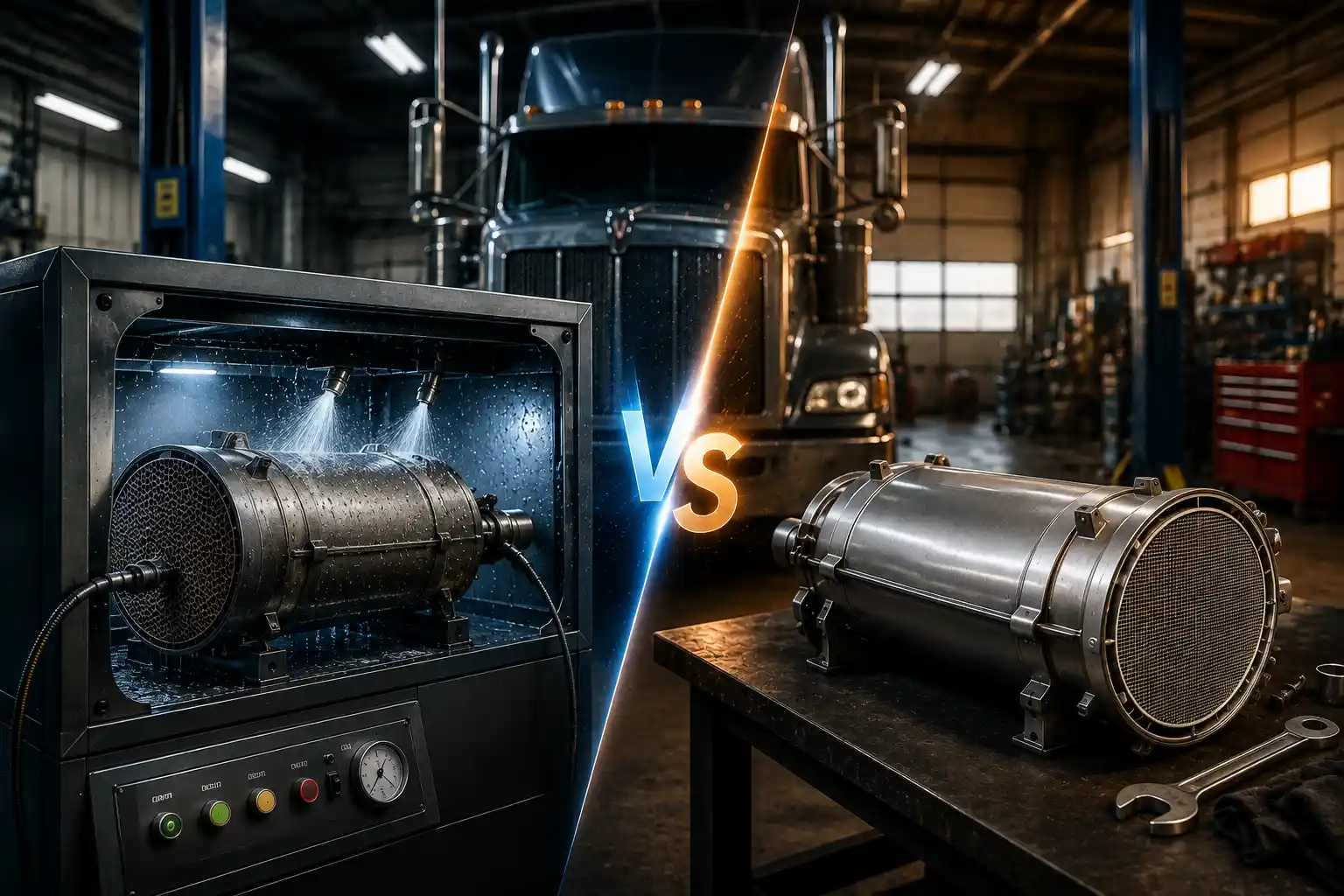
When exhaust backpressure rises or diagnostic fault codes signal soot overload, fleet directors and shop managers face a classic operational dilemma: Should you clean the DPF or replace it altogether?
Making the wrong choice can lead to wasted maintenance budget, premature engine wear, or unexpected vehicle derate modes on the highway.
Understanding DPF Failure Modes: Soot vs. Ash
To choose between cleaning and replacement, you must first understand why DPFs clog. A diesel particulate filter traps exhaust particulate matter through honeycomb micro-channels made of porous ceramic materials such as cordierite or silicon carbide (SiC).
       RAW DIESEL EXHAUST
 (Soot, Ash, Hydrocarbons, NOx)
               │
               ▼
┌──────────────────────────────┐
│  Diesel Oxidation Catalyst   │  ---> Converts NO to NO2 & oxidizes unburned hydrocarbons
│           (DOC)              │
└──────────────┬───────────────┘
               │
               ▼
┌──────────────────────────────┐
│  Diesel Particulate Filter   │  ---> Traps soot & non-combustible lubricant ash
│           (DPF)              │       (Requires Regen for Soot / Bench Cleaning for Ash)
└──────────────┬───────────────┘
               │
               ▼
┌──────────────────────────────┐
│  Selective Catalytic Red.    │  ---> Injects DEF to eliminate remaining NOx
│           (SCR)              │
└──────────────┬───────────────┘
               │
               ▼
        CLEAN EXHAUST
The filter handles two distinct materials over its operational lifetime:
- Soot (Combustible Carbon): Created during incomplete diesel combustion. Soot is burned off periodically through passive regeneration (high exhaust heat during highway driving) or active regeneration (engine-managed fuel injection to heat the exhaust to ~1,100°F / 600°C).
- Ash (Incombustible Metallic Compounds): Derived from engine oil additives, wear metals, and fuel trace elements. Ash cannot be burned off by on-truck regeneration. Over 150,000 to 250,000 miles, ash settles into the rear cell walls, reducing the filter’s working volume and raising baseline exhaust backpressure.
DPF Cleaning: Methods, Effectiveness, and Limits
Bench cleaning removes accumulated non-combustible ash to restore exhaust flow without replacing the housing or ceramic substrate.
Professional Cleaning Methods
- Pneumatic Pulse Cleaning: High-pressure compressed air pulses pass through individual substrate channels to blow loose ash out into a containment system.
- Thermal Bake & Bake-and-Blow: The filter goes into a specialized oven heated gradually to ~1,100°F (600°C) over several hours. This oxidizes deep-seated residual soot and turns hardened deposits into soft ash, which is then blown out pneumatically.
- Aqueous (Liquid Flushing) Cleaning: Uses heated water solutions mixed with specialized detergents to flush out baked-on ash. While effective, aqueous systems require thorough drying cycles to avoid thermal shock or cracking during re-installation.
| Cleaning Method | Soot Removal | Ash Removal | Turnaround Time | Best Used For |
| Pneumatic Only | Moderate | 60% – 70% | 1–2 hours | Preventive maintenance / light ash buildup |
| Thermal Bake & Pulse | High (95%+) | 85% – 95% | 8–12 hours | Heavy ash loading, high backpressure faults |
| Aqueous Flush | High (90%+) | 90% – 95% | 4–8 hours | Hardened chemical scale, oil-contaminated filters |
When Cleaning Works Best
- Filter backpressure is moderately elevated, but internal structures are structurally sound.
- The truck is undergoing routine preventive maintenance at 150,000 to 200,000-mile intervals.
- No engine oil, coolant, or raw diesel has saturated the core.
Signs Cleaning Will Fail
- Thermal Shock Cracks: Caused by uncontrolled thermal runaways during severe regens.
- Substrate Melting / Face Plugging: Ceramic walls have melted into solid blocks due to internal temperatures exceeding 1,800°F (1,000°C).
- Internal Pin-Holes & Erosion: High pressure or chemical erosion allows unmanaged exhaust to bypass the filter walls entirely.
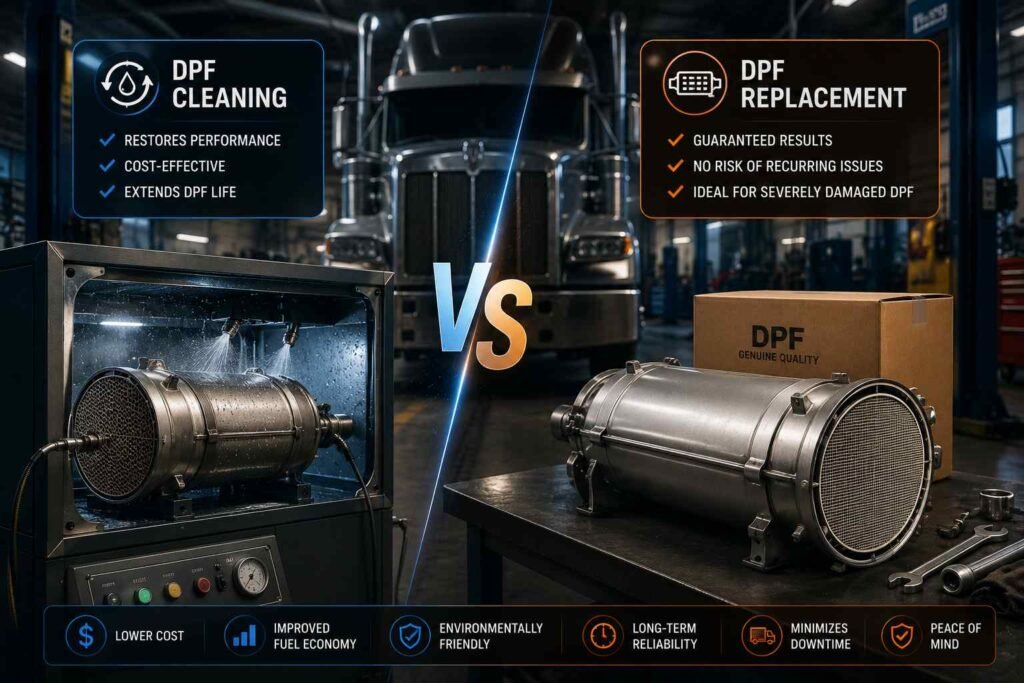
DPF Replacement: OEM vs. Aftermarket Options
When a filter is mechanically compromised or has reached the end of its physical service life (typically 400,000 to 600,000 miles), replacement is required. Fleets have three primary options:
                  ┌─────────────────────────────────────────┐
                  │ Is the DPF Damaged, Melted, or Cracked? │
                  └────────────────────┬────────────────────┘
                                       │
                     ┌─────────────────┴─────────────────┐
                     ▼                                   ▼
                 [ YES ]                              [ NO ]
                     │                                   │
      ┌──────────────┴──────────────┐             ┌──────┴──────────────┐
      │  Select Replacement Type    │             │ Schedule Professional│
      └──────────────┬──────────────┘             │ Thermal Cleaning    │
                     │                            └─────────────────────┘
         ┌───────────┼───────────┐
         ▼           ▼           ▼
      ┌─────┐     ┌─────┐     ┌─────┐
      │ OEM │     │ New │     │ Reman│
      │ New │     │ Aft.│     │ Exch.│
      └─────┘     └─────┘     └─────┘
- OEM New Replacement: Sourced directly from engine manufacturers (Cummins, Detroit Diesel, Volvo/Mack, PACCAR). Offers total compatibility and factory warranties, but carries the highest price tag ($3,000 – $5,000+ per unit).
- Direct-Fit Aftermarket New: Produced by specialized exhaust manufacturers using cordierite or silicon carbide (SiC) substrates. Quality aftermarket units match OEM fitment and EPA standards at a 30% to 50% discount.
- Remanufactured (Reman) Exchange: A cleaned, tested, and recertified OEM core traded in for your old filter. A fast option for fleets needing minimal shop downtime, though substrate age can vary.
Cost Analysis & Fleet ROI Comparison
Evaluating DPF choices requires analyzing the Total Cost of Ownership (TCO), including hardware, labor, and truck downtime costs.
Cost Breakdown Table (USD)
| Cost Category | Professional Thermal Cleaning | Aftermarket New DPF | OEM New DPF |
| Part / Service Cost | $350 – $650 | $1,200 – $2,200 | $3,200 – $5,000 |
| Labor (Remove & Install) | $300 – $500 | $300 – $500 | $300 – $500 |
| Gaskets & Clamps | $75 – $150 | Included or $75 – $150 | $75 – $150 |
| Average Fleet Downtime | 24 – 48 Hours | 4 – 8 Hours | 4 – 8 Hours |
| Estimated Downtime Cost ($1,000/day) | $1,000 – $2,000 | $200 – $400 | $200 – $400 |
| Total Estimated Cost Per Unit | $1,725 – $3,300 | $1,775 – $3,250 | $3,775 – $6,050 |
| Expected Lifespan Post-Service | 100,000 – 150,000 Miles | 250,000 – 400,000 Miles | 300,000 – 500,000 Miles |
Key ROI Insight: While thermal cleaning has a lower direct service cost ($350–$650), shop turnaround times can increase downtime costs if spare DPF units are not kept on hand. Maintaining a small buffer of remanufactured or high-quality aftermarket filters allows commercial fleets to swap units instantly, keeping trucks moving while offloaded units undergo thermal bench cleaning.
The Decision Matrix: Clean or Replace?
Use this operational checklist to evaluate heavy-duty diesel particulate filters during shop servicing:
                            START DPF INSPECTION
                                     │
                                     ▼
                      ┌──────────────────────────────┐
                      │ Visual & Pin Test Inspection │
                      └──────────────┬───────────────┘
                                     │
                    Has structural damage, cracks,
                    melting, or oil contamination?
                                     │
                     ┌───────────────┴───────────────┐
                     ▼                               ▼
                  [ YES ]                         [ NO ]
                     │                               │
        ┌────────────┴────────────┐    ┌─────────────┴─────────────┐
        │ Action: REPLACE         │    │ Action: CLEAN             │
        │ Options: High-Grade     │    │ Process: Bake-and-Blow    │
        │ Aftermarket or OEM      │    │ or Aqueous Wash           │
        └─────────────────────────┘    └─────────────────────────┘
- Step 1: Visual and Pin Test Inspection
- Inspect inlet/outlet faces for black soot streaks on the clean side (indicates internal cracking).
- Insert a fine wire probe down micro-channels (Pin test) to check for internal melt pockets.
- Result: If cracked, melted, or pin-tested deep into broken channels $\rightarrow$ Replace Immediately.
- Step 2: Check Engine Upstream Health
- Inspect for upstream turbo seal leaks, failed EGR coolers, or leaking fuel injectors.
- Result: If oil or raw coolant has saturated the substrate $\rightarrow$ Thermal cleaning will fail or cause thermal runaway fires. Fix upstream engine fault and Replace DPF.
- Step 3: Measure Weight and Delta-P (Backpressure)
- Weigh the filter before service and measure differential pressure on a flow bench.
- Result: If weight accumulation is strictly dry ash and structural integrity is intact $\rightarrow$ Perform Thermal Bake & Pneumatic Clean.
Streamlining Your Fleet’s Spare Parts Supply Chain
Maintaining commercial truck reliability goes beyond routine DPF cleaning and filter maintenance it requires a dependable supply chain for high-grade replacement components. When unexpected emission failures or mechanical wear cause unwanted fleet downtime, having quick access to OEM-quality replacement parts is crucial for keeping vehicles on the road. For commercial fleets, repair shops, and heavy-duty mechanics looking to optimize maintenance schedules, sourcing certified vehicle spare parts designed for heavy-duty compatibility ensures your trucks meet stringent EPA standards while maintaining peak engine efficiency and long-term durability.
Summary Recommendations for Fleet Operations
- Establish Fixed Maintenance Intervals: Do not wait for a dash warning light or vehicle derate mode. Schedule professional DPF cleaning every 150,000 to 200,000 miles for line-haul Class 8 trucks, and every 75,000 to 100,000 miles for severe-duty vocational trucks (dump trucks, refuse, short-haul delivery).
- Fix Upstream Issues Promptly: A DPF is a diagnostic mirror for the engine. Leaking EGR valves, dripping fuel injectors, or worn turbocharger seals will destroy a brand-new $3,500 DPF in under 10,000 miles.
- Use High-Grade Substrates for Replacements: When replacement is required, choose direct-fit aftermarket filters featuring high-density silicon carbide (SiC) or premium cordierite substrates that meet or exceed OEM thermal stress tolerances.
- Leverage Exchange Programs: Minimize vehicle downtime by keeping pre-cleaned or new replacement units in shop inventory, allowing immediate swap-outs during scheduled maintenance windows.
For high-grade commercial vehicle parts, emission control components, and heavy-duty fleet solutions, visit Mekantra Technologies to explore our full range of products and maintenance resources.
FAQs
How often should a heavy-duty Class 8 truck DPF be cleaned?
Most engine OEMs (including Cummins, Detroit Diesel, and Volvo) recommend professional off-truck DPF bench cleaning every 150,000 to 200,000 miles (or roughly every 3,000 to 4,000 engine operating hours). Vocational trucks operating in high-idle or short-haul applications (such as dump trucks or refuse vehicles) should have their DPF serviced earlier, typically between 75,000 and 100,000 miles.
Can on-truck active regeneration replace off-truck bench cleaning?
No. On-truck regeneration (whether passive, active, or forced) only burns off organic soot (combustible carbon) by converting it into ash. It cannot burn off or remove non-combustible metallic ash resulting from burned engine lubricants, zinc, and fuel additives. Over time, this ash builds up inside the ceramic channels and can only be physically removed using specialized off-car air-pulse, thermal-bake, or aqueous washing equipment.
How do I know if my DPF is cracked or melted internally?
The most reliable sign of an internally cracked substrate is black soot buildup on the downstream (outlet) side of the DPF or inside the tailpipe tip. You can also perform a pin test using a fine wire probe to check if the ceramic walls have collapsed or melted internally. If soot bypasses the filter core or the pin drops deep into broken micro-channels, the DPF cannot be restored by cleaning and must be replaced immediately.
What happens if I ignore a clogged DPF warning light?
Ignoring a clogged DPF forces the Engine Control Module (ECM) into a severe engine derate mode, capping vehicle speed and horsepower to prevent engine damage. Continued operation with excessive exhaust backpressure leads to elevated turbocharger temperatures, potential turbo seal blowouts, EGR valve failure, dropped fuel economy, and potential catastrophic engine damage.
Why do newly cleaned or replaced DPFs fail prematurely?
Nearly 80% of premature DPF failures are caused by upstream engine faults rather than defects in the filter itself. Common root causes include leaking turbocharger oil seals, sticking fuel injectors, oil consumption from worn piston rings, or a failing EGR cooler leaking coolant into the exhaust stream. If these upstream issues are not resolved before installing a cleaned or new DPF, the new filter will quickly contaminate or suffer thermal runaway damage.

Mekantra Engineering Team
The technical voice of Mekantra. Our team consists of sourcing specialists, mechanical engineers, and logistics experts dedicated to providing transparent insights and high-performance solutions for the global manufacturing sector.
Mekantra Engineering Team
The technical voice of Mekantra. Our team consists of sourcing specialists, mechanical engineers, and logistics experts dedicated to providing transparent insights and high-performance solutions for the global manufacturing sector.