3 Axis vs 5 Axis CNC: ROI & Machine Cost Guide
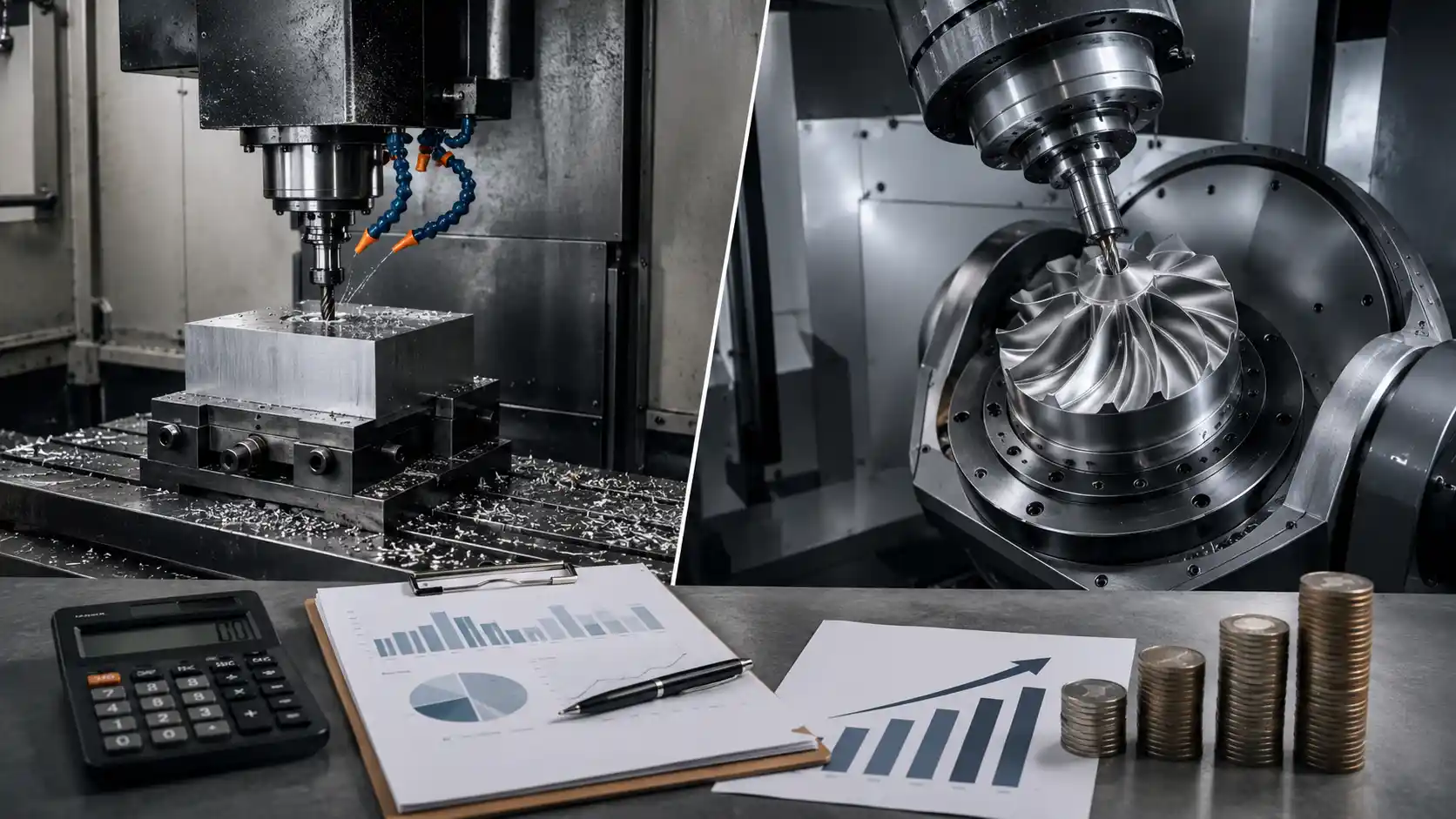
Selecting the right CNC machining center is one of the most critical capital expenditure decisions a manufacturing facility will make. For facility owners, procurement managers, and machine shop operators across the United States, equipment evaluation ultimately hinges on financial return: Which equipment platform yields a better return on investment (ROI)?
While standard 3 axis CNC machine installations remain the backbone of general industrial production due to lower acquisition barriers, advanced 5-axis technology has transitioned from a specialized aerospace tool into a mainstream production standard. Evaluating a 3 axis vs 5 axis CNC purchase requires looking beyond the initial machine price tag to examine complete production cycle times, fixture design overhead, operator touchpoints, material scrap rates, and lifetime operational expenses.
In this comprehensive decision-stage guide, we compare 3-axis and 5-axis CNC technology across 11 critical operational factors, provide a real-world ROI payback calculation model, and deliver a practical equipment selection framework for your plant through Mekantra Technologies.
Technical Kinematics & Mechanical Workflows
Understanding the economic return of each machine category requires a clear look at their underlying mechanical movements and workholding dynamics:
- 3-Axis CNC Machine: Moves along three linear directions simultaneously: X (left/right motion), Y (front/back motion), and Z (up/down spindle depth). The cutting tool maintains a fixed vertical orientation relative to the workpiece table. Machining additional faces of a component requires an operator to manually pause the cycle, unclamp the workpiece, clean the workholding fixture, flip or rotate the stock, re-clamp, and re-establish reference datums.
- 5-Axis CNC Machine: Operates along the three standard linear axes (X, Y, Z) while simultaneously utilizing two rotational axes (typically A rotating around X, and B or C rotating around Y or Z). The spindle or trunnion table dynamically rotates and tilts, granting the cutting tool multi-angled access to five sides of a component within a single clamping operation (“done-in-one” manufacturing).
Kinematic Motion Breakdown
- 3-Axis Machine Flow: Linear movements only -> Fixed vertical tool angle -> Requires 2 to 6+ manual part flips -> High operator labor touchpoints.
- 5-Axis Machine Flow: Linear plus dual rotational axes -> Dynamic multi-angle tool access -> Complete 5-sided machining in 1 setup -> Continuous spindle uptime.
For a broader overview of equipment types and workshop integration, review our guide on CNC Machines Every Workshop Should Consider Today.
3-Axis vs 5-Axis CNC Machining Center Comparison
| Evaluation Factor | 3-Axis CNC Machine | 5-Axis CNC Machine | ROI & Operational Winner |
| Initial Purchase Cost | $35,000 – $90,000 | $120,000 – $350,000+ | 3-Axis (Lower Entry CAPEX) |
| Setup Operations | Multiple (2 to 6+ setups per part) | Single Setup (“Done-in-One”) | 5-Axis (Saves Setup Labor) |
| Operator Skill Requirement | Basic to Intermediate CAM | Advanced Multi-Axis CAM & Verification | 3-Axis (Broader Hiring Pool) |
| Part Geometry Capability | Flat, Prismatic, Simple 2.5D/3D | Sculpted, Impellers, Compound Angles | 5-Axis (High-Margin Complexity) |
| Production Cycle Time | Longer (Includes manual flip delays) | Shorter (Continuous multi-face milling) | 5-Axis (Higher Hourly Output) |
| Tooling Extension & Rigidity | Requires long, flexible cutters | Uses short, rigid end mills | 5-Axis (30%–50% Longer Tool Life) |
| Production Volume Fit | High volume of simple parts | High-mix / low-to-mid complex runs | Context Dependent |
| Dimensional Accuracy | Risk of datum shift during re-clamping | Precision alignment (1 reference datum) | 5-Axis (Substantially Lower Scrap) |
| Shop Floor Footprint | Compact machine footprint | Larger footprint + auxiliary units | 3-Axis (Space Efficiency) |
| Maintenance & Servicing | Low (Fewer mechanical joints) | Moderate-High (Rotary axis alignment) | 3-Axis (Lower Annual OPEX) |
| Cost Per Finished Part | High on complex multi-sided parts | Low on complex multi-sided parts | 5-Axis (Complex Components) |
11 Critical Operational Factors Impacting CNC Machine ROI
When performing a thorough CNC machining center comparison, industrial decision-makers must evaluate how technical specifications convert directly into daily operational profitability.
1. Initial Purchase Price (Capital Expenditure)
The most visible financial barrier when considering a 5 axis CNC machine is upfront capital investment. In the United States industrial equipment market, a quality standard 3-axis vertical machining center (VMC) ranges between $35,000 and $90,000, depending on table dimensions, spindle horsepower, RPM capabilities, and control software options.
Conversely, a purpose-built 5-axis machining center costs between $120,000 and $350,000+. While adding a 4th/5th-axis trunnion table indexer to an existing 3-axis VMC lowers entry costs, dedicated 5-axis platforms feature superior structural castings, thermal stability, and higher dynamic positioning accuracy under continuous multi-axis interpolation.
2. Number of Setups & Fixturing Costs
Fixturing costs represent a significant hidden expense on 3-axis production lines. Machining a complex aluminum valve body on a 3-axis machine requires engineering, building, and maintaining up to five custom fixture plates or soft-jaw vise sets to access every face.
A 5-axis machine accesses five sides of a workpiece in a single workholding setup. Eliminating secondary fixtures reduces initial tooling design budgets, cuts workholding storage needs, and eliminates hours of non-productive machine downtime spent switching between setup stages.
3. Operator Requirements & Skill Availability
Navigating skilled labor shortages is a major operational challenge for US machine shop owners:
- 3-Axis Operating Requirements: Standard G-code programming and basic 2.5D CAM setup procedures allow junior operators to manage production runs after weeks of training. Direct labor costs per machine remain relatively low.
- 5-Axis Operating Requirements: Demands experienced CAM programmers proficient in multi-axis toolpath simulation, collision avoidance verification, and dynamic work coordinate tracking. While 5-axis programmers command higher hourly wages, one skilled operator managing an automated 5-axis cell can replace multiple 3-axis operator stations.
4. Part Geometry & High-Margin Capabilities
If your manufacturing facility produces flat mounting plates, simple brackets, rectangular enclosures, or basic 2D profiles, a 3-axis machine provides optimal efficiency.
However, 5 axis CNC advantages become indispensable when manufacturing organic contoured surfaces, deep-pocket undercuts, compound angled cross-holes, turbine impellers, or complex medical implants. Producing these geometries on a 3-axis machine requires expensive sine plates or specialized indexing heads, which slow down throughput and increase quality risks.
Part Geometry Compatibility Guide:
- Prismatic Plates & Flanges: 3-Axis CNC (Highest Cost Efficiency)
- Multi-Sided Housings & Manifolds: 3+2 Positional 5-Axis (Setup Elimination)
- Complex Impellers & Organic Mold Dies: Continuous Simultaneous 5-Axis (Required)
5. Production Cycle Times & Spindle Utilization
Total unit manufacturing time consists of actual cutting time plus material handling downtime. On a 3-axis machine, even if cutting feeds and speeds are fast, the spindle sits idle while an operator stops the machine, unclamps the part, cleans chips from the vise, flips the stock, re-zeroes coordinate systems, and closes the safety doors.
A 5-axis machine eliminates intermediate handling stops. Continuous multi-sided cutting maximizes active spindle uptime per shift, resulting in 40% to 60% reductions in total floor-to-floor cycle times for multi-sided components.
6. Tooling Length, Rigidity, and Cutter Expenses
To mill deep cavities or lower sidewalls on a 3-axis machine, machinists are forced to use long, extended-length end mills. Tool overhang causes tool deflection and cutter vibration, forcing operators to run reduced cutting speeds and causing premature tool wear or breakage.
With 5-axis kinematics, the tool spindle or table tilts to maintain an optimal cutter angle relative to the feature. Machinists can run shorter, stub-length end mills at maximum spindle speeds and aggressive feed rates. Stiffer tooling extends cutting tool life by 30% to 50% while producing superior surface finishes that eliminate manual hand-polishing or bench deburring operations.
7. Production Volume & Batch Flexibility
- High-Volume Simple Runs: For mass production of uniform, single-sided components, deploying a battery of low-cost 3-axis machines typically yields a lower cost per unit than a single premium 5-axis system.
- High-Mix, Low-Volume Batches: Flexible job shops handling short production runs profit significantly from 5-axis equipment. Changing jobs simply requires loading a new CAM file and adjusting standard vise jaws rather than engineering single-purpose fixture plates.
8. Accuracy & Cumulative Datum Errors
Every time an operator manually unclamps, turns, and re-clamps a part across multiple 3-axis setup stages, minor mechanical positioning errors accumulate. This cumulative “datum shift” increases part scrap rates when working to tight geometric tolerances (such as ±0.0002 inches or ±0.005 mm).
A 5-axis machining center establishes a single primary datum reference during initial clamping. Because all faces are machined relative to one origin point, tight dimensional tolerances are maintained across all features, drastically reducing scrap losses on expensive alloy raw materials.
9. Shop Floor Footprint Utilization
Industrial floor space carries real facility overhead costs in the United States. Operating three individual 3-axis machines to complete multi-stage parts requires three separate electrical drops, compressed air lines, coolant reservoirs, chip removal systems, and operator clearance zones.
A single compact 5-axis machining center can replace two to three individual 3-axis mills for multi-sided component runs, freeing up valuable floor space for raw material staging, quality inspection stations, or additional Mechanical Machinery.
10. Maintenance Overhead & Servicing OPEX
- 3-Axis Maintenance: Simple mechanical construction featuring three linear guide axes and one primary spindle motor translates into low routine maintenance, simple lubrication systems, and low annual service contract costs.
- 5-Axis Maintenance: Involves intricate rotary drives, precision trunnion bearings, dynamic rotary encoders, and dual-axis kinematic linkages. Maintaining precision requires periodic rotary axis calibration, laser interferometer testing, and specialized ball-bar alignments.
11. Cost Per Finished Part
Calculating true cost per finished part requires factoring in equipment depreciation, direct labor, fixture costs, tooling consumables, and scrap rates:
Cost Per Part = (Machine Depreciation + Direct Labor + Fixturing Costs + Tooling Wear + Material Scrap Loss) ÷ Total Finished Units Produced
For simple components, low machine depreciation keeps the 3-axis unit cost lower. For complex multi-sided components, the operational savings achieved on a 5-axis system far outweigh its higher initial purchase price and hourly machine rate.
ROI Calculation Model: Determining the Payback Period
To answer the question “how to choose CNC machine equipment based on ROI?”, shop owners can apply a clear payback formula that measures operational labor savings against capital cost differentials:
Payback Period (Months) = Capital Cost Differential ($) ÷ [Monthly Setup Savings ($) + Monthly Labor Savings ($) + Monthly Scrap Reduction ($) – Higher OPEX ($)]
Real-World US Machine Shop Example
Consider a precision job shop in the United States bidding on an annual contract for 1,200 complex multi-sided aluminum hydraulic bodies.
Option A: Sourcing a 3-Axis CNC Machine
- Initial Machine Cost: $65,000
- Required Setups: 4 separate manual clamping operations per part
- Handling Labor Time: 24 minutes per part ($35/hour loaded labor rate = $14.00 handling cost per part)
- Fixture Fabrication: $6,000 for 4 dedicated fixture plates
- Scrap Rate: 4.0% due to datum shift errors ($150 material cost per ruined part)
Option B: Sourcing a 5-Axis CNC Machine
- Initial Machine Cost: $185,000 (Capital Differential = $120,000)
- Required Setups: 1 single setup (“Done-in-One”)
- Handling Labor Time: 4 minutes per part ($2.33 handling cost per part)
- Fixture Fabrication: $1,200 for standard vise workholding
- Scrap Rate: 0.5% (Single reference datum)
Annual Financial Comparison (1,200 Units/Year)
- 3-Axis Annual Labor Cost: 1,200 units x $14.00 = $16,800
- 5-Axis Annual Labor Cost: 1,200 units x $2.33 = $2,796
- Annual Direct Labor Savings: $14,004
- 3-Axis Annual Scrap Cost: 48 ruined parts x $150 = $7,200
- 5-Axis Annual Scrap Cost: 6 ruined parts x $150 = $900
- Annual Scrap Reduction Savings: $6,300
- Fixture Savings (First Year): $6,000 – $1,200 = $4,800
- Total First-Year Operational Savings: $25,104
- Additional Billable Machine Capacity Value: $2,500 / month ($30,000 / year)
- Total Monthly Financial Benefit: $4,592 / month
Payback Calculation:
Payback Period = $120,000 Capital Differential ÷ $4,592 Monthly Benefit = 26.1 Months
Financial Takeaway: In just 26 months, the 5-axis machine fully recovers its $120,000 price premium over the 3-axis alternative. For the remaining 8 to 10+ years of the equipment’s service life, those operational savings generate direct profit margins.
Equipment Selection Framework
Use this structured decision tree to guide your machinery acquisition strategy:
- Are your components primarily flat, single-sided, or basic 2.5D shapes?
- YES: Select a 3-Axis CNC Machine for maximum cost efficiency.
- NO: Move to Question 2.
- Do your parts require machining on 3 to 5 distinct sides, or do they feature compound angles?
- YES: Select a 5-Axis CNC Machine (or 3+2 Positional 5-Axis) to eliminate multi-stage setups.
- NO: Move to Question 3.
- Does the part feature continuous organic contours, impellers, or sculpted 3D surfaces?
- YES: Select a Simultaneous 5-Axis CNC Machine.
- NO: Consider a 4-Axis CNC Machine with a rotary indexer table.
Choose a 3-Axis CNC Machine when:
- Your production portfolio consists of flat plates, mounting flanges, structural brackets, or shallow enclosures.
- Parts can be completed in 1 or 2 basic vise orientations.
- Capital budgets are tight, or available shop operators have standard machining experience.
- Low routine maintenance overhead and rapid installation are primary goals.
Choose a 5-Axis CNC Machine when:
- Components feature complex 3D curves, angled cross-holes, undercuts, or impellers.
- Parts require precision machining on 5 faces in a single clamping setup.
- Manual re-clamping creates setup bottlenecks or causes high scrap rates on high-value alloys.
- Your facility aims to secure high-margin contracts in aerospace, defense, automotive prototyping, or medical manufacturing.
To browse full technical specifications across our machinery portfolio, visit our main CNC Machines directory.
Maximize Your Shop Floor ROI with Mekantra Technologies
Deciding between 3-axis and 5-axis CNC machines comes down to matching equipment capabilities with your specific part geometries, labor availability, and target profit margins. While 3-axis mills remain an essential workhorse for standard flat parts, a 5-axis machining center delivers lower per-part production costs, reduced scrap rates, and faster ROI for multi-sided components.
At Mekantra Technologies, we assist manufacturing plants and machine shops with sourcing, configuring, and deploying high-precision industrial machinery designed for demanding production goals. Whether you are expanding capacity with versatile 3-axis mills or upgrading to advanced 5-axis machining centers, our application engineering team is ready to assist.
Ready to model an exact equipment ROI calculation for your plant floor? Request Technical Quote today to speak directly with our machinery specialists.

Mekantra Engineering Team
The technical voice of Mekantra. Our team consists of sourcing specialists, mechanical engineers, and logistics experts dedicated to providing transparent insights and high-performance solutions for the global manufacturing sector.
Mekantra Engineering Team
The technical voice of Mekantra. Our team consists of sourcing specialists, mechanical engineers, and logistics experts dedicated to providing transparent insights and high-performance solutions for the global manufacturing sector.