Continuous Stirred Tank Reactor: A Complete CSTR Guide
Summary:
“A Continuous Stirred Tank Reactor (CSTR) is a cornerstone of modern chemical processing. This guide breaks down the CSTR working principle, essential components, and how it compares to batch and plug flow reactors for industrial applications.”
Whether you are designing a brand-new chemical plant or optimizing your existing chemical process equipment, selecting the right reactor is the most critical decision in process engineering. In the realm of industrial mass production, efficiency, consistency, and scalability are everything. This is exactly where the continuous stirred tank reactor shines.
Chemical-engineering literature widely identifies CSTRs as one of the most important and frequently used reactor types available today. The choice of a reactor typically depends on reaction kinetics, production capacity, required temperature, operating pressure, and the desired operating mode.
But what is a CSTR, exactly? How does it maintain consistent, non-stop production? In this comprehensive guide brought to you by Mekantra Technologies, we will break down the continuous stirred tank reactor working principle, its core components, vital operational parameters, and how it stacks up against other types of chemical reactors.
What Is a CSTR?
CSTR stands for Continuous Stirred Tank Reactor. In the chemical engineering and manufacturing industries, it is often referred to simply as a stirred tank reactor, a mixed flow reactor (MFR), or a continuous reactor.
At its most basic level, a CSTR is a vessel used to carry out chemical reactions on a continuous basis. Unlike a traditional pot or vat where you mix ingredients, wait for a reaction to finish, and then empty it, a CSTR operates without ever stopping. Reactants (your raw chemical materials) are continuously pumped into the reactor tank, while the final product is continuously extracted at the exact same rate.
Because the tank is equipped with an active mechanical agitation system (a stirrer or impeller), the contents inside are perfectly mixed. In an ideal CSTR chemical reactor, the composition of the mixture is perfectly uniform throughout the entire vessel. Consequently, the concentration and temperature of the product exiting the reactor are identical to the concentration and temperature of the material anywhere inside the reactor.
The Continuous Stirred Tank Reactor Working Principle
Understanding the continuous stirred tank reactor working mechanism requires looking at fluid dynamics, thermodynamics, and chemical kinetics. The system is engineered to operate under a concept known as “steady-state.” Here is a step-by-step breakdown of how the process works in a real-world setting.
1. How Material Enters and Exits
The primary characteristic of any continuous reactor is the uninterrupted flow of materials. Feed streams containing raw chemical reactants enter the reactor vessel through inlet pipes. Simultaneously, an effluent stream containing the reacted product (and any unreacted material) is drawn out of the tank through an outlet pipe.
To maintain a constant volume of liquid inside the tank, the mass flow rate of the incoming materials must perfectly match the mass flow rate of the outgoing materials.
2. Continuous Mixing
As soon as the reactants enter the tank, they are immediately dispersed by a powerful mechanical agitator. The goal of this continuous mixing is to eliminate any concentration gradients or temperature hot-spots within the fluid. In a well-engineered CSTR reactor, the mixing is so rapid that the newly introduced reactants are instantly blended into the rest of the reacting mass.
3. Steady-State Operation
A CSTR is designed to operate under “steady-state” conditions. This means that once the reactor has been started up and has reached its target operating parameters, the conditions inside the tank do not change over time. The temperature, pressure, reaction rate, and chemical concentration remain completely static.
Operating at a steady state is highly desirable in chemical processing equipment because it guarantees consistent product quality. The output you get at hour two of production will be chemically identical to the output you get at hour two hundred.
4. Residence Time
In chemical engineering, “residence time” (often denoted by the Greek letter tau, ττ) is a critical calculation for a CSTR. It refers to the average amount of time a discrete particle of reactant spends inside the reactor before it exits.
The residence time is calculated by dividing the volume of the reactor (V) by the volumetric flow rate of the fluids passing through it (v).
- Formula: τ=V/vτ=V/v
If the flow rate is too fast, the residence time is too short, and the chemicals will not have enough time to react fully. If the flow rate is too slow, production efficiency drops. Process engineers must perfectly balance the reactor volume and flow rate based on the specific speed of the chemical reaction.
Core Components of a CSTR Chemical Reactor
A continuous stirred tank reactor is a highly complex piece of machinery. To achieve perfect mixing and maintain steady-state conditions safely, several critical components must work together harmoniously.
- Reactor Vessel (Tank): The main body of the CSTR. It is usually constructed from high-grade stainless steel, glass-lined steel, or specialized alloys. The material is chosen based on its ability to resist corrosion and handle extreme internal pressures.
- Agitator / Impeller: The mechanical “stirrer.” The type of impeller (e.g., pitched blade, marine propeller, Rushton turbine) is chosen based on the viscosity of the fluid and the required shear force needed for mixing.
- Baffles: These are flat vertical plates attached to the inner walls of the tank. Without baffles, the spinning agitator would simply create a whirlpool (vortex), which results in poor mixing. Baffles disrupt the circular flow, forcing the fluid to mix vertically and horizontally.
- Temperature Control Jackets / Coils: Chemical reactions naturally produce heat (exothermic) or absorb heat (endothermic). To maintain a steady temperature, the reactor is fitted with a cooling/heating jacket (or internal coils) through which water, steam, or refrigerants are circulated.
- Inlet and Outlet Ports: Engineered nozzles where raw materials enter and products exit. Their precise placement is critical to prevent “short-circuiting” (a scenario where raw materials exit the tank before being mixed).
- Sensors and Transmitters: Continuous monitoring requires advanced instrumentation. Thermocouples, pH meters, pressure sensors, and mass flow controllers constantly feed data back to a centralized control system (like a PLC or DCS) to automate the steady-state.
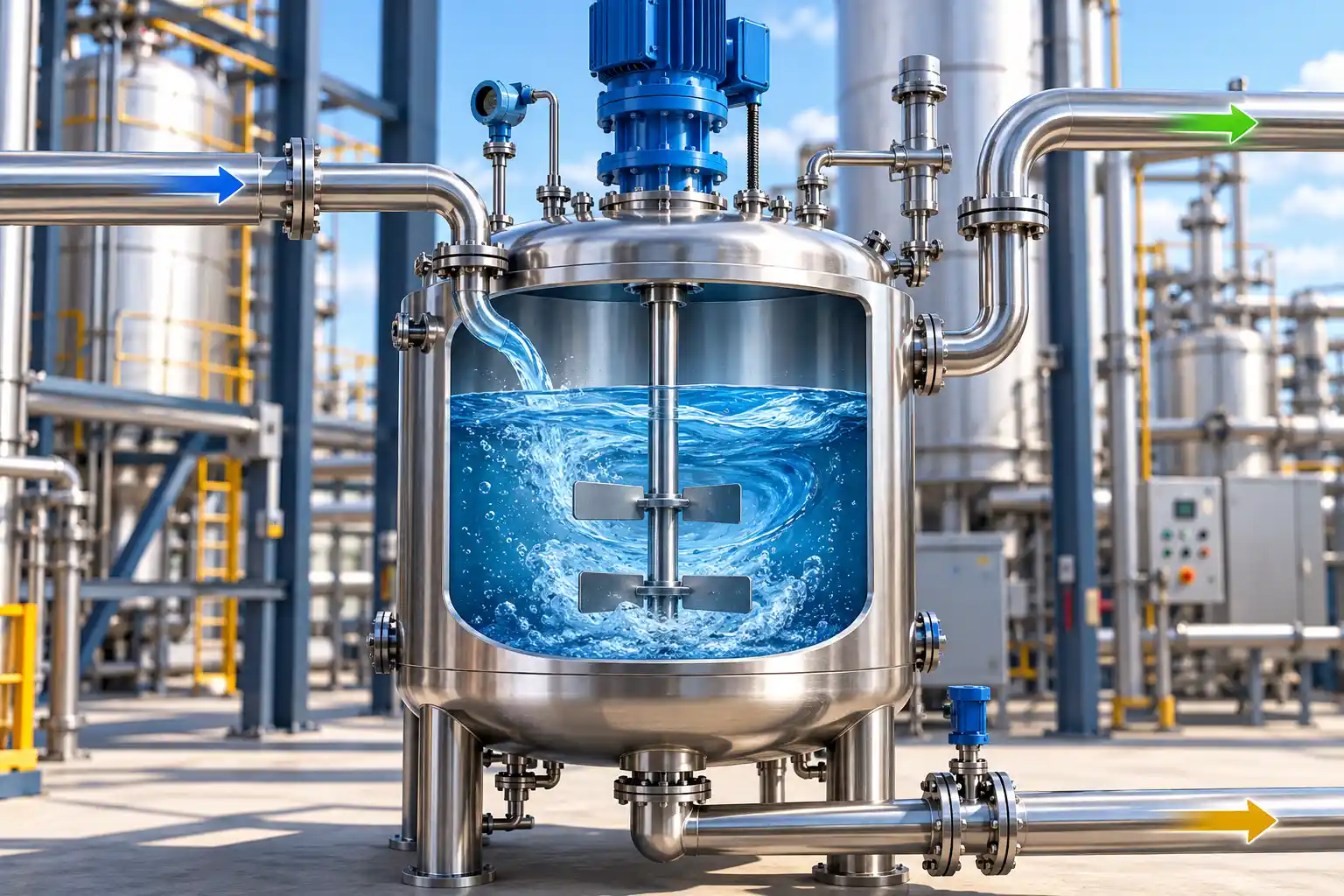
Simple CSTR Diagram (Mental Schematic)
For a clear visual understanding, imagine a large cylindrical tank. At the top, Pipe A and Pipe B constantly drip raw materials into the fluid. Down the direct center of the tank is a metal shaft with fan-like blades (the impeller) spinning rapidly. The walls of the tank are double-layered (the cooling jacket) with cold water flowing between the layers to absorb excess heat. At the very bottom of the tank, Pipe C continuously drains the perfectly mixed, finished chemical product.
Crucial Operational Parameters
To get the most out of a continuous stirred tank reactor, operators must closely monitor and optimize three main parameters.
1. Temperature Control and Heat Transfer
Because the concentration of reactants is uniform throughout a CSTR, the rate of reaction is also uniform across the entire tank. If a reaction is highly exothermic, heat is generated constantly throughout the entire volume of the liquid. The heat transfer system must be highly efficient. If temperature control fails, it can lead to a “thermal runaway” a dangerous situation where the reaction accelerates uncontrollably due to excessive heat.
2. Agitation Quality
The phrase “perfectly mixed” is a theoretical ideal used in chemical-engineering literature. In reality, achieving near-perfect mixing requires careful calculation of the agitator’s RPM (revolutions per minute) and power draw. If the mixture is too thick (high viscosity), standard impellers may fail to mix the edges of the tank, creating “dead zones” where no reaction takes place.
3. Flow Rate and Reaction Kinetics
Because the tank is perfectly mixed, incoming reactants are immediately diluted by the product already inside the tank. This means a CSTR naturally operates at the lowest concentration of reactants. Because chemical reaction speeds generally slow down as reactant concentration drops, CSTRs require larger tank volumes to achieve the same chemical conversion rates as other reactor types.
Reactor Comparison: CSTR vs. Batch vs. Plug Flow Reactor
Process engineers generally choose between three main types of reactors. Understanding how a CSTR compares to a Batch Reactor and a Plug Flow Reactor (PFR) helps clarify its ideal use cases in industrial manufacturing.
CSTR vs Batch Reactor
A batch reactor is like baking a cake: you put all your ingredients into a pan, close the oven, wait for it to bake, and then take it out. A CSTR, on the other hand, is like an assembly line. While batch reactors are great for making small, varied, or highly specialized batches of chemicals (like specialty pharmaceuticals), they suffer from significant downtime (filling, heating, cooling, emptying, and cleaning). A CSTR eliminates this downtime entirely, making it infinitely better for large-scale, 24/7 continuous production.
CSTR vs Plug Flow Reactor (PFR)
A Plug Flow Reactor (PFR) is essentially a long, continuous pipe. Reactants are pumped in one end, and they react as they travel down the length of the pipe, exiting as a finished product at the other end. There is no active agitator in a PFR. PFRs are highly efficient and offer better chemical conversion rates per volume than CSTRs. However, temperature control in a PFR is incredibly difficult. CSTRs are heavily preferred when a reaction requires strict, uniform temperature control, or when liquids contain solid particles that need to be actively suspended.
Reactor Comparison Table
| Feature | CSTR (Stirred Tank) | Batch Reactor | PFR (Plug Flow) |
|---|---|---|---|
| Operating Mode | Continuous | Intermittent (Start/Stop) | Continuous |
| Mixing Quality | Excellent (Active Agitation) | Excellent (Active Agitation) | Variable (Relies on fluid flow) |
| Production Scale | High Volume | Low to Medium Volume | High Volume |
| Temperature Control | Excellent | Good | Poor / Difficult |
| Operational Downtime | Very Low | High | Very Low |
| Conversion per Volume | Low (Requires larger volume) | Requires time rather than volume | High (Smaller volume needed) |
| Best Used For | Liquid-phase reactions, steady output | Specialty chemicals, flexible runs | Fast reactions, gas-phase reactions |
Advantages of the Stirred Tank Reactor
Why do process engineers specifically seek out CSTR process equipment? The advantages are numerous for industrial-scale operations:
- Consistent Product Quality: Because the system operates at a steady state, the chemical makeup of the output never wavers, ensuring uniform product quality day in and day out.
- Exceptional Temperature Control: The continuous active mixing ensures there are no localized hot spots. Heat is uniformly transferred to the cooling jackets, making CSTRs incredibly safe for volatile or highly exothermic reactions.
- Low Operating and Labor Costs: Once a CSTR is up and running, it requires minimal human intervention. It can run for weeks or months at a time, drastically reducing labor costs compared to batch processing.
- Ease of Cleaning and Automation: With self-cleaning (CIP) systems and advanced sensor arrays, a CSTR is easily integrated into a fully automated modern smart-factory setup.
- Easy to Access and Maintain: The open tank design allows easy access to the interior for maintenance, internal inspection, and the installation of pH or temperature probes.
Limitations of Continuous Reactors
No piece of chemical processing equipment is perfect for every single scenario. The CSTR has some notable drawbacks that engineers must account for:
- Lower Conversion Efficiency per Volume: Because incoming raw materials are immediately diluted by the finished product already in the tank, the reaction’s driving force is reduced. Therefore, a CSTR must be significantly larger than a PFR to achieve the same amount of chemical conversion.
- Risk of Bypassing: If the inlet and outlet ports are not perfectly positioned, a fraction of the raw materials might accidentally exit the tank before they have had time to react. This phenomenon is known as “short-circuiting.”
- Not Ideal for Slow Reactions: If a chemical reaction is very slow, it requires a massive residence time. In a continuous flow scenario, achieving this would require an uneconomically huge tank.
- High Initial Capital Cost: Heavy-duty agitators, baffles, specialized cooling jackets, and continuous pump systems make the initial setup and design of a CSTR expensive compared to simpler vessels.
Common CSTR Applications
Due to their reliability, CSTR applications span across nearly every sector of the chemical, petrochemical, and biochemical industries. Common real-world applications include:
- Wastewater Treatment: CSTRs are frequently used in environmental engineering. Activated sludge processes and anaerobic digesters use CSTR principles to continuously mix and treat municipal and industrial wastewater.
- Fermentation and Bioreactors: In the pharmaceutical and food/beverage industries, biological organisms (like yeast or bacteria) require constant food, strict temperature control, and homogeneous mixing. CSTR bioreactors are perfect for continuous fermentation.
- Polymerization: The creation of plastics and synthetic polymers requires exact temperature control to ensure the polymer chains grow uniformly. CSTRs are heavily utilized throughout the plastics industry.
- Industrial Chemical Synthesis: Bulk commodity chemicals, such as ammonia, various acids, and agricultural fertilizers, are produced using massive CSTR networks. (Note: Often, engineers connect multiple CSTRs in a series to overcome the low conversion rate of a single tank, combining the benefits of a CSTR with the high conversion rates of a PFR).
Conclusion: Optimizing Your Chemical Process Equipment
Choosing the right reactor requires a deep understanding of fluid dynamics, reaction kinetics, and mechanical engineering. The continuous stirred tank reactor (CSTR) remains one of the most versatile, reliable, and crucial pieces of chemical process equipment in the industrial world today.
By offering unmatched temperature control, steady-state continuous production, and highly efficient homogeneous mixing, the CSTR working principle allows manufacturers to scale up production safely and profitably. Whether you are transitioning your plant from batch reactors to continuous operations, or looking to optimize a multi-reactor setup, understanding the engineering behind the CSTR is your first step toward process excellence.
At Mekantra Technologies, we are dedicated to providing cutting-edge insights and solutions for your process technology needs. By leveraging the right chemical processing equipment from CSTRs to advanced automation instrumentation you can ensure maximum efficiency, safety, and profitability for your plant operations.
Are you looking to upgrade your chemical processing systems or seeking expert guidance on process technology? Explore our extensive resources at Mekantra Technologies to find the right equipment and engineering solutions tailored to your unique industrial applications.

Mekantra Engineering Team
The technical voice of Mekantra. Our team consists of sourcing specialists, mechanical engineers, and logistics experts dedicated to providing transparent insights and high-performance solutions for the global manufacturing sector.
Mekantra Engineering Team
The technical voice of Mekantra. Our team consists of sourcing specialists, mechanical engineers, and logistics experts dedicated to providing transparent insights and high-performance solutions for the global manufacturing sector.