Crude Oil Desalting: Process, Types & Efficiency Tips
Summary
“Desalting sits between crude storage and the distillation unit for a reason: it’s cheaper to remove salt and water here than to repair corrosion damage later. This article covers the mechanics, design choices, and efficiency benchmarks.”
Crude oil arrives at a refinery carrying salts, water, and sediment picked up from the reservoir and transport chain. Left untreated, these impurities turn into hydrochloric acid at distillation temperatures, corroding towers, exchangers, and pipework. Desalting removes this risk before crude ever reaches the Crude Distillation Unit (CDU), making it one of the most important pretreatment steps in the entire refining process.
What Is Crude Oil Desalting and Why It Comes First
Desalting is the first major treatment step crude oil undergoes after storage and before it enters the CDU. The unit sits directly upstream of the distillation column, and its job is simple: strip out salts, free water, and suspended solids so the crude entering the tower is as clean as possible.
Refineries place desalting here for a practical reason. It is far cheaper to remove salt and water at this stage than to repair corrosion damage in the distillation column, overhead system, or downstream exchangers later. A properly desalted feed also improves heat transfer efficiency and reduces fouling across the unit.
What’s Actually in Crude Oil That Needs Removing
Crude oil rarely arrives clean. It carries a mix of dissolved salts, emulsified water, and fine sediment, most of it originating from the formation water trapped alongside the oil reservoir.
| Impurity | Typical Source | Risk if Not Removed |
|---|---|---|
| Sodium chloride (NaCl) | Formation water | Hydrochloric acid formation, fouling |
| Calcium chloride (CaCl2) | Formation water | Scale buildup, corrosion |
| Magnesium chloride (MgCl2) | Formation water | Hydrolyzes readily, worst corrosion offender |
| Free/emulsified water | Reservoir, transport | Reduces heat transfer, adds to salt load |
| Sediment/sludge | Wellhead, storage | Fouling, tower plugging |
Of these three chloride salts, magnesium chloride is the most reactive. It hydrolyzes at lower temperatures than sodium or calcium chloride, releasing hydrochloric acid earlier in the heating process and making it the primary driver of overhead corrosion if desalting is incomplete.
How the Desalting Process Works, Step by Step
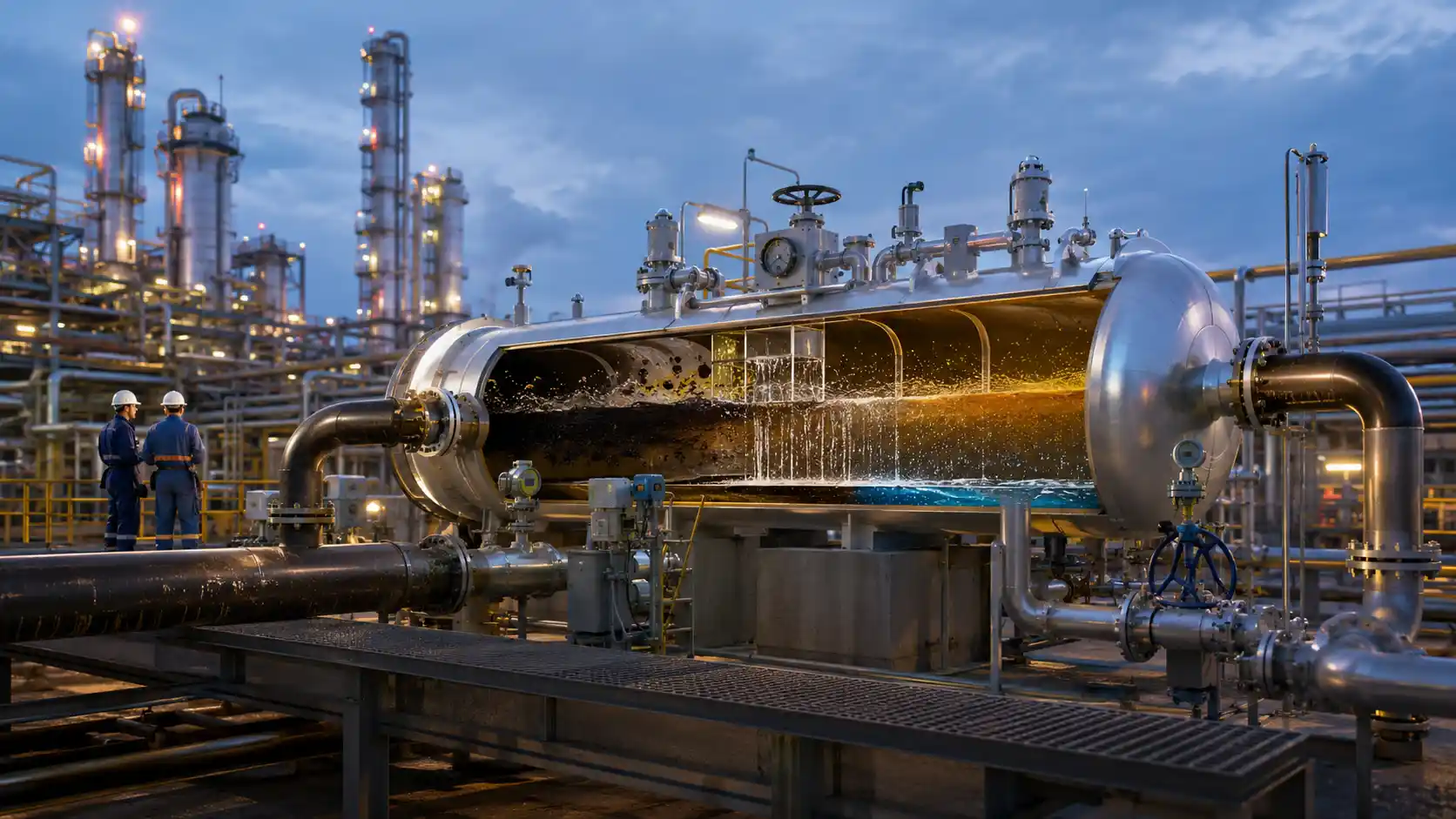
The desalting process combines mechanical mixing with an electric field to separate water and salts from the crude oil. The sequence typically runs as follows:
- Crude preheating. Crude is heated to 120–150°C to reduce viscosity and improve water-oil separation.
- Wash water injection. Fresh or recycled wash water is injected into the crude stream, usually at 3–10% of crude volume, to dilute salt concentration.
- Mixing at the mix valve. Crude and wash water pass through a mix valve that creates controlled turbulence, dispersing water into fine droplets so it contacts dissolved salts.
- Emulsion formation. The mixing creates a temporary water-in-oil emulsion, with salts now dissolved into the water droplets rather than the oil.
- Electrostatic coalescing. Inside the desalter vessel, an AC/DC electrostatic field is applied across grids or electrodes. The field forces small water droplets to collide and merge into larger droplets.
- Gravity separation. Once large enough, the water droplets settle by gravity to the bottom of the vessel, separating cleanly from the lighter crude oil above.
- Brine and sludge draw-off. The salt-laden water (brine) is drawn off from the bottom, along with accumulated sludge, and routed to wastewater treatment.
- Desalted crude outlet. Treated crude, now with significantly reduced salt and water content, exits the top of the vessel toward the CDU.
Interface level control between the oil and water layers is critical throughout this process. If the interface rises too high, water can carry over into the desalted crude outlet; if it drops too low, oil can be lost into the brine stream.
Single-Stage, Two-Stage, and Three-Stage Desalters
Not all crude requires the same level of treatment. Refineries choose desalter configurations based on the salinity and water content of the crude they process.
| Type | Salt Removal Efficiency | Typical Use Case | Relative Cost |
|---|---|---|---|
| Single-stage | 90–95% | Lower-salinity crude, simpler refineries | Lower |
| Two-stage | 95–99% | Most modern refineries, variable crude sources | Moderate |
| Three-stage | 99%+ | Heavy or high-salinity opportunity crudes | Higher |
Single-stage desalters run the crude through one mixing and separation cycle. This works well for lighter, lower-salinity crudes but often falls short when refiners switch to heavier or more variable feedstocks.
Two-stage desalters repeat the wash water injection and electrostatic separation twice, using fresh wash water in the second stage. This configuration has become the industry standard because it handles a wider range of crude qualities without major redesign.
Three-stage desalters add a third wash cycle and are typically reserved for very heavy or high-salinity opportunity crudes, where a single or double wash cannot bring salt content down to acceptable levels.
Key Equipment and Design Considerations
Desalter performance depends heavily on the equipment specification, not just the process steps. A few design factors matter most:
- Vessel material. Desalter vessels are typically carbon steel with a corrosion allowance, sometimes with cladding or overlay in high-chloride service to resist localized corrosion.
- Electrostatic transformer and grid design. The transformer supplies the AC/DC field; grid spacing and voltage affect droplet coalescing efficiency and must be matched to crude viscosity and water cut.
- Mix valve pressure drop. Too little pressure drop under-mixes the wash water; too much creates a tight emulsion that’s difficult to break in the vessel.
- Interface level instrumentation. Reliable level control (capacitance or displacer-type) prevents water carryover and oil loss.
- Mud wash system. Nozzles at the vessel bottom periodically resuspend and flush accumulated sludge, preventing dead zones that reduce effective vessel volume over time.
Because desalters operate continuously with corrosive brine at the vessel bottom, material selection and periodic inspection matter as much as the electrostatic design itself.
Corrosion and Fouling Risks From Poor Desalting
When desalting underperforms, the consequences show up downstream, not in the desalter itself. Residual chlorides carried into the CDU hydrolyze at distillation temperatures, forming hydrochloric acid. This acid concentrates in the tower’s overhead system, where it condenses and attacks carbon steel piping, exchangers, and condensers a problem refiners commonly refer to as overhead corrosion.
Chloride stress corrosion cracking is a related risk, particularly in stainless steel components exposed to chloride-laden water at elevated temperatures. Poor desalting also increases fouling rates in preheat exchangers, since suspended solids and unremoved salts deposit on heat transfer surfaces, gradually reducing exchanger efficiency and increasing energy costs.
This is why desalter reliability is treated as a corrosion-prevention measure as much as a separation process the equipment and material choices made here directly affect the lifespan of everything downstream.
Desalter Efficiency and Performance Benchmarks
Desalter performance is usually tracked using outlet salt content, measured in pounds per thousand barrels (PTB) or parts per million (ppm). Most refiners target an outlet salt content below 1–3 PTB, though the acceptable threshold depends on the crude’s initial salinity and the refinery’s corrosion tolerance.
Efficiency is calculated as the percentage reduction from inlet to outlet salt content. A well-operating two-stage desalter should consistently deliver 95–99% removal efficiency. Performance below this range usually points to one of a few root causes: insufficient wash water ratio, poor mix valve pressure drop, degraded electrostatic grid performance, or interface level control issues.
| Stage Configuration | Typical Inlet Salt (PTB) | Typical Outlet Salt (PTB) | Efficiency |
|---|---|---|---|
| Single-stage | 10–20 | 1–2 | 90–95% |
| Two-stage | 10–20 | 0.2–1 | 95–99% |
| Three-stage | 20–40 (opportunity crude) | <0.2 | 99%+ |
Tracking this data over time, rather than checking it only during commissioning, is what allows plant teams to catch gradual efficiency drops before they turn into corrosion incidents.
Maintenance and Operational Best Practices
Consistent desalter performance depends on a few operational habits:
- Maintain wash water ratio. Running below the design wash water percentage is one of the most common causes of poor salt removal.
- Monitor demulsifier dosing. Demulsifier chemicals help break the water-in-oil emulsion cleanly; incorrect dosing leads to either poor separation or excess water carryover.
- Check mud accumulation regularly. Sludge buildup at the vessel bottom reduces effective residence time and can interfere with interface level readings.
- Inspect electrostatic grids periodically. Grid fouling or electrical faults reduce coalescing efficiency even when other parameters look normal.
- Track outlet salt content continuously. Regular sampling catches drift in performance before it affects the CDU.
Where Desalting Fits in the Bigger Picture
Desalting is the first line of defense in protecting a refinery’s distillation assets from chloride-driven corrosion. Getting the process right the correct wash water ratio, the right stage configuration for the crude slate, and reliable interface control reduces maintenance costs and extends equipment life across the entire unit.
FAQs
What is crude oil desalting in a refinery?
Crude oil desalting is a refinery pretreatment process that removes salts, water, and suspended solids from crude oil before it enters the Crude Distillation Unit. This step helps protect refinery equipment from corrosion, fouling, and reduced heat transfer efficiency.
Why is desalting important before crude distillation?
Desalting is important before crude distillation because chloride salts in crude oil can form hydrochloric acid at high temperatures. If these salts are not removed early, they can damage distillation towers, overhead systems, condensers, exchangers, and piping.
What salts are removed during the crude oil desalting process?
The crude oil desalting process mainly removes sodium chloride, calcium chloride, and magnesium chloride. Magnesium chloride is especially harmful because it hydrolyzes more easily and can contribute strongly to overhead corrosion in refinery units.
What is the typical salt removal efficiency of a crude oil desalter?
A single-stage desalter can typically remove around 90–95% of salts, while a two-stage desalter can usually reach 95–99% removal efficiency. For heavy or high-salinity crude oils, three-stage desalting may achieve even higher salt removal performance.
How can refineries improve crude desalter performance?
Refineries can improve crude desalter performance by maintaining the right wash water ratio, controlling mix valve pressure drop, using proper demulsifier dosing, monitoring interface levels, removing sludge buildup, and regularly testing outlet salt content.

Mekantra Engineering Team
The technical voice of Mekantra. Our team consists of sourcing specialists, mechanical engineers, and logistics experts dedicated to providing transparent insights and high-performance solutions for the global manufacturing sector.
Mekantra Engineering Team
The technical voice of Mekantra. Our team consists of sourcing specialists, mechanical engineers, and logistics experts dedicated to providing transparent insights and high-performance solutions for the global manufacturing sector.