Heavy Equipment Guide for Large Construction Projects
Summary
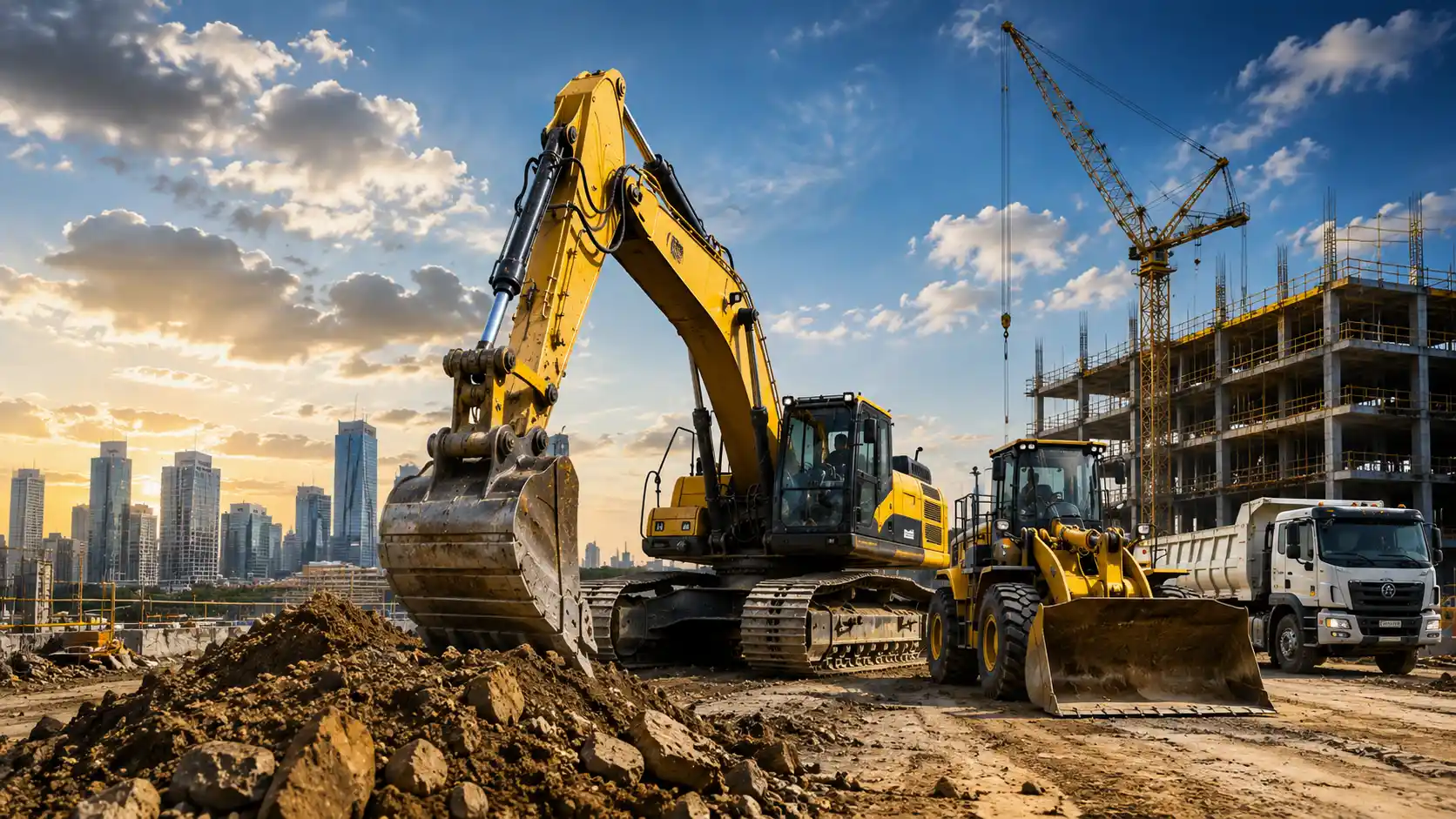
Large construction projects rely on specialized heavy equipment to move earth, lift materials, and keep timelines on track. This guide breaks down every machine category, from excavators and bulldozers to cranes and dump trucks, with specifications and selection criteria that help procurement teams make informed decisions.
Global construction activity is surging. Megaprojects in data center infrastructure, renewable energy, and semiconductor manufacturing are driving demand for heavy equipment at a scale the industry has not seen in decades. The U.S. heavy-duty construction equipment market alone is valued at approximately $87.9 million in 2026, growing at 6.0% CAGR through 2033.
For procurement teams, selecting the right construction vehicles and industrial machines directly shapes project timelines, operating costs, and site safety. The wrong equipment mix leads to bottlenecks. The right one keeps production moving.
What Qualifies as Heavy Equipment in Construction?
Heavy equipment refers to large, powered machines designed for earthmoving, lifting, hauling, compaction, and grading tasks that manual labor or light tools cannot handle. These machines typically exceed 10 to 20 tons in operating weight and are built for continuous operation under demanding conditions.
Compact machines like skid steers and mini excavators serve residential and small commercial projects. Large construction equipment, including full-size excavators, bulldozers, crawler cranes, and motor graders, is engineered for high-volume output on infrastructure, mining, and energy projects.
Most heavy machinery runs on diesel engines, though hybrid and electric powertrains are entering the market. These machines rely on hydraulic systems to power arms, blades, buckets, and lifting mechanisms. Their undercarriages (tracked or wheeled) handle rough terrain, heavy loads, and extended work cycles.
Essential Heavy Equipment Categories for Large Projects
Every large project site requires a coordinated fleet of construction equipment. The following sections cover each major machine category, its primary function, specifications, and the project types where it delivers the most value.
1. Excavators
Hydraulic excavators are the most widely used heavy equipment on construction sites. They feature a 360-degree rotating upper structure mounted on a tracked or wheeled undercarriage, connected to a hydraulic arm with an interchangeable attachment at the end.
For large projects, excavators in the 20 to 90-ton range handle the majority of digging, trenching, and demolition work. The hydraulic arm provides variable reach and digging depth, while the swing radius allows operators to load trucks without repositioning the machine.
Attachments extend the excavator’s versatility beyond standard bucket work. Breakers handle demolition, augers drill foundation piles, and grapples manage debris. Key specs include bucket capacity (cubic yards), maximum digging depth, swing speed, and crawler track width. Leading manufacturers include Caterpillar, Komatsu, Hitachi, and Volvo CE.
2. Bulldozers
Bulldozers are tracked machines equipped with a heavy front-mounted blade designed for pushing large volumes of soil, rock, and debris. They are the primary machines for land clearing, rough grading, and site preparation before vertical construction begins.
Blade configuration determines capability. Straight blades (S-blade) work for fine grading and short-distance pushing. Universal blades (U-blade) carry larger loads over longer distances. Semi-U blades offer versatility for general earthwork.
Modern bulldozers integrate GPS-guided grade control systems that allow operators to cut and fill to precise elevations without manual staking, reducing rework and shortening grading timelines. For large projects, dozers in the 15 to 70-ton class deliver the drawbar pull needed to move serious volume.
3. Wheel Loaders
Wheel loaders are front-loading machines built for scooping, carrying, and dumping loose materials such as soil, gravel, sand, and crushed stone. On large sites, they serve as the primary link between excavation zones and haul trucks.
Articulated steering allows tight turning in confined spaces, and rubber tires give them faster travel speeds than tracked machines. Bucket capacity for large project loaders ranges from 3 to 10+ cubic yards, with breakout forces engineered to penetrate compacted material banks.
Tracked loaders offer an alternative for soft or muddy ground where wheeled machines lose traction, though they sacrifice speed for stability. Key metrics include bucket capacity, payload rating, breakout force, and cycle time.
4. Cranes: Tower, Mobile, and Crawler
Cranes are the primary lifting machines on large construction sites, responsible for placing structural steel, precast concrete panels, and mechanical equipment. Three crane types dominate large-scale projects.
Tower cranes are fixed-position machines anchored to a concrete base or building structure. They provide consistent lifting capacity across a high-rise project, with capacities from 10 to 80 tons and jib lengths extending 50 to 80 meters.
Mobile cranes are truck-mounted and road-transportable, with capacities from 30 to 600 tons. Outriggers provide stability during lifts. They are common on bridge construction, plant shutdowns, and infrastructure projects.
Crawler cranes move on tracked undercarriages and operate on soft or uneven ground without outriggers. Lifting capacities reach up to 3,500 tons, handling wind turbine assembly, petrochemical vessel placement, and large bridge girder installation.
Crane Type Comparison
| Crane Type | Lifting Capacity | Best Use Case | Mobility |
|---|---|---|---|
| Tower Crane | 10 to 80 tons | High-rise, fixed-position lifts | Stationary |
| Mobile Crane | 30 to 600 tons | Flexible site lifts, road transport | High |
| Crawler Crane | 50 to 3,500 tons | Heavy lifts on soft ground | Low to Medium |
Key specifications across all crane types include maximum lifting capacity (at minimum and maximum radius), boom length, counterweight configuration, and load chart compliance.
5. Dump Trucks and Articulated Haulers
Hauling machines move excavated earth, aggregate, and fill between digging zones, stockpiles, and disposal areas. Hauling efficiency directly affects overall production because excavators and loaders can only work as fast as trucks can cycle through.
Rigid dump trucks operate on stable haul roads with payloads ranging from 25 to 400 tons. Their fixed-frame design provides speed on flat ground but limits maneuverability on rough terrain.
Articulated dump trucks (ADTs) feature a pivot joint between cab and dump body, allowing navigation of steep grades, soft ground, and tight curves. ADT payloads typically range from 25 to 45 tons, making them the standard for earthmoving on variable terrain. Key planning metrics include payload capacity, haul distance, and average cycle time.
6. Motor Graders
Motor graders are precision machines used for fine grading, road base preparation, slope shaping, and ditch cutting. Unlike bulldozers that push bulk material, graders use a long, adjustable moldboard mounted between the front and rear axles to spread thin layers of material with high accuracy.
The moldboard can be angled, tilted, and shifted to create crowned road surfaces, drainage slopes, and uniform base layers. A scarifier attachment rips compacted surfaces before grading. Modern graders support GPS and laser-guided systems for automated grade control. Graders in the 13 to 25-ton range handle most large-scale road and site finishing work.
7. Compaction Equipment: Rollers and Compactors
Compaction equipment presses soil, gravel, and asphalt to the required density for foundations, road bases, and paved surfaces. Without proper compaction, settled ground causes cracking and structural failure.
Vibratory rollers use static weight plus high-frequency vibration to compact granular soils and asphalt. Smooth drum rollers handle asphalt and gravel, while padfoot (sheepsfoot) rollers compact cohesive clay soils by concentrating pressure through protruding feet.
Compaction results are verified through density testing (Proctor test). Different soil types require different compactor types, so matching the roller to the material is critical. Key specs include static weight, centrifugal force, and drum width.
8. Concrete Equipment: Mixers, Pumps, and Batching Plants
Large projects consuming high volumes of concrete often require dedicated on-site equipment beyond standard ready-mix delivery.
Transit mixers transport pre-batched concrete with drum capacities from 6 to 12 cubic meters. Concrete pumps (boom and line pumps) place concrete at height or across long distances, with boom reach extending 60+ meters on larger units.
For sustained high-volume pours like dam construction or high-rise cores, on-site batching plants provide continuous supply without dependency on external delivery schedules, giving the contractor full control over mix design and pour timing.
Heavy Equipment Comparison at a Glance
| Equipment Type | Primary Function | Weight Range | Typical Use Cases |
|---|---|---|---|
| Excavator | Digging, demolition, material handling | 20 to 90 tons | Foundations, trenching, dredging |
| Bulldozer | Pushing, grading, land clearing | 15 to 70 tons | Site prep, rough grading, clearing |
| Wheel Loader | Loading, hauling, stockpiling | 12 to 55 tons | Aggregate handling, truck loading |
| Tower Crane | Vertical lifting | N/A (fixed) | High-rise steel/concrete placement |
| Mobile Crane | Flexible lifting | 30 to 600 tons | General lifts, infrastructure |
| Crawler Crane | Heavy lifting, soft ground | 50 to 3,500 tons | Bridge, wind turbine assembly |
| Dump Truck / ADT | Material hauling | 25 to 400 tons | Earthmoving, aggregate transport |
| Motor Grader | Fine grading, road prep | 13 to 25 tons | Road construction, final grading |
| Vibratory Roller | Soil/asphalt compaction | 7 to 25 tons | Road base, structural fill |
| Concrete Pump | Concrete placement | Varies | High-rise pours, slab placement |
How to Select the Right Heavy Equipment for Your Project
Matching machines to project requirements is a procurement decision that affects cost, schedule, and risk. Here are the six primary factors that drive equipment selection.
Project scope and scale define the starting point. Calculate the total volume of earth to move and loads to lift. Overspecifying wastes capital. Underspecifying causes production bottlenecks.
Terrain and ground conditions determine whether tracked or wheeled machines are appropriate. Soft, wet ground requires tracks for stability. Stable haul roads favor wheeled machines for speed and lower operating cost.
Timeline and productivity targets translate into capacity requirements. Higher-capacity machines reduce cycle times but cost more per hour. Calculate cost per cubic yard moved to find the efficient balance.
Buy vs. rent analysis is increasingly relevant. The rental segment leads the U.S. heavy equipment market in 2026 due to cost-effectiveness and flexibility. For single-project machines, renting preserves cash and eliminates long-term maintenance liability.
Technology and automation features like GPS grading, telematics, and predictive maintenance reduce operator dependence and improve accuracy across dispersed worksites.
Compliance and safety requirements, including emissions standards and OSHA regulations, must factor into every decision. Non-compliant machines cannot operate on regulated sites.
Equipment Selection Criteria
| Selection Factor | What to Evaluate |
|---|---|
| Project Volume | Total cubic yards of earth, tons of material to move |
| Ground Conditions | Soil type, slope grade, water table level |
| Lift Requirements | Maximum weight, height, and reach needed |
| Haul Distance | One-way distance from dig to dump or stockpile |
| Fleet Utilization | Target 60 to 70% utilization before buying |
| Technology Needs | GPS, telematics, autonomous features |
Fleet Planning Tips for Large-Scale Projects
Smart contractors in 2026 are adopting a hybrid fleet strategy: own core machines used daily, rent for peak demand periods, and make strategic used equipment purchases for long-duration projects where immediate availability matters.
The industry rule of thumb is the 60 to 70% utilization threshold. If a machine will be utilized above 65% over 12 months, ownership typically costs less than continuous rental. Below that threshold, renting keeps the balance sheet lighter.
Telematics and fleet management software are now essential for multi-site operations, tracking equipment hours, fuel consumption, idle time, and maintenance schedules in real time. For total cost of ownership, factor in acquisition cost, financing, insurance, maintenance, fuel, operator labor, and residual value at disposal.
Conclusion
Large construction projects demand a coordinated fleet of heavy equipment, and every machine on site should earn its place through measurable productivity. The equipment you select defines what your project can achieve on schedule and within budget.
Mekantra Technologies simplifies equipment sourcing by working directly with verified manufacturers, conducting on-site technical inspections, and managing global logistics from factory to project site. If you are planning a large-scale build, request a quote to discuss your requirements.
For mechanical machinery, vehicle spare parts, and other industrial equipment needs, explore the full product range at Mekantra Technologies.

Mekantra Engineering Team
The technical voice of Mekantra. Our team consists of sourcing specialists, mechanical engineers, and logistics experts dedicated to providing transparent insights and high-performance solutions for the global manufacturing sector.
Mekantra Engineering Team
The technical voice of Mekantra. Our team consists of sourcing specialists, mechanical engineers, and logistics experts dedicated to providing transparent insights and high-performance solutions for the global manufacturing sector.