New vs Used Excavator: Which Is the Better Investment?
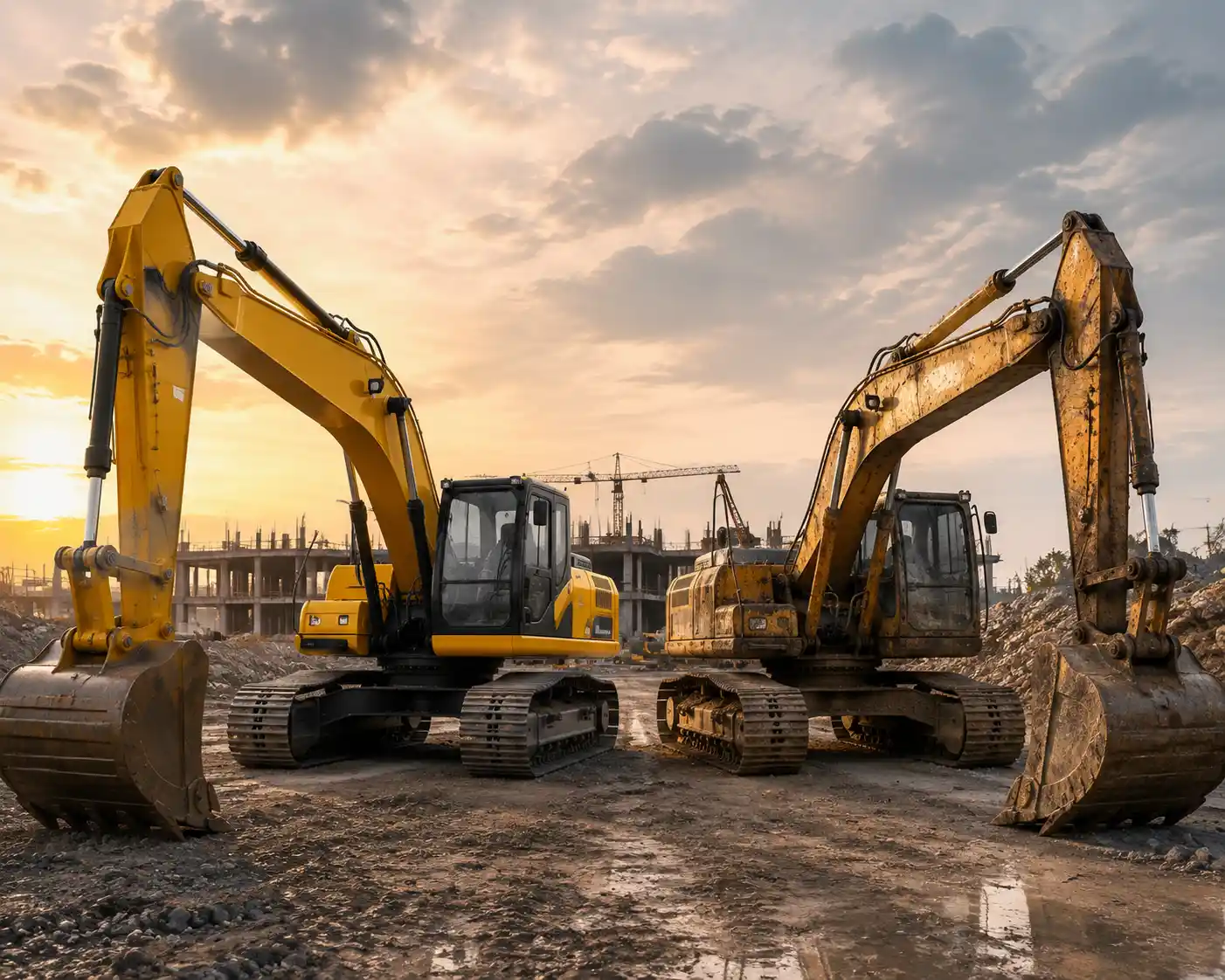
When expanding your heavy machinery fleet, one decision directly dictates your profit margins for years to come: Should I buy a new or used excavator?
At first glance, the decision seems simple. A pre-owned machine frees up capital immediately, saving anywhere from $60,000 to $150,000 on purchase price. However, experienced fleet managers know that purchase price represents less than 35% of a machine’s lifecycle expenses. When does paying less for a used machine actually cost more in the long run?
To make an informed capital investment, contractors across the United States must evaluate the complete financial lifecycle—balancing upfront capital expenditure against operating costs, component degradation, fuel burn, and job site downtime risk.
Whether you are scaling up your general earthmoving fleet or sourcing specialized Construction Machinery, this guide delivers a hard-data comparison of total cost of ownership, a 10-point technical inspection checklist, and an ROI evaluation framework designed to paste seamlessly into your content management system.
Total Cost of Ownership (TCO): The Real Financial Equation
To determine whether a new or used machine is the better investment, you must calculate Total Cost of Ownership across a standard 5-year (or 5,000-hour) operating cycle. TCO consists of two core buckets: Owning Costs and Operating Costs.
TCO Formula:
Total Cost of Ownership = (Purchase Price + Financing + Insurance - Resale Value) + (Fuel + Maintenance + Repairs + Downtime Losses)
5-Year TCO Comparison: 20-Ton Class Crawler Excavator (US Market Averages)
The financial table below illustrates a typical 20-ton earthmoving machine operating 1,000 hours per year over a 5-year period in the United States:
| Cost Factor | New 20-Ton Excavator | Used 20-Ton Excavator (4,000 Initial Hrs) | Financial Variance / Impact |
| Initial Purchase Price | $240,000 | $125,000 | Used saves $115,000 upfront |
| Financing Rate (Avg US APR) | 5.5% ($21,500 total interest) | 8.5% ($19,800 total interest) | New offers lower OEM interest rates |
| Warranty Coverage | 3-Year / 3,000-Hour Full OEM | None (or 90-Day Powertrain) | New eliminates unexpected repair bills |
| 5-Yr Maintenance & Service | $18,000 ($3.60/hr) | $32,000 ($6.40/hr) | Used requires earlier major overhauls |
| Unplanned Repairs & Wear Parts | $4,000 (Covered by Warranty) | $28,000 (Hydraulics, pins, undercarriage) | High financial variability for used units |
| Fuel Burn (5,000 hrs @ $3.80/gal) | $76,000 (8.0 gal/hr avg) | $89,300 (9.4 gal/hr avg) | New hydraulics save ~15% in fuel burn |
| Downtime Losses (Estimated) | $3,000 (50 hours total) | $18,000 (300 hours total) | Used machines carry higher job disruption risk |
| Estimated Resale Value (Year 5) | $110,000 (46% residual) | $55,000 (44% residual) | New retains higher nominal value |
| NET 5-YEAR TOTAL COST | $252,500 | $257,100 | New machine saves $4,600 net over 5 years |
Key Takeaway from the Financial Breakdown
While the pre-owned unit saved $115,000 on day one, higher fuel burn, increased repair bills, undercarriage wear, and lost job site productivity completely erased the initial price advantage by year five. However, if your annual usage is low (e.g., under 500 hours per year), the used machine remains significantly more economical.
10 Critical Factors to Calculate Before Buying
1. Purchase Price & Capital Allocation
A new standard crawler excavator ranges from $200,000 to $500,000+ depending on weight class and attachments, while used units typically sell for 40% to 70% of new retail price. If preserving working capital for payroll, bonding, or project mobilization is your top priority, buying used provides instant liquidity relief.
2. Machine Operating Hours (The Wear Tiers)
Hours on an excavator are equivalent to mileage on a commercial truck:
- 0 – 2,000 Hours (Low Wear): Prime condition. Minimal component degradation; performs like new.
- 2,000 – 5,000 Hours (Mid-Life): Expect initial undercarriage wear, pin bushing slack, and minor seal leaks.
- 6,000+ Hours (High Risk): Major hydraulic pump rebuilds, track replacement, and engine overhaul windows open.
3. Engine Condition & Emissions Tier Standards
Modern new excavators come equipped with Tier 4 Final or Stage V compliant engines featuring advanced Diesel Particulate Filters (DPF) and Selective Catalytic Reduction (SCR). Older used units (Tier 3 or early Tier 4 Interim) may lack these controls. While older engines avoid complex DEF systems, they face strict municipal emissions bans on major urban job sites across North America.
4. Hydraulic System Health & Efficiency
An excavator’s hydraulic pump and main control valve dictate digging power and cycle speed. Over time, heat and micro-particulate contamination degrade internal tolerances. A used machine with internal pump bypass can suffer a 10% to 20% loss in cycle speeds, resulting in fewer truck loads completed per shift.
5. Undercarriage Wear (The Hidden 50% Maintenance Expense)
The undercarriage—comprising track shoes, chains, bottom/top rollers, idlers, and sprockets—accounts for up to 50% of an excavator’s total lifetime repair costs. Replacing a full steel undercarriage on a 20-ton machine costs between $10,000 and $18,000. If a used excavator’s undercarriage is 75% worn, you must factor that replacement cost immediately into your purchase price.
6. Maintenance History & Fluid Analysis Reports
A used excavator with 5,000 hours and meticulous fluid sampling records (S·O·S oil analysis) is a safer investment than a 2,500-hour machine with missing service logs. Oil analysis reports reveal hidden engine bearing wear, hydraulic pump metal flakes, and coolant leaks long before mechanical failure occurs.
7. Fuel Consumption & Smart Hydraulics
New excavators integrate electro-hydraulic controls and auto-idle engines that reduce fuel consumption by 10% to 18% compared to models from a decade ago. At 1,000 operating hours per year and diesel priced at $3.80/gallon, an efficient new machine saves $2,500 to $4,000 annually in fuel alone.
8. Parts Availability & OEM Support
Buying a widely supported brand (such as Caterpillar, Komatsu, John Deere, or Volvo) ensures 24-hour spare parts availability across North America. Purchasing an obsolete or gray-market used machine can leave your crew stranded for weeks waiting for imported hydraulic seals or electronic control units (ECUs).
9. Downtime Risk & Project Schedule Penalties
For prime contractors on strict deadline contracts, equipment reliability is paramount. Unplanned downtime costs average $500 to $1,500 per day in idle labor, operator wages, and liquidated damages. New excavators backed by 24/7 dealer emergency support mitigate this operational risk.
10. Residual Value & Depreciation Curve
New excavators experience their steepest depreciation curve during the first 24 months, dropping 20% to 35% in value. Pre-owned excavators bought at year 3 or 4 have already absorbed this initial loss, allowing you to resell the equipment 3 years later with minimal capital loss.
Comparing Machinery Classes: When Size Alters the Decision
The decision to buy new versus pre-owned also depends heavily on the machine class you are deploying.
Compact & Mini Excavators vs. Heavy Crawler Machines
- Mini Excavators (< 6 Tons): Mini excavators feature lower initial purchase costs ($35,000 – $85,000 new). Because they are frequently used as secondary support units, buying used is often highly profitable. For a deeper breakdown of machine sizing, read our comparison on Mini Excavators vs Standard Excavators.
- Standard & Heavy Excavators (13 to 45+ Tons): High-production main diggers run continuously on large site development projects. Here, high fuel efficiency, factory telematics, and zero downtime make new equipment the preferred choice for primary earthmoving contractors.
For broader operational context across fleet categories, consult our general Heavy Equipment Guide or review utility options like Wheel Loaders vs Skid Steers.
Used Excavator Inspection Checklist (Field Guide)
Before signing a bill of sale or wiring funds for a pre-owned machine, send a certified technician to complete this 10-step inspection checklist:
Phase 1: Structural & Visual Walkaround
- Boom & Arm Structural Integrity: Inspect weld seams along the boom and stick for hairline tension cracks, stress fractures, or re-welded patch plates.
- Bucket & Attachment Wear: Check bucket teeth, side cutters, and quick-coupler locking pins for excessive play or severe metal loss.
- Carbody & Slewing Ring: Inspect the center swivel ring and house gear for gear tooth wear and grease contamination.
Phase 2: Undercarriage & Drive System
- Track Chain & Shoe Measurement: Measure bushing wear and pin enlargement. Check if the adjuster cylinder has reached max extension limit.
- Bottom Rollers & Idlers: Check for oil leaks around roller seals and feel for flat spots on rollers.
- Final Drive Motors: Check final drive gear oil levels and inspect motor covers for hydraulic oil leaks.
Phase 3: Engine & Hydraulics
- Engine Blow-By Test: Start the engine, remove the oil filler cap, and check for excessive crankcase pressure or smoke blow-by.
- Hydraulic Cylinder Rods: Inspect boom, arm, and bucket cylinder rods for pitting, deep scratches, or chrome peeling.
- Cycle Time & Drift Test: Raise the boom and bucket fully off the ground, shut off the engine, and measure vertical hydraulic drift over 10 minutes (excessive drift indicates leaking valve spools or cylinder seals).
Phase 4: Cabin & Electronics
- Telematics & Error Logs: Connect diagnostic software to pull historical active fault codes, engine over-temp alerts, and historical fuel consumption logs.
Decision Framework: Should You Buy New or Used?
To make WordPress publishing clean and simple, use this structured comparison matrix to determine which purchasing path fits your operational profile:
| Operating Parameter | Recommended Choice | Primary Financial & Operational Reason |
| Annual Usage: > 1,200 Hours/Yr | BUY NEW | High utilization maximizes fuel savings and warranty coverage benefits. |
| Annual Usage: < 800 Hours/Yr | BUY USED | Low usage avoids high initial depreciation while preserving capital. |
| Contract Type: Firm Deadlines / Penalties | BUY NEW | Eliminates unplanned downtime risk and guarantees 24/7 dealer support. |
| Project Type: Utility / Intermittent Support | BUY USED | Provides high ROI for non-continuous support tasks on job sites. |
| Capital Availability: Restricted Cash Flow | BUY USED | Reduces upfront equipment purchase costs by 30% to 50%. |
| Emissions Rules: Strictly Tier 4 Final Cities | BUY NEW | Avoids retrofitting older engines or facing job site compliance fines. |
Strategic Summary:
- Buy NEW if: Your machine is a primary production unit running daily shift work where fuel efficiency, zero downtime, and full OEM warranty coverage directly protect contract profitability.
- Buy USED if: The unit serves as a backup or specialized tool running low annual hours, allowing your business to preserve liquidity and avoid early depreciation losses.
Source Your Next Machine with Mekantra Technologies
Navigating the heavy equipment market requires balancing upfront costs with long-term reliability. Whether you are looking to invest in a brand-new high-production machine or require a certified, fully inspected pre-owned unit with verified service logs, Mekantra Technologies provides tailored sourcing solutions.
Our heavy equipment specialists help contractors across North America select, inspect, and finance the exact machinery class required for their project needs.
Ready to calculate the exact ROI for your upcoming project?
Request Technical Quote today to receive custom equipment specs, pricing, and lifecycle financial analysis.
FAQs
Is it better to buy a new or used excavator?
Buy new if you operate over 1,200 hours per year on primary production sites where warranty coverage, fuel efficiency, and zero downtime protect your profits. Buy used if annual usage is under 800 hours, or if preserving upfront cash flow is your main goal.
How many hours on a used excavator is considered high?
An excavator with over 6,000 to 8,000 operating hours is considered high-wear. At this threshold, major components such as hydraulic pumps, engine injectors, slewing rings, and track chains typically require expensive overhauls or complete replacement.
What are the most critical things to check on a used excavator?
Focus on undercarriage wear percentage, hydraulic cylinder drift and cycle speeds, boom/stick weld cracks, engine blow-by, and verified S·O·S oil analysis records to ensure internal components aren’t failing.
How much does a full excavator undercarriage replacement cost?
Replacing a full steel undercarriage (track chains, sprockets, bottom/top rollers, and front idlers) on a standard 20-ton excavator typically costs between $10,000 and $18,000 including labor.
Does a new excavator really save money on fuel compared to an older unit?
Yes. Modern excavators equipped with electro-hydraulic systems and Tier 4 Final engines are 10% to 18% more fuel-efficient, saving roughly $2,500 to $4,000 annually per 1,000 operating hours based on standard US diesel rates.

Mekantra Engineering Team
The technical voice of Mekantra. Our team consists of sourcing specialists, mechanical engineers, and logistics experts dedicated to providing transparent insights and high-performance solutions for the global manufacturing sector.
Mekantra Engineering Team
The technical voice of Mekantra. Our team consists of sourcing specialists, mechanical engineers, and logistics experts dedicated to providing transparent insights and high-performance solutions for the global manufacturing sector.