Cavitation Guide: Protecting Refinery Pump Reliability
Summary
“Cavitation occurs when low pressure inside a refinery pump creates vapor bubbles that collapse and damage the impeller, seals, and bearings. High temperatures, poor suction conditions, gas entry, and insufficient NPSH increase the risk. Common warning signs include rattling noise, vibration, unstable pressure, reduced flow, and impeller pitting. Maintaining a safe NPSH margin, improving suction piping, operating near the”
Most pump failures in a refinery don’t happen overnight. A centrifugal pump that suddenly starts rattling, vibrating, or losing flow has usually been struggling for weeks, sometimes months, before anyone noticed. Cavitation is one of the biggest reasons behind this slow-motion failure. It eats away at impellers and seals from the inside, and by the time it’s audible, the damage is already done. In high-pressure refinery service, where fluids often run close to their vapor pressure to begin with, the margin for error is thin. This piece walks through what actually causes cavitation, why refinery pumps see it more than most, and what to check before you end up pulling a pump apart. If you’re specifying new pumps or troubleshooting an existing fleet, Mekantra Technologies builds and supplies API 610-compliant pumps and valves designed with this exact problem in mind.
What Is Cavitation, Really
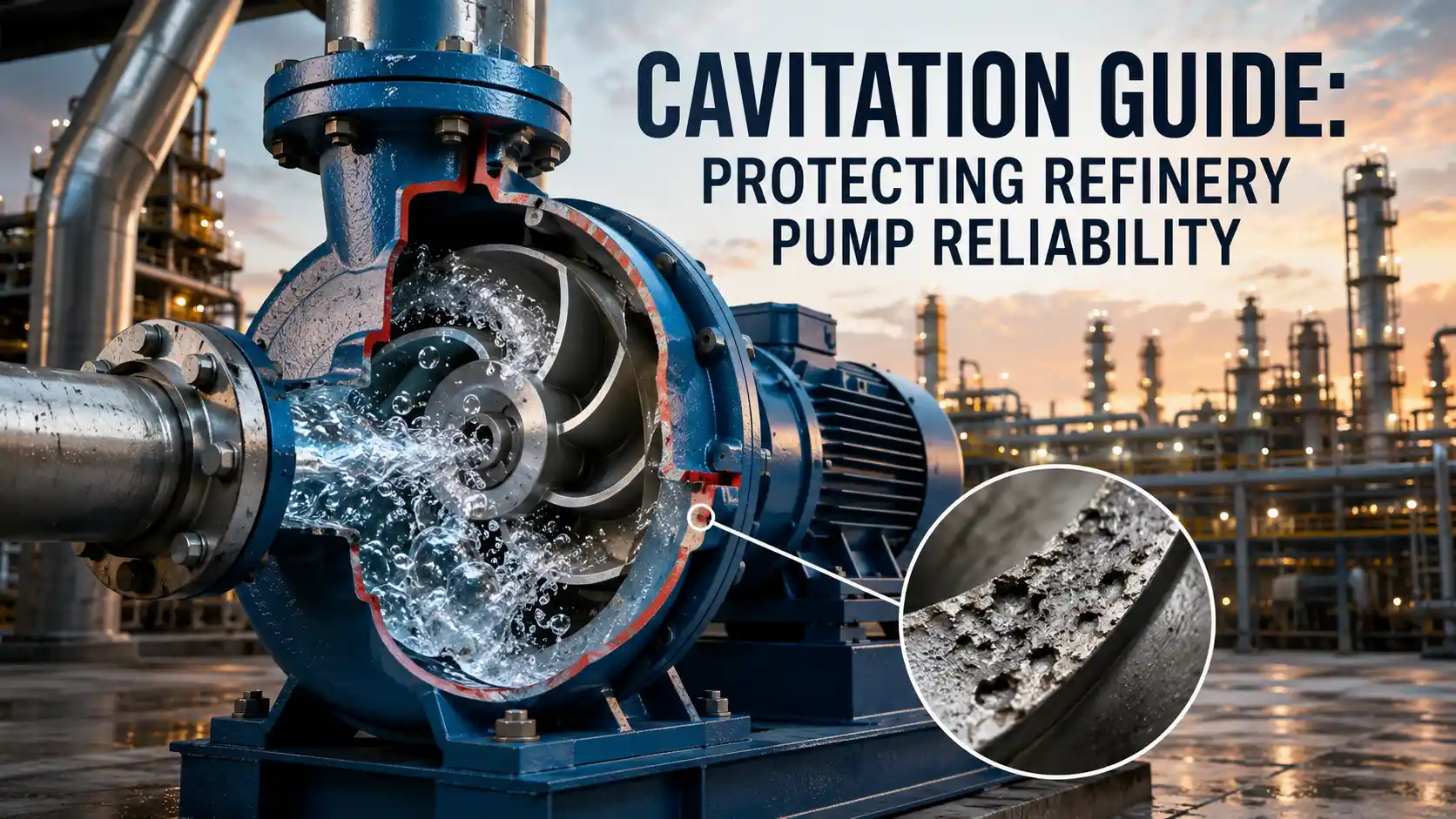
Here’s the short version: liquid moving through a pump impeller can hit a pressure point low enough that it briefly turns to vapor. Tiny bubbles form. A fraction of a second later, as the fluid reaches a higher-pressure zone, those bubbles collapse. Not gently, either. Each collapse sends out a microscopic shockwave that slams into the metal around it.
One bubble collapsing does nothing. But a pump running under cavitating conditions produces millions of these collapses per minute. Over time, that adds up to pitted, almost sponge-like erosion on the impeller vanes, usually near the inlet or along the low-pressure side of the blade. If you pull an impeller and see rounded, clustered pitting rather than the more even wear you’d get from sand or scale in the fluid, that’s cavitation. It’s a distinct signature, and recognizing it early saves a lot of guesswork during a teardown.
Why Refinery Pumps Are More Exposed
It comes down to how close refinery fluids run to their vapor pressure. That’s not a design flaw, it’s often unavoidable given the process. But it means the buffer between normal operation and cavitation is smaller than in, say, a water utility pump. A handful of conditions make this worse:
Flashing feed lines are a common culprit. A hot hydrocarbon stream can partially vaporize the moment it loses pressure across a control valve or a tight elbow just before the pump suction. Temperature plays a role too, as it climbs, vapor pressure climbs with it, and your NPSH margin shrinks even if nothing else on the suction side has changed. Then there’s the simple stuff: a suction valve that got left partially closed after the last maintenance shutdown, quietly adding pressure drop nobody accounted for. And upset conditions, a column level swinging, a compressor tripping, feed composition shifting, can push a pump past its safe window without any alarm going off first.
The tricky part is that these conditions come and go. A pump can run fine for a year and then start cavitating after what looks like a minor process tweak. That’s exactly why NPSH checks belong in routine reliability reviews, not just in the troubleshooting binder you pull out after something breaks. A pump commissioned five years ago with a healthy NPSH margin might have almost none left today, especially if a debottlenecking project quietly pushed flow rates up without anyone revisiting the suction piping.
NPSH Available vs. NPSH Required
Two numbers matter more than anything else in this conversation: NPSH available (NPSHa) and NPSH required (NPSHr). NPSHa belongs to the system, it’s a function of suction pressure, elevation, friction loss in the piping, and the vapor pressure of whatever you’re pumping at that temperature. NPSHr belongs to the pump, it’s measured by the manufacturer and shows up right on the pump curve. The moment NPSHa dips below NPSHr, you’re cavitating. API 610 and the Hydraulic Institute both call for a real safety margin here, not a razor-thin buffer, because actual operating conditions rarely match the design case exactly.
In practice: NPSHa depends on the system, suction pressure, elevation, pipe friction losses, and fluid vapor pressure, while NPSHr is fixed by the pump manufacturer and published on the pump curve. API 610 calls for NPSHa to exceed NPSHr with a real safety margin, not just a hair’s width, because cavitation begins the moment NPSHa drops below NPSHr.
One thing worth flagging: don’t just check NPSH margin at the design flow point and call it done. A lot of pumps cavitate at flows well off their best efficiency point (BEP), where internal flow gets turbulent and local pressure dips are harder to predict from a spec sheet. Look at the margin across the whole operating range the pump actually sees, not just the number stamped on the datasheet.
How Cavitation Shows Up Before It Breaks Something
Cavitation rarely gives you one clean signal. It’s usually a combination, a rattling, almost gravel-like noise from the casing as bubbles collapse near the impeller; discharge pressure that won’t hold steady even though upstream conditions look fine; vibration that creeps up at frequencies tied to vane passing; power draw that’s higher than it should be for the flow you’re getting; and seals or bearings failing sooner than their rated life because they’re absorbing vibration they were never designed for.
A few patterns show up often enough to be worth naming directly. Rattling or gravel-like noise usually traces back to vapor bubbles collapsing near the impeller, and the fix is raising suction pressure or cutting back flow. Fluctuating discharge pressure often points to entrained gas or a partial vapor lock, worth checking for air ingress or deaerating the suction line. Premature impeller pitting is the signature of a sustained low NPSH margin, and it calls for a suction piping redesign or lower elevation loss. High vibration at low flow usually means the pump is running away from its BEP and needs its operating point adjusted, or resizing altogether. Seal leakage or early seal failure often comes from repeated bubble collapse right at the seal faces, which points to a seal material upgrade and a review of the flush plan.
Catch these early, vibration monitoring is far better than waiting to hear the rattle, and you avoid the expensive version of this story: a cracked impeller or a seal that fails mid-shift and forces an unplanned shutdown.
Working Through the Root Cause
Before anyone jumps to “replace the pump,” it’s worth walking the checklist. Suction piping is the usual starting point, long horizontal runs, too many elbows crammed near the inlet, or an undersized line all add friction loss that quietly eats into NPSHa. A partially clogged suction strainer does the same thing gradually, and it’s easy to miss until flow has already dropped noticeably. Sometimes the pump itself is the problem: one sized well above the actual duty point ends up running away from its BEP, which stirs up turbulence and raises cavitation risk at low flow. Low suction head is another common one, a tank running lower than the original design basis, or a suction vessel operating at reduced pressure, cuts directly into NPSHa. And don’t rule out entrained gas: a leaking suction gasket, vortexing from a low tank level, or dissolved gas coming out of solution as pressure drops can all look exactly like classic cavitation.
Walk this list during a site inspection alongside a fresh NPSH calculation, and you’ll usually land on the cause without needing to pull the pump at all.
Fixing It: Engineering and Material Options
Once you know the cause, the fix tends to fall into one of a few buckets. Suction piping redesign is often the cheapest place to start, shorten the line, cut out unnecessary elbows, bump up the pipe diameter, and NPSHa goes up without touching the pump. If piping changes aren’t practical, raising the suction vessel’s elevation or pressure does the same job from a different angle.
On the pump side, an inducer, essentially a low-pressure impeller stage bolted on ahead of the main one, can lower the NPSHr needed for a given duty, which is useful when NPSHa is locked in by site constraints you can’t change. Upgrading impeller and wear ring materials, duplex stainless steel being a common choice, won’t eliminate cavitation on its own, but it buys service life in marginal conditions where some erosion is unavoidable.
Variable frequency drives help too, mainly by keeping the pump closer to its BEP across changing flow demand instead of throttling a fixed-speed pump against a control valve. That smooths out the internal flow disturbances that make cavitation worse off-design. Mekantra Technologies works directly with process teams on this kind of selection, matching pump type, materials, and NPSH margin to the actual site conditions rather than pulling a pump off a generic spec sheet.
Keeping It From Coming Back
None of this is a one-time fix. It holds up only with ongoing monitoring and a bit of operating discipline. Vibration trending catches the early signs of cavitation well before it’s loud enough to hear on a walkdown. Keeping the pump near its BEP, rather than throttling it hard against a valve, cuts both cavitation risk and general mechanical stress. NPSH should get rechecked after any real process change, not just during the annual turnaround, since margin erodes quietly. And condition-based maintenance, scheduling inspections off actual vibration and performance data instead of a fixed calendar, puts maintenance dollars where they’re actually needed instead of spreading them evenly across equipment that doesn’t need the attention.
Put these habits together with the root-cause checklist above, and a reliability team ends up with a repeatable process instead of firefighting each cavitation event as a surprise. Logging NPSH margin whenever a major process change happens, rather than trusting the original design calculation forever, keeps that number honest as flow rates, temperatures, and equipment condition shift over the plant’s life.
Where Mekantra Technologies Fits In
Getting pump reliability right under API 610 is as much a systems question as it is a pump question. Mekantra Technologies supplies centrifugal pumps, valves, and related equipment built for refinery and chemical processing conditions, with NPSH margin, material selection, and suction system design considered at the specification stage, not bolted on afterward. Whether you’re replacing a pump, reworking suction piping, or running a full reliability review across your pump fleet, Mekantra Technologies can support that from initial selection through commissioning.
Conclusion
Cavitation is preventable, but only if suction conditions, pump selection, and day-to-day operating practice get reviewed as one connected system rather than three separate problems. A real NPSH margin, sensible suction piping, and consistent monitoring will catch most cavitation risk long before it turns into a failed impeller or a shutdown nobody planned for. In high-pressure refinery service, where the gap between operating pressure and vapor pressure is often narrow to start with, this isn’t a nice to have. It’s just part of running a reliable pump fleet.
Frequently Asked Questions
What’s the difference between cavitation damage and normal pump wear?
Cavitation leaves rounded, pitted erosion clustered near the impeller inlet, from vapor bubbles collapsing. Wear from abrasive particles in the fluid tends to look more even, spread across whatever surfaces the flow touches.
Can you fix cavitation without replacing the pump?
Usually, yes. Redesigning the suction piping, raising suction pressure, or correcting a pump that was oversized for the duty can solve it without a full replacement.
Does API 610 give a specific NPSH margin number?
Not a fixed number, it calls for a genuine safety margin between NPSHa and NPSHr, since real operating conditions drift from the original design case over time.

Mekantra Engineering Team
The technical voice of Mekantra. Our team consists of sourcing specialists, mechanical engineers, and logistics experts dedicated to providing transparent insights and high-performance solutions for the global manufacturing sector.
Mekantra Engineering Team
The technical voice of Mekantra. Our team consists of sourcing specialists, mechanical engineers, and logistics experts dedicated to providing transparent insights and high-performance solutions for the global manufacturing sector.