Commercial Fleet Suspension: Replacing Leaf Springs & Bushings
Summary:
“Unplanned fleet downtime costs US commercial carriers an average of $150 to $400 per hour per tractor-trailer. Replacing worn leaf springs and degraded bushings before catastrophic fatigue occurs ensures continuous highway operation and protects bottom-line profitability.”
In the North American commercial freight and logistics industry, vehicle uptime directly dictates operational revenue. For Class 6, 7, and 8 heavy-duty vehicles, suspension failure ranks among the top causes for unexpected roadside breakdowns and FMCSA (Federal Motor Carrier Safety Administration) out-of-service (OOS) citations. While engine diagnostics and braking systems receive continuous telematics monitoring, passive mechanical components, specifically leaf springs and suspension bushings, are frequently overlooked until structural failure occurs.
Maintaining the integrity of commercial fleet suspensions requires an understanding of the mechanical stresses these components endure under heavy payloads, regional road conditions, and extreme duty cycles. Combining systematic visual inspections with strategic spare parts inventory management enables fleet maintenance teams to replace leaf springs and bushings at optimal intervals, protecting driver safety and fleet profitability.
1. The Physics & Engineering of Heavy-Duty Suspension Components
Commercial leaf springs serve two critical structural functions: supporting static and dynamic vehicle loads, and positioning the axle relative to the truck chassis frame.
Multi-Leaf vs. Parabolic Spring Packs
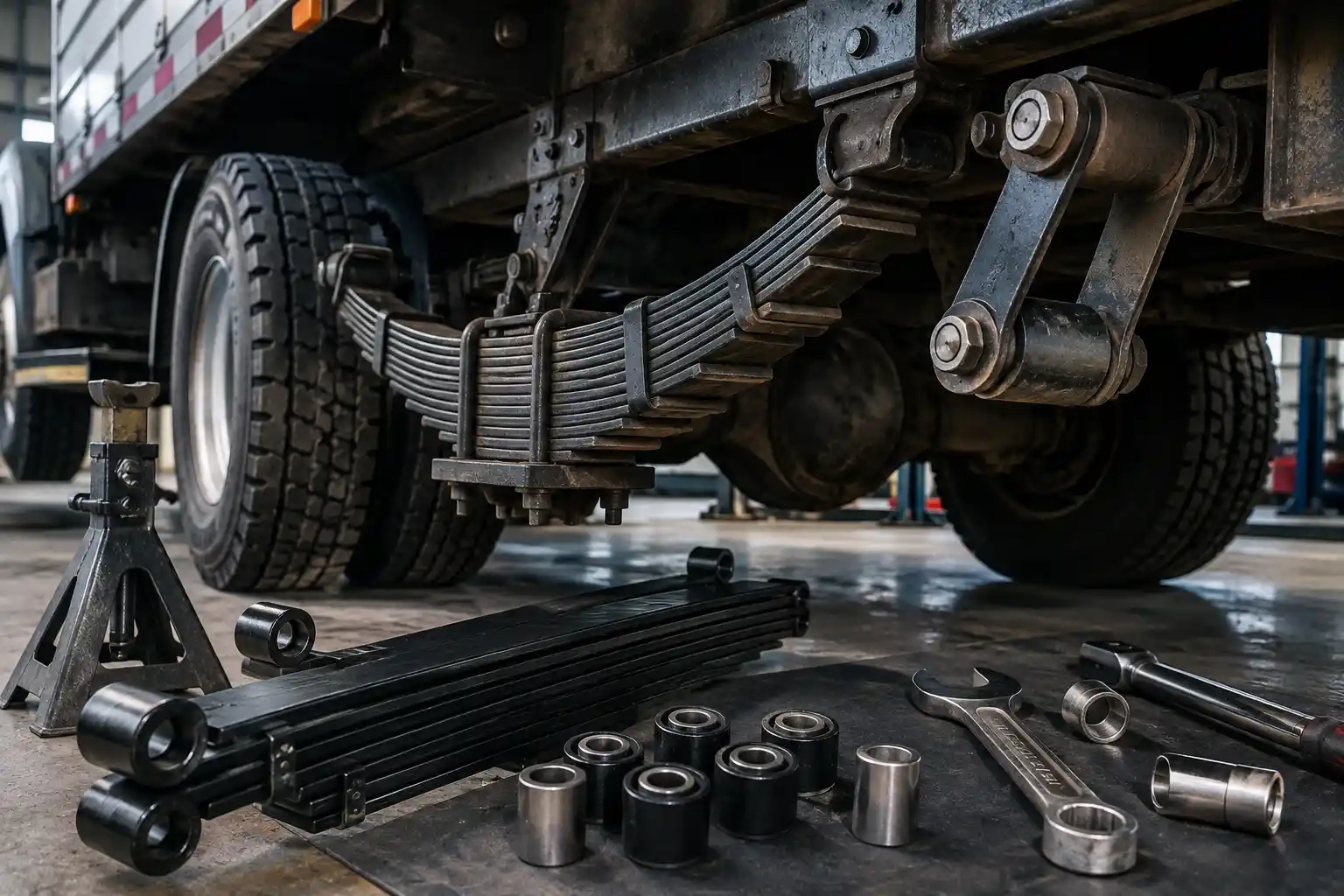
- Multi-Leaf Assemblies: Constructed from multiple stacked steel plates of varying lengths clamped by center bolts and rebound clips. They rely on inter-leaf friction to assist shock absorption. They excel under extreme load capacities (vocational dump trucks, heavy haulers) but add unsprung weight.
- Parabolic Springs: Feature fewer leaves with tapered thicknesses from the center to the tips. Leaves touch only at the center and ends, reducing inter-leaf friction and weight while delivering smoother ride quality for long-haul Class 8 tractors.
The Role of Spring Eye and Shackle Bushings
Bushings act as the flexible mechanical interface between the rigid steel spring eye and the vehicle frame shackle pin. They isolate high-frequency road vibrations, allow required angular movement as the spring flexes, and preserve lateral axle alignment.
When bushings degrade, the leaf spring shifts out of position, forcing the axle out of alignment and causing rapid, irregular drive-tire wear that can reduce tire life by up to 35%.
2. Diagnostic Matrix: When to Replace Leaf Springs and Bushings
Waiting for a leaf spring to snap during highway transit risks catastrophic loss of vehicle control, cargo damage, and severe financial liability. Fleet technicians must conduct visual and dimensional checks during every scheduled Preventive Maintenance (PM) service window.
Diagnostic Matrix for Suspension Wear
| Physical Symptom | Root Cause | Safety & Financial Impact | Recommended Action |
| Vehicle Leaning or Sagging | Metal fatigue; loss of arch in main or helper leaves | Altered center of gravity; unequal weight distribution; headlight misalignment | Replace leaf spring assembly in axle pairs |
| Gaps Between Leaves | Stretched center bolt; loose U-bolts; leaf distortion | Inter-leaf debris intrusion; accelerated snapping hazard under bump impact | Retorque U-bolts to spec; inspect center bolt; replace pack if bent |
| Metallic Clunking / Squeaking | Worn-out rubber/polyurethane bushing sleeve; metal-on-metal contact | Rapid shackle pin wear; frame eye hole elongation | Replace bushings immediately; replace shackle pins if scored |
| Uneven Drive-Tire Tread Wear | Worn spring eye bushings causing axle mis-tracking (dog-tracking) | Increased rolling resistance; early tire condemnation ($400–$600 per tire) | Perform 3-axle alignment; replace worn eye and torque rod bushings |
| Rust Bleeding Between Leaves | Failure of inter-leaf liner pads; deep inter-leaf corrosion pitting | Friction binding; high stress concentration leading to sudden leaf fracture | Clean and lubricate if minor; replace assembly if leaf thickness is degraded |
3. Replacement Benchmarks and Lifecycle Analysis
Unlike engine oil or brake pads, leaf springs and bushings do not have a universal, mileage-based expiration date. Their lifespan varies based on operating conditions and payload profiles across the United States.
Expected Service Life Benchmark by Operational Profile
| Operational Category | Average Leaf Spring Lifespan | Average Bushing Lifespan |
| Long-Haul OTR (Class 8) | 350,000 – 500,000 Miles | 150,000 – 200,000 Miles |
| Regional Freight (Class 6-7) | 200,000 – 300,000 Miles | 100,000 – 125,000 Miles |
| Severe Duty / Construction | 100,000 – 175,000 Miles | 50,000 – 75,000 Miles |
Regional & Environmental Duty-Cycle Factors
- The US Rust Belt (Northeast / Midwest): Road salt and liquid calcium chloride accelerate inter-leaf rusting and chemical degradation of standard rubber bushings. Fleets operating in these states experience 25% to 40% shorter suspension life cycles.
- Regional Stop-and-Go Routes: Frequent curb mounting, tight turning radii, and dock loading exert severe lateral torque on spring eye bushings and shackle pins.
- Heavy-Haul & Vocational Operations: Constant maximum gross vehicle weight rating (GVWR) loading forces springs to operate near their yield point, accelerating metal fatigue and arch loss.
4. Material Selection: Rubber vs. Polyurethane vs. Bronze
When replacing worn suspension bushings, fleet managers must choose between three primary material formulations. Selecting the correct material directly influences maintenance frequency and ride characteristics.
| Feature / Property | Natural Vulcanized Rubber | Polyurethane (Poly) | Bronze / Threaded Steel |
| Vibration Damping (NVH) | Superior (Absorbs road noise) | Moderate | Poor (Transmits road shock) |
| Load Bearing Capacity | Standard | High (3x tensile strength vs rubber) | Extreme |
| Chemical & Oil Resistance | Vulnerable to petroleum leaks | Highly Resistant | Impervious |
| Service Lifespan | 100,000 – 150,000 Miles | 200,000 – 300,000 Miles | 300,000+ Miles (Grease required) |
| Maintenance Need | Maintenance-free (bonded) | Periodic greasing required | Constant manual lubrication |
| Ideal Fleet Application | Long-haul over-the-road (OTR) | Regional freight & vocational trucks | Severe off-road / heavy construction |
5. Spot Repair vs. Dual-Axle Suspension Overhaul
When a technician identifies a broken main leaf or a single disintegrated bushing, maintenance teams face a classic dilemma: replace only the damaged part or replace the entire suspension pack on both sides of the axle?
The Hidden Cost of Partial Repairs
Replacing only one leaf spring or single-side bushing creates asymmetrical spring rates across the axle. The newer, stiffer leaf spring bears a disproportionate share of the load, causing the vehicle to lean and subjecting the new spring to premature fatigue. Furthermore, old U-bolts stretch upon torque application and must never be reused.
Cost Comparison: Spot Repair vs. Dual-Axle Overhaul
- Spot Repair (Single Leaf / One Bushing):
- Parts Cost: $120
- Labor: 3.0 hrs @ $110/hr = $330
- Initial Repair Cost: $450
- Secondary Risk: High risk of opposite-side failure within 30 days ($450 repair + 4 hrs downtime @ $150/hr = $1,050)
- Total Effective Cost: $1,500+
- Dual-Axle Overhaul (Both Packs, Bushings & U-Bolts):
- Parts Cost: $650
- Labor: 4.5 hrs @ $110/hr = $495
- Total Effective Cost: $1,145 (Delivers 30% lower lifetime cost per mile)
Maintenance Rule: Always replace leaf springs in axle pairs to preserve balanced vehicle handling, correct ride height, and uniform alignment metrics.
6. Step-by-Step Installation Standards for Fleet Technicians
To maximize part longevity and ensure driver safety, fleet service centers must enforce standardized installation protocols:
- Mandatory U-Bolt Replacement: U-bolts utilize roll-formed threads designed to stretch permanently under initial torque application to clamp the spring pack securely to the axle seat. Reusing old U-bolts leads to loss of clamping force, center bolt shear, and total spring displacement.
- Torque U-Bolts in a Cross Pattern under Full Curb Weight: Final tightening of U-bolts must be performed using a calibrated torque wrench while the truck rests on its wheels at full curb weight. Tightening while suspended on a frame hoist distorts bushing seating.
- 500-Mile Retorque Protocol: Newly installed leaf spring packs settle after initial operational vibration. Retorquing all U-bolts after the first 500 operational miles prevents inter-leaf shift and center bolt failure.
- Inspect Frame Shackle Hangers: Never press new bushings into cracked or out-of-round shackle hanger eyes. Measure eye roundness with a dial caliper before pressing in replacement bushings.
7. Strategic Inventory Management for Commercial Fleet Suspension Parts
Carrying excessive heavy-duty inventory ties up working capital, while running stockouts risks keeping haulers parked for days awaiting freight deliveries. Fleet maintenance departments must implement precise spare parts control methods.
Reorder Point (ROP) Calculation
To maintain zero-downtime maintenance operations without overstocking, fleets use the standard Reorder Point formula:
Reorder Point (ROP) = (Daily Consumption × Lead Time in Days) + Safety Stock
Where:
- Daily Consumption: Average daily usage of replacement units (e.g., bushings per day)
- Lead Time in Days: Supplier delivery lead time
- Safety Stock: Extra buffer stock reserved to prevent stockouts during supply chain delays
ABC Inventory Framework for Suspension Parts
- Class A (High Value / Long Lead): Complete leaf spring assemblies for specialized rig configurations. Stock 1–2 replacement sets based on lead time.
- Class B (Moderate Value / High Turn): Standard spring eye bushings, torque rod bushings, shackle pins, and center bolts. Maintain 3 to 4 months of buffer stock.
- Class C (Hardware / Fasteners): Grade 8 U-bolt kits, locknuts, and washer sets. Stock in bulk bins.
Vendor-Managed Inventory (VMI) Strategies
Establishing consignment stock arrangements with reliable heavy-duty spare parts distributors like Mekantra Technologies ensures that critical suspension kits remain on shop shelves without upfront inventory holding capital, charging your account only when parts are checked out to a specific repair order.
FAQs
How often should commercial fleet vehicles inspect and replace leaf springs?
Inspect every 15,000 miles during routine PM. Replace immediately if sagging or cracked, or typically between 200,000 and 500,000 miles based on duty cycle.
What are the FMCSA out-of-service (OOS) criteria for leaf springs?
A vehicle fails inspection if any main leaf is broken, 25% or more leaves in a pack are cracked, or a leaf shifts toward tires or fuel tanks.
Why should leaf springs always be replaced in axle pairs?
Replacing one side causes uneven weight distribution, vehicle tilt, and rapid premature wear on the new spring.
Why must U-bolts always be replaced during suspension maintenance?
U-bolts stretch permanently when torqued. Reusing old U-bolts leads to loose clamping force, center pin shearing, and axle displacement.
Are polyurethane bushings better than standard rubber bushings?
Polyurethane lasts 2x to 3x longer and resists oil and chemicals better. Rubber provides better vibration damping for long-haul highway routes.

Mekantra Engineering Team
The technical voice of Mekantra. Our team consists of sourcing specialists, mechanical engineers, and logistics experts dedicated to providing transparent insights and high-performance solutions for the global manufacturing sector.
Mekantra Engineering Team
The technical voice of Mekantra. Our team consists of sourcing specialists, mechanical engineers, and logistics experts dedicated to providing transparent insights and high-performance solutions for the global manufacturing sector.