Heat Exchanger Fouling: Causes, Signs & Prevention
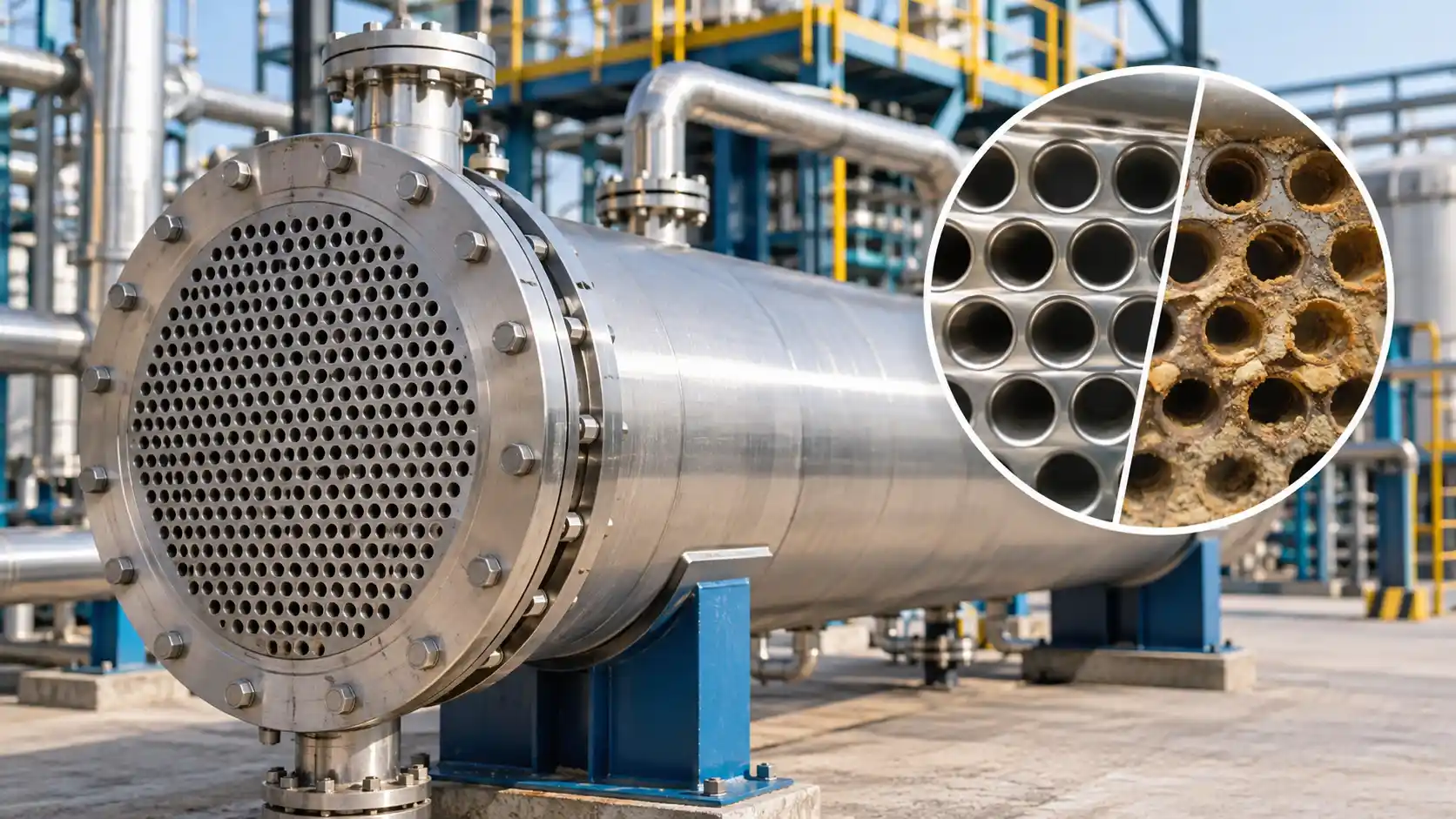
Heat exchangers play an important role in chemical processing, power generation, oil refining, food manufacturing, and other industrial operations. They transfer heat between fluids without requiring the fluids to mix directly. However, their performance can gradually decline as unwanted materials accumulate on internal surfaces.
This buildup is known as heat exchanger fouling. It can reduce heat transfer efficiency, restrict fluid flow, increase energy consumption, and create unexpected maintenance requirements.
Mineral scaling, suspended particles, corrosion products, and biological growth are common causes. If these deposits are not controlled, they can affect production quality and equipment reliability.
Understanding how fouling develops helps maintenance teams recognize problems early and select appropriate cleaning and prevention methods.
What Is Heat Exchanger Fouling?
Heat exchanger fouling is the accumulation of unwanted material on surfaces that transfer heat between fluids. These deposits create an additional layer of thermal resistance, making it harder for heat to move through the equipment.
In a clean heat exchanger, heat passes through a metal surface from a hotter fluid to a cooler fluid. When deposits form on that surface, they interfere with heat transfer.
Fouling can occur in several types of industrial equipment, including shell-and-tube heat exchangers, plate heat exchangers, condensers, and cooling systems.
The rate of buildup depends on fluid composition, temperature, flow conditions, equipment materials, and maintenance practices.
For example, mineral-rich cooling water may produce scale when operating conditions encourage dissolved minerals to precipitate. In another system, suspended solids may settle in low-velocity areas and gradually restrict the flow passages.
What Are the Main Causes of Heat Exchanger Fouling?
Different industrial processes produce different types of deposits. Identifying the cause is important because each type may require a different cleaning or prevention method.
1. Mineral Scaling
Mineral scaling occurs when dissolved minerals in a fluid form solid deposits on heat transfer surfaces.
Calcium carbonate is a common example in water-based systems. Changes in temperature, water chemistry, and mineral concentration can encourage scale formation.
As the deposit becomes thicker, it increases thermal resistance and may restrict fluid movement.
Common contributing factors include hard water, unsuitable water treatment, and operating conditions that promote precipitation.
2. Particulate Fouling
Particulate fouling occurs when suspended solids accumulate on internal surfaces.
These materials may include dirt, sand, sediment, process residues, and other solid particles carried by the fluid.
Deposition can become more significant in areas where flow conditions allow particles to settle.
Particulate fouling is common in systems handling untreated water, contaminated process fluids, or liquids containing suspended solids.
3. Corrosion Fouling
Corrosion fouling develops when corrosion products accumulate on heat transfer surfaces.
Rust and other metal oxides can form when equipment materials react with their operating environment. These products may remain attached to the surface or travel through the system and collect elsewhere.
Corrosion deposits can reduce thermal performance and may indicate a wider equipment-integrity problem.
Water chemistry, material compatibility, temperature, and dissolved gases can influence corrosion behavior.
4. Biological Fouling
Biological fouling, also called biofouling, occurs when microorganisms grow on wetted surfaces.
Bacteria and other microorganisms can form biofilms that attach to internal passages and create additional resistance to heat transfer.
Biofouling is particularly relevant in cooling-water systems and other environments where microbial growth is possible.
Suitable water treatment, system monitoring, and cleaning practices help control biological deposits.
5. Chemical Reaction Fouling
Chemical reaction fouling occurs when unwanted chemical reactions produce deposits on heat transfer surfaces.
Certain process fluids may undergo polymerization, decomposition, or other reactions under particular operating conditions.
These reactions can produce sticky or solid materials that accumulate inside the equipment.
Chemical reaction fouling is especially important when processing temperature-sensitive or reactive materials.
Common Types of Heat Exchanger Fouling
| Fouling type | Typical cause | Common prevention approach |
|---|---|---|
| Mineral scaling | Dissolved minerals precipitating | Water treatment and chemistry control |
| Particulate | Suspended solids | Filtration and flow management |
| Corrosion | Metal oxidation and degradation | Material selection and corrosion control |
| Biological | Microbial growth and biofilm | Suitable microbial control and monitoring |
| Chemical reaction | Unwanted process reactions | Temperature and process-condition control |
The correct prevention method should be selected according to the actual deposit composition and operating conditions.
How Fouling Reduces Heat Transfer Efficiency
Heat transfer efficiency loss is one of the most important consequences of fouling.
A heat exchanger transfers thermal energy through a separating surface. When unwanted deposits accumulate, they add resistance to heat movement.
As a result, the equipment may transfer less heat under otherwise comparable operating conditions.
Reduced Heat Transfer Coefficient
The overall heat transfer coefficient describes how effectively heat moves between the fluids through the heat exchanger.
Fouling introduces additional thermal resistance, which generally reduces the overall heat transfer coefficient.
A simplified heat-transfer relationship is:
Q = U × A × ΔTlm
Where:
- Q: Heat transfer rate
- U: Overall heat transfer coefficient
- A: Heat transfer surface area
- ΔTlm: Log mean temperature difference
If fouling reduces U while the other conditions remain unchanged, the amount of heat transferred decreases.
The actual performance change depends on the exchanger design, fluid conditions, and operating arrangement.
What Is the Fouling Factor?
The fouling factor is an engineering parameter representing additional thermal resistance caused by deposits.
It is commonly expressed in units of m²·K/W in SI calculations.
Design engineers may include an allowance for expected fouling when sizing heat exchangers. However, this allowance does not eliminate the need for cleaning or maintenance.
Actual fouling resistance changes with operating conditions and deposit buildup.
Increased Energy Consumption
When heat transfer performance declines, the surrounding process may require additional heating, cooling, or operating time to achieve the desired result.
This can increase energy consumption and operating costs.
Severe fouling may also limit production capacity when the equipment can no longer meet the required thermal duty.
How Fouling Affects Heat Exchanger Pressure Drop
Pressure drop is the difference in fluid pressure between the inlet and outlet of a heat exchanger.
As deposits accumulate, they may narrow flow passages, increase resistance, and cause pressure drop to rise at a comparable flow rate.
This is particularly important in equipment with narrow channels, such as certain plate heat exchangers.
However, pressure drop does not always increase in a simple or predictable way.
Changes in flow rate, viscosity, temperature, or system operation can also affect the measurement.
For example, a heavily fouled exchanger operating at a reduced flow rate may not show the same pressure-drop increase expected at its normal flow rate.
Therefore, maintenance teams should compare pressure readings under similar operating conditions and review them alongside thermal performance data.
Common Warning Signs of Heat Exchanger Fouling
Fouling often develops gradually. Recognizing early warning signs can help facilities investigate problems before they become more serious.
1. Reduced Heating or Cooling Performance
A heat exchanger may struggle to achieve its normal outlet temperature even when the surrounding process appears unchanged.
This can indicate additional thermal resistance caused by deposits.
2. Increasing Pressure Drop
A rising differential pressure at comparable flow rates may indicate restricted passages or deposit buildup.
3. Higher Energy Consumption
Heating, cooling, or pumping systems may require additional energy to maintain the desired process conditions.
4. Unstable Process Temperatures
Unexpected changes in outlet temperature or difficulty maintaining a stable process temperature may indicate declining exchanger performance.
5. Reduced Production Throughput
Some processes depend on achieving a specific heating or cooling rate. Reduced thermal performance can limit the amount of material processed.
6. Visible Deposits During Inspection
Scale, sludge, rust, or biofilm found during maintenance inspections can provide direct evidence of fouling.
Warning Signs and Recommended Checks
| Warning sign | Possible explanation | Recommended check |
|---|---|---|
| Reduced heat transfer | Thermal resistance from deposits | Compare thermal performance |
| Rising pressure drop | Restricted passages | Check flow and differential pressure |
| Unusual outlet temperature | Reduced thermal duty | Verify inlet/outlet temperatures |
| Higher energy use | Additional heating, cooling, or pumping demand | Review energy trends |
| Reduced throughput | Insufficient heat transfer | Check process conditions |
| Visible scale or sludge | Deposit accumulation | Inspect surfaces and identify deposits |
These symptoms can also result from other equipment or process problems, so fouling should be confirmed before cleaning is scheduled.
How Water Quality Affects Heat Exchanger Fouling
Water quality has a significant influence on fouling in cooling systems, condensers, and water-based industrial heat exchangers.
Poor water quality can introduce dissolved minerals, suspended particles, and microorganisms that contribute to deposits.
Important parameters include:
- Water hardness: High concentrations of calcium and magnesium can contribute to mineral scaling.
- pH: Influences corrosion and mineral precipitation.
- Conductivity: Helps indicate the concentration of dissolved ions.
- Suspended solids: Can accumulate in passages and on heat transfer surfaces.
- Microbial activity: Can encourage biofilm formation.
- Temperature: Can influence mineral solubility, corrosion, and biological growth.
Water treatment may involve filtration, softening, chemical conditioning, or microbial control, depending on the application.
Treatment methods must be compatible with the equipment materials and process requirements.
Heat Exchanger Cleaning Methods
Heat exchanger cleaning removes deposits that interfere with heat transfer or restrict fluid movement.
The appropriate method depends on the type of fouling, equipment construction, accessibility, and material compatibility.
Mechanical Cleaning
Mechanical cleaning physically removes deposits from accessible surfaces.
Common methods include tube brushing, approved water-jet cleaning, and manual removal of deposits.
Mechanical cleaning is often useful for shell-and-tube heat exchangers with accessible tubes.
However, unsuitable tools or excessive cleaning pressure can damage tubes, coatings, or sealing surfaces.
Chemical Cleaning
Chemical cleaning uses suitable cleaning agents to dissolve or loosen deposits.
In some systems, cleaning solutions can be circulated through the exchanger without complete disassembly. This process is commonly called clean-in-place (CIP).
Chemical cleaning may be effective for certain mineral scales and other deposits, but the cleaning agent must be compatible with the exchanger materials, seals, and deposit chemistry.
Chemical selection, concentration, temperature, circulation time, neutralization, and waste disposal require an approved procedure.
Mechanical vs Chemical Cleaning
| Factor | Mechanical cleaning | Chemical cleaning |
|---|---|---|
| Method | Physical deposit removal | Chemical dissolution or loosening |
| Best suited for | Accessible deposits | Chemically removable deposits |
| Disassembly | May be necessary | CIP may avoid disassembly |
| Main concern | Mechanical surface damage | Chemical compatibility and corrosion |
| Key requirement | Suitable tools and access | Approved chemical procedure |
Before cleaning, equipment must be safely isolated, depressurized, drained, and prepared according to site procedures. Hazardous residues, confined spaces, and chemical exposure require appropriate controls.
How to Prevent Heat Exchanger Fouling
Preventing fouling completely may not be practical, but suitable operating and maintenance practices can reduce deposit buildup.
1. Maintain Water Quality
Monitor water chemistry and use appropriate treatment methods to control scaling, corrosion, and biological growth.
2. Use Suitable Filtration
Filters and strainers can remove suspended particles before they enter sensitive heat exchanger passages.
3. Control Operating Temperatures
Avoid unnecessary temperature extremes that encourage scaling, unwanted reactions, or thermal degradation.
4. Maintain Suitable Flow Conditions
Appropriate fluid velocity can help reduce particle settling. However, excessive velocity may cause erosion or other operating problems.
5. Monitor Thermal Performance
Track inlet and outlet temperatures, flow rates, and heat transfer performance. Compare readings under similar operating conditions to identify deterioration.
6. Monitor Pressure Drop
Record differential pressure trends and investigate changes that cannot be explained by normal variations in flow, temperature, or viscosity.
7. Follow a Maintenance Program
Routine inspection, water-quality checks, and condition monitoring help maintenance teams identify developing problems.
A combination of scheduled servicing and performance-based inspections can be particularly useful. The guide to preventive vs predictive maintenance explains how these approaches can support industrial equipment reliability. mekantratech.com
When Should a Heat Exchanger Be Cleaned?
There is no universal cleaning interval suitable for every industrial heat exchanger.
Cleaning frequency depends on the process fluid, deposit formation rate, equipment design, operating conditions, and production requirements.
Cleaning may be necessary when:
- Thermal performance falls below acceptable operating limits.
- Pressure drop approaches the equipment’s allowable limit.
- Required process temperatures can no longer be maintained.
- Inspections reveal significant deposits.
- Energy consumption rises because of confirmed fouling.
- Maintenance procedures require cleaning at a scheduled interval.
A useful approach is to establish baseline performance when the equipment is clean and compare future measurements against that reference.
Cleaning should be scheduled when the expected performance improvement and operational benefits justify the intervention, while always respecting equipment safety limits.
Heat Exchanger Fouling Troubleshooting Checklist
Before deciding that fouling is responsible for poor performance, maintenance teams should examine the complete operating system.
| Inspection item | What to verify |
|---|---|
| Inlet and outlet temperatures | Compare against normal operating conditions |
| Fluid flow rate | Check for reduced or unstable flow |
| Differential pressure | Compare readings at similar flow conditions |
| Water chemistry | Test relevant mineral and contamination levels |
| Thermal performance | Assess changes in heat transfer duty |
| Pumps and valves | Check for flow-control problems |
| Physical condition | Inspect for scale, sludge, corrosion, or biofilm |
| Maintenance records | Review recurring problems and cleaning history |
This systematic approach helps distinguish actual fouling from problems caused by instruments, pumps, valves, or changes in process conditions.
Why Equipment Design Matters in Fouling Control
Heat exchanger design can influence how quickly deposits accumulate and how easily equipment can be cleaned.
Flow passage dimensions, surface materials, temperature distribution, accessibility, and fluid velocity all affect fouling behavior.
For example, narrow passages may be more sensitive to blockage from suspended particles, while accessible tubes can simplify certain mechanical cleaning procedures.
Material selection also matters. Suitable corrosion-resistant materials can help reduce corrosion-related deposits when matched to the process environment.
In chemical manufacturing, heat exchangers must also integrate with reactors, pumps, filtration systems, and temperature-control equipment.
Choosing appropriate industrial heat exchangers and condensers involves considering the process fluid, thermal duty, operating pressure, corrosion resistance, and maintenance accessibility. Mekantra Technologies
These factors should be evaluated during equipment selection rather than addressed only after fouling becomes a recurring problem.
Frequently Asked Questions
What is heat exchanger fouling?
Heat exchanger fouling is the accumulation of unwanted deposits on heat transfer surfaces. These deposits increase thermal resistance and may restrict fluid flow, reducing equipment performance.
What causes fouling in heat exchangers?
Common causes include mineral scaling, suspended particles, corrosion products, biological growth, and unwanted chemical reactions. The dominant cause depends on the fluid and operating conditions.
How does fouling affect heat transfer efficiency?
Fouling creates additional resistance between the heat transfer surface and the fluid. This reduces the overall heat transfer coefficient and can lower heating or cooling performance.
Can fouling increase pressure drop?
Yes. Deposits can narrow flow passages and increase resistance. However, pressure drop also depends on flow rate, viscosity, and other operating conditions.
Can heat exchanger fouling be prevented completely?
Not always. However, appropriate water treatment, filtration, operating conditions, performance monitoring, and maintenance can reduce the rate and severity of fouling.
Conclusion
Heat exchanger fouling is a common industrial maintenance problem that can reduce heat transfer efficiency, increase pressure drop, raise energy costs, and affect production reliability. Mineral scaling, particulate deposits, corrosion products, biological growth, and chemical reactions are among its main causes.
Recognizing warning signs early and investigating changes in thermal performance, flow, and pressure drop helps maintenance teams identify problems before they become more severe. Suitable cleaning methods, water-quality management, filtration, and preventive maintenance can reduce deposit buildup and support reliable operation.
For industrial facilities evaluating heat exchangers or upgrading chemical-processing systems, equipment design, material compatibility, and maintenance accessibility are important long-term considerations. Mekantra Technologies provides industrial machinery sourcing solutions that help manufacturers evaluate equipment for their processing requirements.

Mekantra Engineering Team
The technical voice of Mekantra. Our team consists of sourcing specialists, mechanical engineers, and logistics experts dedicated to providing transparent insights and high-performance solutions for the global manufacturing sector.
Mekantra Engineering Team
The technical voice of Mekantra. Our team consists of sourcing specialists, mechanical engineers, and logistics experts dedicated to providing transparent insights and high-performance solutions for the global manufacturing sector.