Baghouse vs Cartridge Dust Collector: Selection Guide
Selecting the right industrial dust collection system is one of the most critical engineering decisions for plant managers, facility directors, and EHS safety officers in North America. An incorrectly specified dust collector leads to rapid filter blinding, excessive differential pressure, unplanned production shutdowns, inflated compressed air usage, and severe regulatory non-compliance under OSHA Permissible Exposure Limits (PELs), EPA Title V air quality regulations, and NFPA combustible dust standards.
Both pulse jet baghouses and pleated cartridge collectors clean process air, capture hazardous airborne particulates, protect expensive machinery, and allow conditioned air recirculation. However, their internal filter geometries, airflow dynamics, media characteristics, and operational boundaries differ significantly.
This engineering selection guide breaks down the baghouse vs cartridge dust collector debate across 11 core operating parameters, provides industry-specific benchmarks, offers total cost of ownership (TCO) considerations, and helps you identify the ideal industrial dust extraction system for your manufacturing plant.
Understanding the Core Mechanics: Bag Filter vs Cartridge Filter
To evaluate a bag filter vs cartridge filter system accurately, facility engineers must first understand how each media type captures and dislodges particulate matter during operation.
1. Pulse Jet Baghouse Collectors (Depth Filtration)
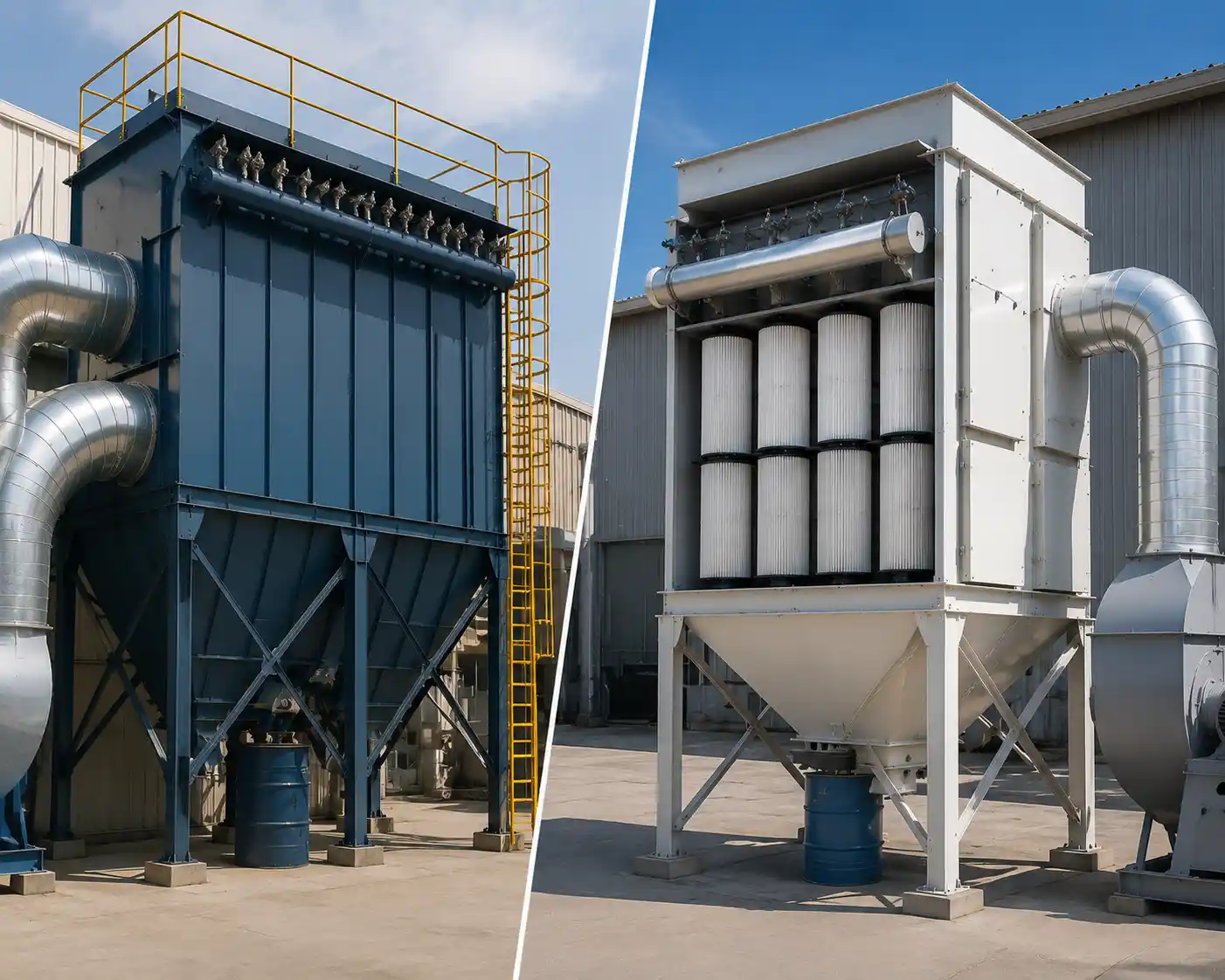
A standard pulse jet baghouse utilizes cylindrical fabric filter bags typically 8 to 12 feet long and 5 to 6 inches in diameter supported internally by heavy-duty metal wire cages. Contaminated process air enters the lower hopper or side inlet plenum and flows from the outside of the bag to the inside.
- Filtration Type: Depth filtration. Particulate penetrates the outer layer of needle-punched felt media, establishing a porous dust cake on the exterior. This accumulated dust cake acts as the primary filtering barrier.
- Cleaning Mechanism: A short pulse (100–150 milliseconds) of dry compressed air at 80 to 100 PSI is injected down through a venturi nozzle into the clean air side of the bag. This creates an expanding shockwave that flexes the fabric outwards, snapping the dust cake off into the collection hopper below.
- Common Filter Media: Polyester felt, polypropylene, aramid (Nomex), woven fiberglass, P84 (polyimide), and expanded PTFE (ePTFE) membranes.
2. Cartridge Dust Collectors (Surface Filtration)
A cartridge dust collector replaces long cylindrical fabric bags with compact, pleated cylindrical or oval filter elements. By pleating the media around a rigid central core, a single cartridge element packs between 200 to 350 square feet of filter surface area into a footprint a fraction of the size of a baghouse.
- Filtration Type: Surface filtration. Advanced media treatments—such as synthetic spunbond, cellulose/polyester blends, or sub-micron nanofiber coatings trap dust directly on the extreme surface of the pleats before particles can embed inside the substrate.
- Cleaning Mechanism: Downward or horizontal pulse-jet bursts shoot compressed air through the center core of the cartridge element, creating a reverse flow that dislodges surface dust into the hopper.
- Common Filter Media: Nanofiber-coated cellulose, spunbond polyester, PTFE membrane laminates, and flame-retardant synthetic blends rated up to MERV 15 and MERV 16 under ASHRAE 52.2 standards.
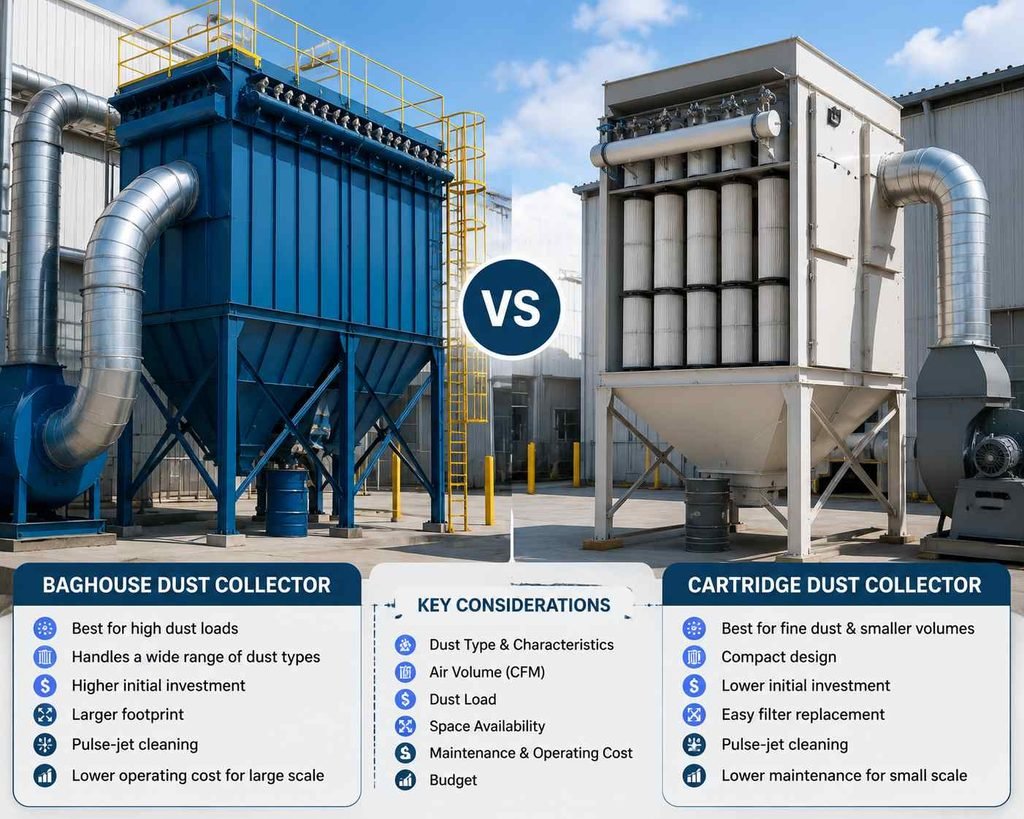
11-Point Engineering Head-to-Head Comparison
| Engineering Parameter | Pulse Jet Baghouse Collector | Cartridge Dust Collector |
| 1. Particle Size & Efficiency | Coarse to medium particulate ($\ge 5\ \mu\text{m}$); 99.9% on coarse dust. | Fine to sub-micron smoke/fume ($0.3 – 5\ \mu\text{m}$); MERV 15–16 ($\ge 99.97\%$ @ $0.5\ \mu\text{m}$). |
| 2. Dust Loading Capacity | Heavy, continuous bulk loads ($> 55\text{ gal/day}$ or continuous pneumatic conveying). | Light to moderate particulate concentrations ($< 1 – 2\text{ drums/day}$). |
| 3. Airflow Volumetric Range (CFM) | High-volume systems ($> 15,000$ to $100,000+\text{ CFM}$). | Low to medium/high airflow ($500$ to $35,000\text{ CFM}$). |
| 4. Air-to-Cloth Ratio (AMR) | High operating AMR ($4:1$ to $6:1\text{ CFM/sq ft}$ for light dust; $2:1$ for heavy). | Low operating AMR ($0.75:1$ to $2.5:1\text{ CFM/sq ft}$ depending on dust). |
| 5. Temperature Resistance | High heat tolerance (Up to $500^\circ\text{F} / 260^\circ\text{C}$ with Nomex/Fiberglass). | Ambient to low heat limits ($\le 180^\circ\text{F} – 200^\circ\text{F}$ max). |
| 6. Moisture & Oil Tolerance | High resistance; handles hygroscopic, sticky, or moist stream conditions. | Poor; moisture causes mudding and permanent pleat blinding. |
| 7. Combustible Dust Safety | Ideal for outdoor installation with standard NFPA explosion panels. | Requires strict NFPA 652/654 isolation valves, flameless vents, or chemical suppression. |
| 8. Space & Footprint Requirement | Large footprint; requires high vertical clearance ($20 – 35\text{ ft}$). | Compact footprint ($50 – 60\%$ smaller); fits under $10 – 14\text{ ft}$ indoor ceilings. |
| 9. Operating Pressure Drop | Higher baseline differential pressure ($3.5$ to $6.0\text{ in. w.g.}$). | Lower baseline differential pressure ($1.5$ to $3.5\text{ in. w.g.}$). |
| 10. Filter Service Life | Longer life in heavy loading ($2$ to $5\text{ years}$). | $1$ to $2\text{ years}$ (requires clean dry air to prevent premature blinding). |
| 11. Maintenance Ergonomics | Labor-intensive bag changeout (often inside top tube sheet plenum). | Fast, tool-free exterior changeout via side door access. |
In-Depth Analysis of Critical Operating Parameters
1. Particle Size Distribution and MERV Efficiency
Particle size distribution dictates filter media selection. Sub-micron particulates generated during thermal cutting, laser cutting, plasma arc operations, and manual stick/MIG welding produce microscopic metal oxide smoke particles ranging between 0.1 and 1.0 microns. Cartridge dust collectors with nanofiber layers excel in these applications because the ultra-fine surface fibers trap sub-micron smoke at the surface, achieving MERV 15 or MERV 16 ratings.
Conversely, processes like wood planing, shot blasting, crushing, screening, and grain handling produce larger, abrasive particulates ($> 10\ \mu\text{m}$). A baghouse dust collector utilizes thick needle-punched felts that withstand the impact velocity of coarse, high-density particles without tearing or eroding the media fibers.
2. Dust Loading Volume and Grain Loading Limits
Grain loading refers to the mass of dust suspended per cubic foot of process air (grains per dry standard cubic foot, or $\text{gr/DSCF}$). High bulk material handling operations can present grain loads exceeding 5 to 20 $\text{gr/DSCF}$.
- Baghouses thrive under high grain loading. The vertical orientation and open spacing between hanging bags allow falling dust cakes to dislodge smoothly into the hopper during pulse pulses without bridging between adjacent bags.
- Cartridge collectors perform best when grain loading remains below 2 to 3 $\text{gr/DSCF}$. Under heavy grain loading, falling dust gets trapped between the tight horizontal pleats of the cartridge, causing irreversible dust bridging that pulse jet cleaning cannot clear.
3. Operating Air-to-Cloth Ratio (AMR) Calculations
The Air-to-Cloth Ratio (AMR), expressed in cubic feet per minute per square foot of media ($\text{CFM/sq ft}$ or $\text{fpm}$ velocity), measures how fast air moves through the filter media.
For example, if your process requires an industrial air filtration system operating at 10,000 CFM:
- A Pulse Jet Baghouse operating at an AMR of $4:1$ requires $10,000 / 4 = 2,500\text{ sq ft}$ of fabric media. Assuming each 10 ft bag offers 13 sq ft of surface area, the unit requires approximately 192 filter bags.
- A Cartridge Collector for dry, fine dust operating at an AMR of $1.5:1$ requires $10,000 / 1.5 = 6,667\text{ sq ft}$ of media. However, because one pleated cartridge yields 250 sq ft of surface area, the unit requires only 27 cartridge elements!
This dramatic difference in media packing density explains why cartridge units occupy a significantly smaller physical footprint.
4. Temperature, Humidity, and Moisture Risks
Temperature limitations and moisture content represent strict boundaries in dust collector selection:
- High Temperature: Standard cartridge elements utilize synthetic polymers and glue compounds that soften or degrade above $180^\circ\text{F}$ to $200^\circ\text{F}$ ($82^\circ\text{C} – 93^\circ\text{C}$). Baghouses designed with woven fiberglass, aramid/Nomex, or P84 felts comfortably handle hot flue gas streams up to $500^\circ\text{F}$ ($260^\circ\text{C}$).
- Moisture & Condensation: If process gas drops below its dew point, moisture condenses inside the collector. In cartridge systems, water combines with dust to form a thick, clay-like paste deep inside the narrow pleat V-grooves, permanently blinding the filter. Baghouses with hydro-oleophobic (water- and oil-repellent) PTFE membrane coatings release wet or sticky cakes far more effectively.
5. Facility Footprint and Maintenance Accessibility
When physical space inside a manufacturing plant is at a premium, cartridge collectors offer a distinct spatial advantage. A cartridge unit occupying a $6 \times 8\text{ ft}$ floor space can match the air handling capacity of a $12 \times 16\text{ ft}$ structural baghouse.
Furthermore, maintenance ergonomics favor cartridge units in light-to-moderate applications. Modern cartridge collectors feature quick-opening side doors and cam-lock handles, enabling technicians to replace filter cartridges from outside the collector without entering dirty plenums or using specialized overhead rigging.
Industry-Specific Selection Recommendations
1. Cement, Rock & Aggregate Processing
- Recommended Technology: Pulse Jet Baghouse
- Key Reason: Cement manufacturing involves massive continuous bulk material loading, heavy clinker dust, highly abrasive silica, and elevated kiln process gas temperatures ($> 300^\circ\text{F}$). Cartridge pleats would choke within hours.
2. Steel, Iron & Heavy Metallurgy
- Recommended Technology: Pulse Jet Baghouse
- Key Reason: Electric Arc Furnaces (EAF), blast furnace exhaust, induction melting, and heavy slag handling generate extreme heat, heavy metallic oxide loads, and thermal spikes. Integrating specialized Iron & Steel Processing Equipment with a rugged baghouse guarantees long-term compliance.
3. Welding, Laser Cutting & Plasma Thermal Cutting
- Recommended Technology: Cartridge Dust Collector
- Key Reason: Thermal cutting yields high volumes of dry, sub-micron metallic fumes ($< 1\ \mu\text{m}$) containing hazardous substances like Hexavalent Chromium ($\text{Cr(VI)}$) and Manganese. Cartridges with MERV 15/16 nanofiber media achieve high capture efficiency, while advanced Industrial Air Filtration Control Systems regulate fan VFD speeds to keep energy costs minimal.
4. Woodworking, Cabinetry & Biomass Processing
- Recommended Technology: Pulse Jet Baghouse (or Baghouse preceded by a Cyclone)
- Key Reason: Wood processing generates high volumes of coarse sawdust, stringy shavings, and fine sander dust. Fibrous wood strands bridge across cartridge pleats, whereas a baghouse equipped with explosion relief vents safely handles bulky wood waste. Pair your wood collection exhaust with high-efficiency Mechanical Machinery hoods to maintain safe indoor air quality.
5. Foundries & Metal Casting Operations
- Recommended Technology: Pulse Jet Baghouse
- Key Reason: Sand handling systems, green sand shakeout tables, and mold cooling lines release high ambient dust loads combined with abrasive bentonite clay and silica sand. Heavy needle-punched felt filter bags resist the continuous impact of sharp sand grains.
6. Mining, Mineral Processing & Quarrying
- Recommended Technology: Pulse Jet Baghouse
- Key Reason: Primary and secondary jaw crushers, screening stations, and transfer conveyors produce high-velocity dust streams. Review Mekantra’s detailed Heavy Industrial Air Filtration Guide to properly engineer hopper slope angles, abrasion-resistant target plates, and air-to-cloth ratios for mining operations.
Total Cost of Ownership (TCO): CapEx vs. OpEx Analysis
Evaluating an industrial dust extraction system purely on initial capital purchase price (CapEx) often leads to higher total lifetime operating costs (OpEx). Consider these four vital cost drivers:
- Initial Capital Outlay (CapEx): For airflows under 15,000 CFM, cartridge dust collectors typically cost 15% to 30% less to purchase and ship than baghouses due to their smaller frame size and factory-assembled modular construction.
- Fan Motor Electrical Consumption: Cartridges operate at a lower differential pressure ($2.0 – 3.5\text{ in. w.g.}$) compared to baghouses ($4.0 – 6.0\text{ in. w.g.}$). Running a system fan against lower static pressure cuts electric motor horsepower requirements, yielding substantial annual utility savings.
- Compressed Air Consumption: Pulse-jet cleaning consumes significant compressed air. Cartridge collectors require less frequent pulsing on dry, light particulates, whereas baghouses in heavy dust loads require continuous sequential pulse firing, increasing air compressor electrical demand.
- Filter Replacement and Labor Costs: While cartridge elements carry a higher individual price tag ($120 – $250 each) than standard fabric bags ($25 – $60 each), replacing cartridges requires roughly 70% less maintenance labor time, reducing facility downtime during turnarounds.
6-Step Decision Matrix for Plant Engineers
- Is the process exhaust gas temperature above 200°F (93°C)?
- YES: Specify a Pulse Jet Baghouse with heat-resistant felt (Nomex, Fiberglass, or P84).
- NO: Proceed to Step 2.
- Is the particulate stream wet, oily, sticky, or hygroscopic?
- YES: Specify a Pulse Jet Baghouse with PTFE membrane or oleophobic treated bags.
- NO: Proceed to Step 3.
- Is the dust volume heavy/bulk (> 2–3 drums/day) or coarse/fibrous?
- YES: Specify a Pulse Jet Baghouse with proper hopper discharge and rotary airlock.
- NO: Proceed to Step 4.
- Is the particulate sub-micron fume or smoke (< 2 µm) from welding, laser, or plasma cutting?
- YES: Specify a Cartridge Dust Collector with nanofiber MERV 15/16 media.
- NO: Proceed to Step 5.
- Is floor space severely restricted or ceiling height under 15 feet?
- YES: Specify a compact indoor Cartridge Dust Collector with explosion safety controls.
- NO: Either system may be evaluated based on total 5-year TCO.
- Does the dust present a combustible dust explosion risk under NFPA 652/654?
- Ensure both baghouse and cartridge proposals incorporate certified explosion venting, chemical isolation systems, or flameless venting devices.
Partner with Mekantra Technologies for Custom Air Filtration Engineering
Choosing between a baghouse and a cartridge dust collector is not about finding a universally “superior” system—it is about matching the precise physical properties of your dust stream with the correct filtration architecture.
At Mekantra Technologies, we design, engineer, and manufacture heavy-duty pulse jet baghouses and advanced cartridge dust collection systems engineered specifically for demanding US industrial environments. Our engineering team provides complete support, including:
- Comprehensive airflow audits, duct design, and CFM calculations.
- Custom filter media selection tailored to grain loading, moisture, and chemical compatibility.
- Turnkey NFPA combustible dust safety retrofits and environmental compliance support.
Ready to optimize your plant’s air filtration performance? Contact Mekantra Technologies today to consult with an industrial air filtration specialist and receive a customized engineering proposal.

Mekantra Engineering Team
The technical voice of Mekantra. Our team consists of sourcing specialists, mechanical engineers, and logistics experts dedicated to providing transparent insights and high-performance solutions for the global manufacturing sector.
Mekantra Engineering Team
The technical voice of Mekantra. Our team consists of sourcing specialists, mechanical engineers, and logistics experts dedicated to providing transparent insights and high-performance solutions for the global manufacturing sector.