Cross-Reference Obsolete Part Numbers: B2B Fleet Guide
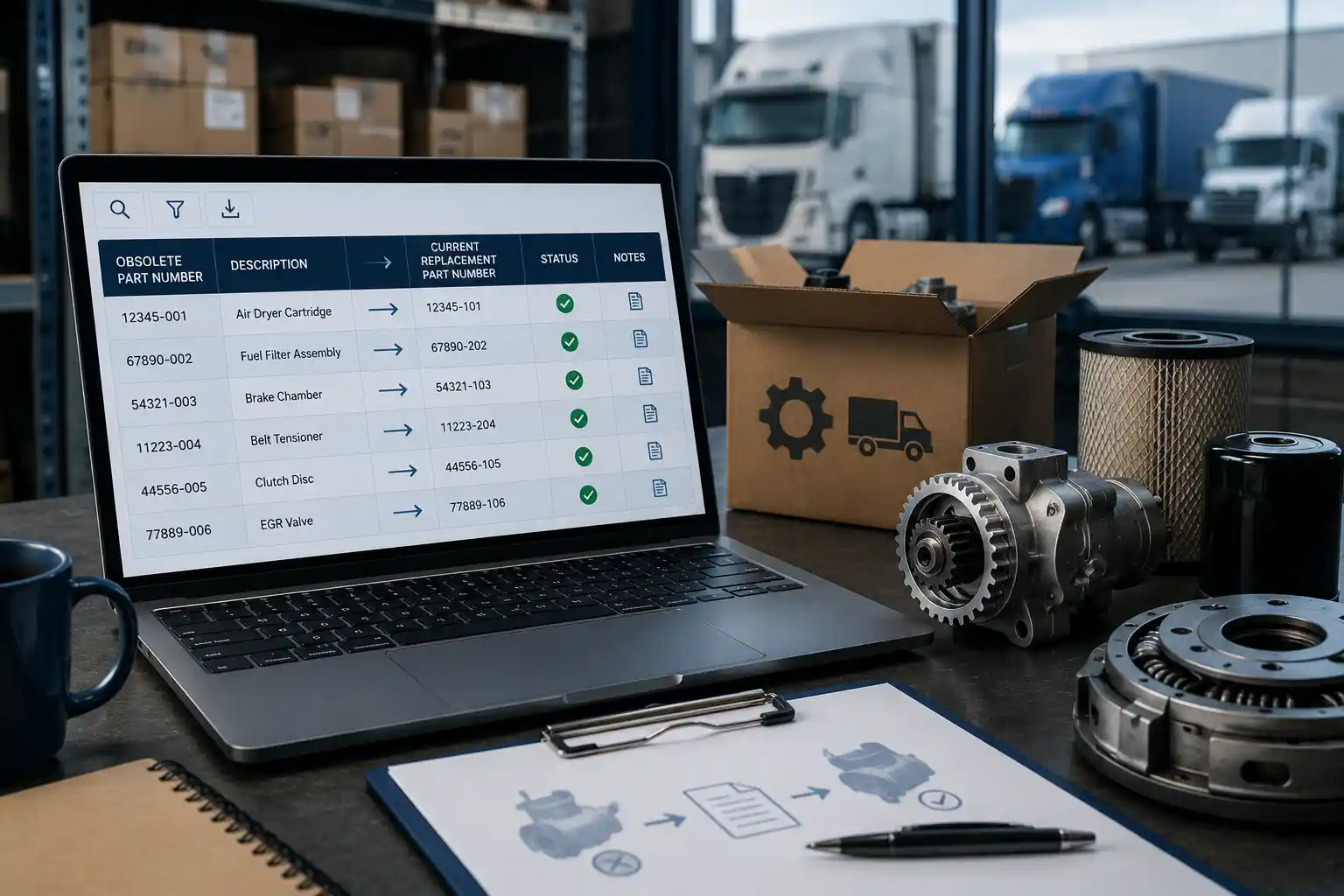
In commercial transportation, vehicle uptime directly dictates operating margins. For US fleet managers overseeing Class 6, 7, and 8 heavy-duty trucks, keeping assets on the road requires a steady supply of replacement components. However, an industry-wide challenge continues to disrupt maintenance schedules: component obsolescence.
As vehicle manufacturers shorten design cycles, introduce complex electronics, and consolidate supplier contracts, legacy replacement parts are frequently designated as End-of-Life (EOL) or discontinued. When an Original Equipment Manufacturer (OEM) stops producing a vital air brake valve, starter motor, steering gear, or engine sensor, fleet procurement managers face a difficult choice: search indefinitely for rare original stock, pay extortionate markups, or leave income-generating trucks parked in the bay.
The strategic solution is systematic part number cross-referencing. Also known as interchange mapping, cross-referencing is the process of identifying identical or functionally equivalent components manufactured by alternative Tier-1 suppliers or independent aftermarket specialists.
The Cross-Reference Ecosystem: OEM, Tier-1, and Aftermarket
Accurate part substitution requires a thorough understanding of how commercial vehicle components are manufactured, branded, and distributed across the supply chain.
+-----------------------------------------------------------------------------------+
|                            PRIMARY VEHICLE ASSEMBLY                               |
|                  (e.g., Freightliner, International, Kenworth)                    |
+-----------------------------------------------------------------------------------+
                                          |
                        +-----------------+-----------------+
                        |                                   |
                        v                                   v
          +---------------------------+       +---------------------------+
          |  OEM (Dealer Label SKU)   |       |   Tier-1 Direct Supplier  |
          |  (Higher Cost / Branding) |       |   (Same Physical Factory) |
          +---------------------------+       +---------------------------+
                        |                                   |
                        +-----------------+-----------------+
                                          |
                                          v
                        +-----------------------------------+
                        |   Independent Aftermarket (IAM)   |
                        |   (Re-engineered / Equivalent)    |
                        +-----------------------------------+
1. OEM (Original Equipment Manufacturer) Parts
OEM parts are distributed under the vehicle manufacturer’s brand name (e.g., Freightliner, Kenworth, Volvo Trucks, Peterbilt, International). However, truck manufacturers rarely build every sub-assembly in-house. Instead, they outsource specialized systems—such as braking controls, alternators, fuel injectors, and turbochargers—to specialized industrial component suppliers.
2. Tier-1 Supplier Direct Equivalents
Tier-1 manufacturers (such as Bendix, Delco Remy, Bosch, Eaton, Meritor, Cummins, and BorgWarner) design and manufacture the original assemblies installed on the truck assembly line. Crucially, these suppliers also sell the exact same physical parts through their own commercial distribution networks under their own part numbers. Sourcing the Tier-1 cross-reference number typically yields the exact original specification at a 30% to 60% savings compared to dealer pricing.
3. Independent Aftermarket (IAM) Components
IAM manufacturers re-engineer replacement parts designed to match or exceed OEM specifications. When an OEM discontinues a legacy component, IAM vendors often step in to fill the market void by producing direct-fit replacement parts—frequently upgrading materials or internal seals to fix known design flaws present in the original design.
Step-by-Step Methodology for Cross-Referencing Obsolete Components
Relying on unverified search engine results or guesswork during part substitution leads to high return rates, premature component failure, and dangerous installation delays. Maintenance teams should adopt a standardized four-step engineering evaluation process.
Step 1: Physical Identification and Casting Mark Inspection
When an obsolete part arrives at the workbench without original packaging or invoices, technical identification begins on the hardware itself:
- Casting Marks & Stamped Digits: Inspect the housing for raised cast numbers, laser-engraved codes, or riveted metal identification plates.
- Vendor Brand Stamps: Look for secondary supplier trademarks (for example, a Wabco or Dana stamp on an OEM-branded housing).
- Dimensional Measurement: Record critical dimensions using digital calipers and thread gauges, including bolt pattern center-to-center distances, port thread pitch, shaft diameters, and flange offsets.
Step 2: Mapping the Manufacturer Supersession Chain
Vehicle manufacturers frequently update part numbers to reflect minor revisions, material changes, or vendor transitions. An initial lookup for an older part number may return a “Discontinued” status simply because the SKU was superseded by a newer number.
- Consult official manufacturer catalog supersession indexes to trace the complete part number evolution.
- Verify whether the original single SKU was replaced by a revised individual part or converted into a service kit that requires adapter harnesses or mounting plates.
+------------------+      +------------------+      +------------------+
| Legacy Part SKU  | ---> | Superseded SKU   | ---> | Current Active   |
| (e.g., A12-1840) |      | (e.g., A12-1840A)|      | Service Kit SKU  |
+------------------+      +------------------+      +------------------+
Step 3: Conducting a Form-Fit-Function (FFF) Audit
The Form-Fit-Function (FFF) framework is the engineering standard for evaluating replacement part compatibility:
- Form: Geometric and visual properties (overall shape, outer envelope dimensions, weight, bracket orientations).
- Fit: Physical connection points (bolt hole positions, thread pitch and sizing, wiring harness pinouts, splines, shaft lengths).
- Function: Operational performance parameters (working pressure, operating voltage, flow rates, heat tolerance, structural load capacity).
Step 4: Data Validation via ACES and PIES Standards
In the North American heavy-duty automotive market, digital cataloging is governed by standards maintained by the Auto Care Association:
- ACES (Aftermarket Catalog Exchange Standard): Defines precise vehicle application criteria (Year, Make, Model, Engine Type, Axle Configuration).
- PIES (Product Information Exchange Standard): Defines part specifications (dimensions, weight, interchange part numbers, digital imagery, UPC codes).
Cross-referencing candidate parts against ACES and PIES datasets confirms that an alternative SKU matches the exact vehicle operational parameters.
Form-Fit-Function (FFF) Technical Evaluation Matrix
When substituting obsolete heavy-duty truck parts, maintenance supervisors must systematically verify key technical parameters. Below is a comparative evaluation matrix across primary commercial vehicle systems:
| System Category | Parameter | OEM Target Spec (Obsolete) | Candidate A (Tier-1 Cross) | Candidate B (IAM Alternative) | Technical Verdict |
| Heavy-Duty Starter Motor | Voltage / Output | 12V / 4.8 kW | 12V / 4.8 kW | 12V / 4.2 kW | Candidate A matches; Candidate B is underpowered for cold starts |
| Pinion Gear Teeth | 11-Tooth, Module 3.0 | 11-Tooth, Module 3.0 | 10-Tooth, Module 3.0 | Candidate A matches; Candidate B damages flywheel ring gear | |
| Mounting Flange | SAE No. 3 Rotatable | SAE No. 3 Rotatable | SAE No. 2 Fixed | Candidate A fits; Candidate B bolt pattern fails to align | |
| Air Brake Dryer Valve | Cut-Out Pressure | 130 PSI | 130 PSI | 120 PSI | Candidate A matches; Candidate B under-pressurizes air tanks |
| Port Thread Sizes | 1/2-inch NPT | 1/2-inch NPT | 3/8-inch NPT | Candidate A direct fit; Candidate B requires flow-restricting adapters | |
| Heater Element | 12V / 75W Hardwire | 12V / 75W Hardwire | 24V / 100W Plug | Candidate A matches; Candidate B causes electrical circuit overload | |
| Engine Oil Cooler Core | Heat Dissipation | 45 kW BTU | 48 kW BTU | 38 kW BTU | Candidate A exceeds OEM spec; Candidate B presents engine overheating risk |
| Core Construction | Stacked Stainless Steel | Stacked Stainless Steel | Extruded Aluminum | Candidate A approved; Candidate B has lower fatigue resistance | |
| O-Ring Geometry | Dual-Flange Viton | Dual-Flange Viton | Single-Flat Nitrile | Candidate A approved; Candidate B risks oil seal degradation |
Integrating Cross-Reference Data into Fleet Management Systems via VMRS
Managing thousands of spare parts manually across multiple shop locations introduces data errors and redundant inventory purchases. Modern fleet operations integrate cross-reference databases directly into their Enterprise Resource Planning (ERP) and Fleet Management Systems (FMS).
Standardizing Inventory with VMRS Code Key 33
The Vehicle Maintenance Reporting Standards (VMRS), established by the Technology & Maintenance Council (TMC) of the American Trucking Associations (ATA), provide a universal coding framework for fleet assets.
- VMRS Code Key 33 (Component Code): Assigns a standard 9-digit logical identifier to every vehicle part regardless of manufacturer numbering (e.g.,
013-001-004represents a 12V Heavy-Duty Alternator). - Unified Part Mapping: By assigning all OEM, Tier-1, and aftermarket interchange numbers to a single VMRS code within your inventory database, shop technicians can see every available substitute in stock—even if cataloged under different vendor part numbers.
+-----------------------------------------------------------------------------------+
|                            VMRS CODE KEY 33 LOGICAL LINK                          |
|                       Component Identifier: 013-001-004 (Alternator)              |
+-----------------------------------------------------------------------------------+
                                          |
        +---------------------------------+---------------------------------+
        |                                 |                                 |
        v                                 v                                 v
+-----------------------+     +-----------------------+     +-----------------------+
| OEM SKU: Freightliner |     | Tier-1 SKU: Delco     |     | Aftermarket SKU:      |
| A12-34567-000         |     | Remy 28SI 8600307     |     | Leece-Neville 110-555 |
| (Status: Obsolete)    |     | (Status: Active Stock)|     | (Status: Approved)    |
+-----------------------+     +-----------------------+     +-----------------------+
Commercial Benefits of VMRS-Driven Cross-Referencing
- Eliminates Phantom Stockouts: Prevents purchasing agents from reordering obsolete OEM numbers when compatible Tier-1 equivalents sit unused on warehouse shelves.
- Shortens Repair Turnaround: Allows technicians to issue pre-approved direct-fit substitutes instantly without waiting for engineering clearance.
- Improves Supplier Quality Tracking: Enables fleet managers to compare lifetime reliability and warranty performance across cross-referenced brands.
Critical Cross-Referencing Pitfalls and Risk Mitigation
While cross-referencing is essential for mitigating parts shortages, careless substitution introduces severe operational risks. Procurement officers must avoid three primary pitfalls:
1. Part Number Collisions Across Manufacturers
Different manufacturers frequently use identical alphanumeric numbering schemes for completely unrelated items. For example, part number 10101 might denote a wheel seal from one vendor and a fuel filter housing from another. Always confirm manufacturer brand codes and product categories before approving purchase orders.
2. Thread and Sealing Interface Mismatches
Pneumatic and hydraulic fittings cross-referenced purely by sight often fail due to thread variations. Interchanging National Pipe Tapered (NPT), Straight Thread O-Ring Boss (ORB), and Metric threads leads to fluid leaks, stripped threads, or housing fractures under system pressure.
3. CAN-Bus Protocol & Electrical Sensor Tolerances
Modern commercial vehicles rely heavily on Controller Area Network (CAN-bus / J1939) protocols. Substituting engine management sensors, exhaust backpressure valves, or NOx sensors requires precise matching of electrical resistance curves and operating voltage ranges. Installing an incompatible sensor can trigger engine derate conditions or immediate diagnostic trouble codes (DTCs).
Actionable Implementation Roadmap for Fleet Procurement Managers
To build a resilient supply chain capable of handling component obsolescence, implement this structured four-stage action plan across your maintenance network:
- Audit Legacy Assets: Identify all Class 6–8 trucks in your fleet operating past their primary warranty period (typically assets 5+ years old). Compile a master list of high-wear components prone to market obsolescence.
- Pre-Map High-Frequency Interchanges: Partner with specialized B2B sourcing providers to establish pre-approved Tier-1 and aftermarket cross-references for essential wear items (starters, alternators, brake valves, water pumps) before failures occur.
- Cleanse Inventory Master Data: Unify all internal inventory records by linking OEM numbers, superseded SKUs, and cross-reference options under standardized VMRS codes in your ERP or FMS system.
- Enforce Workbench FFF Verification: Mandate that technicians perform visual and physical Form-Fit-Function side-by-side audits before installing alternative parts, logging verified matches into central vehicle maintenance records.
Strengthening Supply Chain Resilience for Commercial Fleets
Component obsolescence is a manageable operational reality for modern commercial fleets. By mastering part number cross-referencing, tracing OEM supersession chains, and strictly enforcing Form-Fit-Function compatibility audits, fleet managers can eliminate unnecessary vehicle downtime, avoid dealer price inflation, and maximize the operating life of their transport assets.
For reliable B2B spare parts sourcing, technical interchange mapping, and heavy-duty supply chain support, explore the full line of solutions at Mekantra Technologies Vehicle Spare Parts.
FAQs
What is a cross-reference part number?
A cross-reference part number is an alternative brand SKU that matches an original OEM component in physical fit and function.
How do I find a replacement for an obsolete truck part?
Check the physical casting numbers, trace OEM supersession history, search ACES/PIES databases, and run a Form-Fit-Function check.
What is the difference between supersession and cross-reference?
Supersession is an updated part number from the same manufacturer. Cross-referencing is finding an equivalent part from a different brand or Tier-1 supplier.
How do ACES and PIES standards help?
ACES verifies vehicle application fitment (Year/Make/Model), while PIES standardizes part specifications and interchange data to eliminate errors.
What is a Form-Fit-Function (FFF) audit?
It is a 3-step check that verifies a replacement part’s physical shape (Form), mounting points (Fit), and operational limits (Function) before installation.

Mekantra Engineering Team
The technical voice of Mekantra. Our team consists of sourcing specialists, mechanical engineers, and logistics experts dedicated to providing transparent insights and high-performance solutions for the global manufacturing sector.
Mekantra Engineering Team
The technical voice of Mekantra. Our team consists of sourcing specialists, mechanical engineers, and logistics experts dedicated to providing transparent insights and high-performance solutions for the global manufacturing sector.