Food & Beverage Machinery: Standards & Selection Guide
Summary
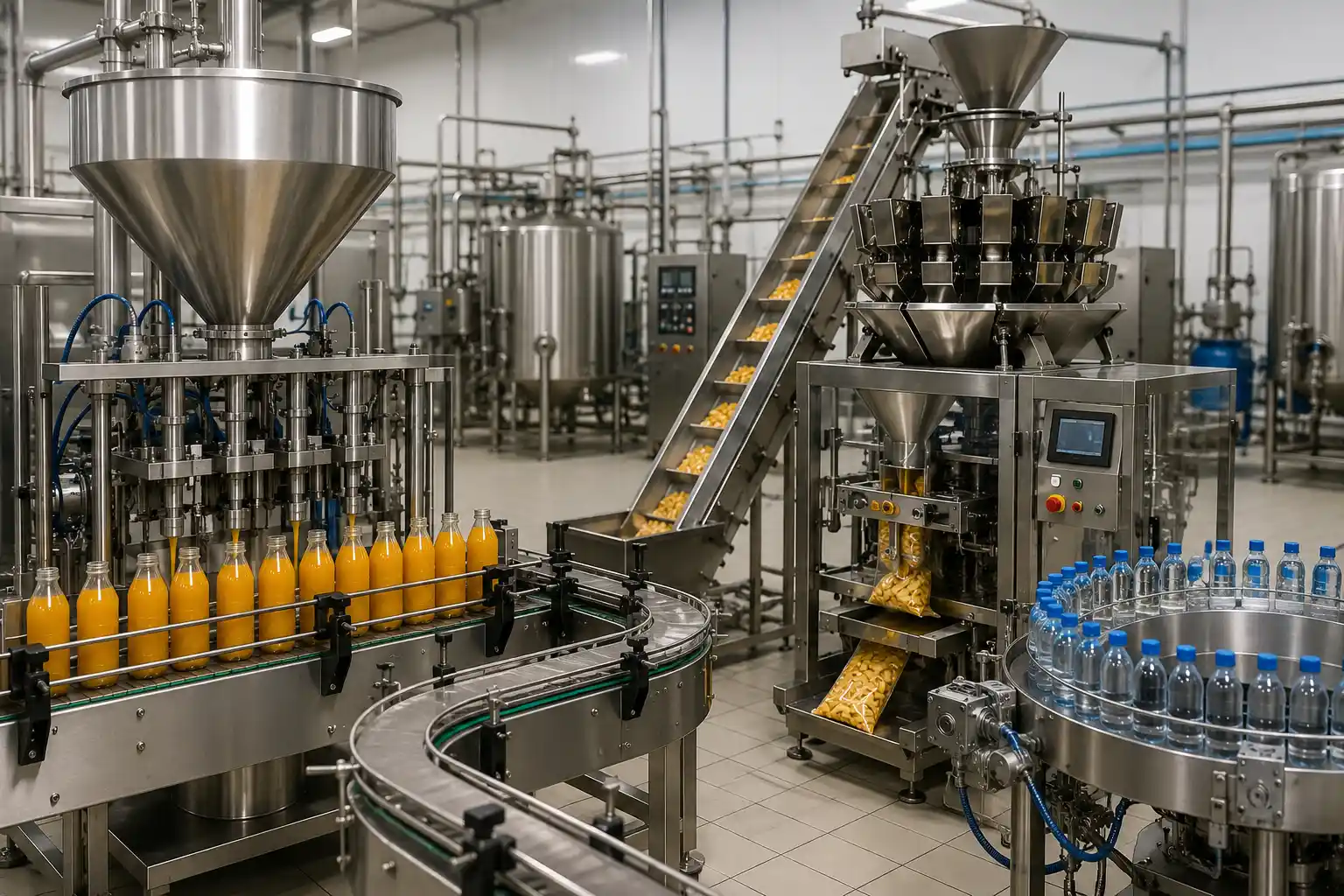
Food and beverage processing machinery must meet strict hygiene standards such as 3A, EHEDG, and FDA regulations before it can touch your product. From industrial mixers to CIP systems, every piece of equipment in the line needs to be built for washdown, inspection, and contamination control. This guide covers the full processing and filling stack used in modern F&B facilities.
A single contamination event can shut down a production line, trigger a product recall, and cost a food manufacturer hundreds of thousands of dollars in losses, regulatory fines, and damaged contracts. In most cases, the root cause is not operator error. It is equipment that was never designed to be properly cleaned.
Food and beverage processing machinery must be engineered around hygiene from the first design stage, not retrofitted for cleanliness after the fact. That requirement is codified in three major standards: 3A Sanitary Standards, EHEDG (European Hygienic Engineering & Design Group), and FDA 21 CFR Part 117 under FSMA. Together, they define what materials, surface finishes, weld quality, drainability, and cleanability mean in practice for every mixer, heat exchanger, filler, and CIP system on your line.
The Three Hygiene Frameworks That Govern F&B Equipment
Before comparing equipment types, it is worth understanding what each framework actually regulates and where they overlap.
| Standard | Governing Body | Geographic Scope | Primary Application |
| 3A Sanitary Standards | 3-A SSI (USA) | North America (globally recognized) | Dairy, food & beverage equipment, product-contact surfaces |
| EHEDG | European Hygienic Engineering & Design Group | EU & international export markets | Broad food processing, aseptic and hygienic design |
| FDA 21 CFR Part 117 | U.S. Food & Drug Administration | USA (FSMA compliance) | Equipment used in CGMP food facilities |
| EC 1935/2004 | European Commission | European Union | Food-contact materials and article safety |
3A Sanitary Standards
3A standards are developed jointly by equipment fabricators, processors, and public health regulators through 3-A SSI (Sanitary Standards, Inc.). Each standard covers a specific equipment type: Standard No. 02 covers centrifugal and positive rotary pumps, No. 74 covers flow meters, No. 85 covers mixers and agitators, and so on.
The core design requirements across 3A standards include:
- All product-contact surfaces must be smooth, corrosion-resistant, non-absorbent, and free of pits, cracks, or crevices
- Internal surface finish must meet Ra (average roughness) of 0.8 microns or better
- Welds must be continuous, smooth, and cleanable without disassembly
- Equipment must be self-draining with no dead legs where product or cleaning solutions can pool
- Seals and gaskets must be FDA-compliant materials (PTFE, EPDM, food-grade silicone)
Third-party certification is issued by Dairy Practices Council (DPC) or NSF International. A certified piece of equipment carries a 3A symbol and a registration number that can be verified on the 3-A SSI public registry at www.3-a.org.
EHEDG (European Hygienic Engineering & Design Group)
EHEDG was founded in 1989 and operates as a consortium of food manufacturers, equipment suppliers, research institutions, and public health authorities. It publishes over 50 technical guidelines covering hygienic design principles for processing equipment, installation, and facility design.
EHEDG issues two primary certification types:
- EL (Hygienic Design): for equipment used in non-aseptic environments, cleaned-in-place or out-of-place
- EL Aseptic (Class I or II): for equipment operating in aseptic or ultra-clean environments, including UHT processing lines
Where 3A focuses heavily on dairy and commodity food processing, EHEDG covers a broader range of food categories and places additional emphasis on installability and dead-leg-free system design at the full line level, not just individual pieces of equipment.
For manufacturers exporting to EU markets or operating under EU food safety law, EHEDG certification on product-contact equipment is increasingly a contractual requirement from buyers and auditors.
FDA 21 CFR Part 117 and FSMA
The Food Safety Modernization Act (FSMA) mandates that all equipment and utensils used in food contact must be designed and constructed to be adequately cleanable, maintained in good repair, and prevent contamination of food. The specific regulation is 21 CFR Part 117.40, which falls under Current Good Manufacturing Practice (CGMP).
FDA does not certify individual pieces of equipment the way 3A or EHEDG does. Instead, compliance is verified during facility inspections, and the burden of proof rests with the food manufacturer to demonstrate that equipment selection, installation, and cleaning procedures meet CGMP requirements. In practice, purchasing 3A or EHEDG certified equipment is the most direct way to satisfy FDA inspection requirements.
Material Requirements: Stainless Steel Grades and Seal Materials
Material selection is the foundation of hygienic equipment design. The wrong grade of stainless steel, or a seal material not listed in FDA 21 CFR 177, can disqualify an otherwise well-engineered piece of equipment from a hygienic production environment.
| Material | Grade | Best Use | Key Limitation |
| Stainless Steel | 304 SS | General food-contact surfaces, tanks, conveyors | Susceptible to pitting in chloride-rich environments |
| Stainless Steel | 316L SS | Acidic products, brine, seafood, CIP chemical exposure | Higher cost than 304 |
| PTFE | Virgin or glass-filled | Seals, gaskets, valve seats requiring chemical resistance | Lower mechanical strength vs. metal |
| EPDM | Food-grade EPDM | Gaskets, O-rings in heat exchangers and filling valves | Not suitable for oils and some solvents |
| Silicone | FDA-grade silicone | Tubing, flexible connections, CIP hoses | Higher permeability than PTFE |
304 vs. 316L Stainless Steel: When the Upgrade Matters
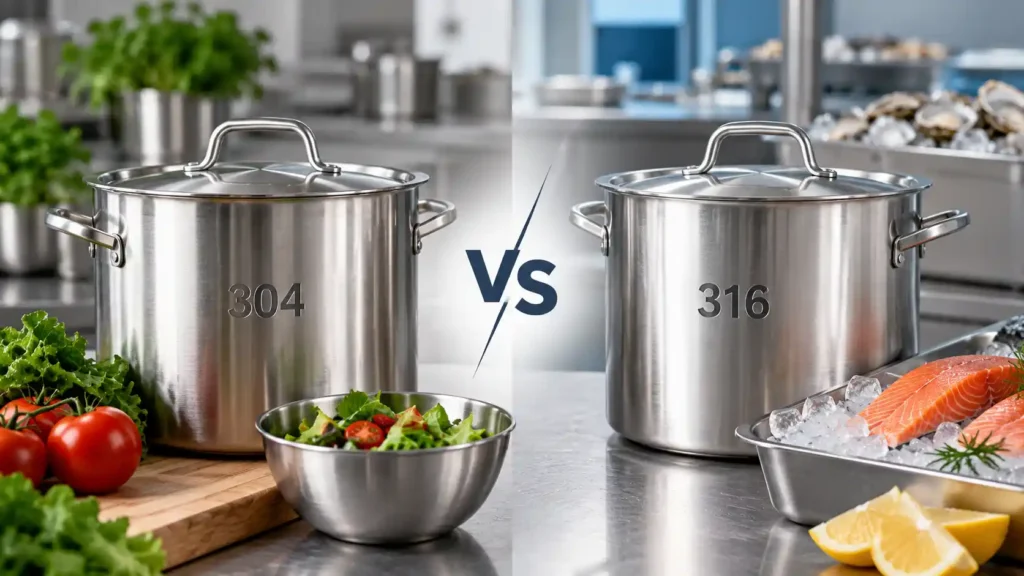
304 SS (also called 18/8 for its 18% chromium and 8% nickel content) is the standard food-grade material for tanks, conveyors, chutes, and non-aggressive product contact surfaces. It handles most food applications well at a lower cost.
316L SS adds 2-3% molybdenum, which significantly improves resistance to pitting corrosion caused by chlorides. This matters in three common F&B scenarios:
- Equipment that contacts acidic products like citrus juices, vinegar, fermented beverages, or tomato-based products
- CIP systems that use chlorinated sanitizers or aggressive acid washes
- Coastal or high-humidity environments where airborne chlorides accelerate external corrosion
The ‘L’ in 316L designates low carbon content, which prevents carbide precipitation at weld joints. This is critical for hygienic equipment because carbide precipitation creates micro-crevices at welds that trap bacteria and resist cleaning.
Surface Finish Standards: Why Ra Values Define Cleanability
Surface roughness is measured as Ra (arithmetic average roughness) in micrometers. A rough surface has more microscopic peaks and valleys where biofilm can develop and cleaning solutions cannot reach. 3A and EHEDG both specify maximum Ra values based on the surface location and its risk level.
| Surface Location | Required Ra Value | Finish Method | Standard Reference |
| Product-contact interior (tanks, pipes) | Ra ≤ 0.8 µm | Mechanical polish + electropolish | 3A-SSI, EHEDG |
| Weld seams (internal) | Ra ≤ 0.8 µm (full penetration) | Orbital welding + re-polish | EHEDG Doc 9 |
| Valve seats & plug surfaces | Ra ≤ 0.4 µm | Precision grinding + lap finish | 3A Standard No. 74 |
| Non-product exterior surfaces | Ra ≤ 3.2 µm | Mechanical brush or mill finish | General hygiene guidelines |
| CIP spray nozzle internals | Ra ≤ 0.8 µm | Electropolish | 3A-SSI, EHEDG |
Electropolishing is the preferred finishing method for the highest-risk surfaces. Unlike mechanical polishing, which can leave directional scratch marks, electropolishing removes the microscopic peaks through an electrochemical process, producing a passive chromium-oxide layer that is smoother, more corrosion-resistant, and easier to clean.
Weld Quality: The Most Common Compliance Failure Point
Internal weld quality is where many equipment manufacturers fail hygiene audits. The specific failures that 3A and EHEDG inspectors look for include:
- Undercut welds: surface depression at the weld toe that creates a crevice
- Incomplete fusion: gaps within the weld body that bacteria can colonize over time
- Irregular bead geometry: raised or uneven weld surface that cannot be polished to Ra < 0.8 µm
- Discoloration (heat tint): oxidized weld surface that reduces corrosion resistance and must be removed by pickling or re-passivation
Orbital welding is now the standard for hygienic pipe fabrication because it produces consistent, repeatable weld geometry with minimal spatter and uniform penetration. For tank fabrication, TIG (GTAW) welding by a certified welder, followed by re-polish and passivation, remains standard practice.
How These Standards Apply to Specific Equipment Categories
Mixers and Agitators
3A Standard No. 85 covers mixers and agitators for food processing. The key design requirements include seal-less shaft options or lip seals with no pockets, spray ball coverage for CIP in sealed mixing vessels, and self-draining geometry in the vessel base and agitator blades.
Planetary mixers present a more complex certification challenge than ribbon blenders because of the multi-shaft orbital mechanism. High-end commercial planetary mixers now offer CIP-validated wash cycles where the entire bowl and agitator assembly is cleaned in-place using an integrated spray system. Operators should request the CIP validation documentation, including spray ball coverage maps, before purchase.
Heat Exchangers
Plate heat exchangers must use food-grade gasket materials (EPDM or NBR) that comply with EC 1935/2004 and FDA 21 CFR 177. Gasket design must be crevice-free at the plate contact interface. EHEDG Guideline Doc. No. 9 specifically covers heat exchangers and requires that the plate pack can be fully CIP-cleaned without disassembly.
Tubular heat exchangers for aseptic processing must meet EHEDG EL Aseptic Class I certification. The tube-to-tube-sheet joint is the highest-risk point: improper welds here create dead spaces where product can burn onto the surface during thermal processing.
Filling and Capping Machines
Filling valves and nozzles must be designed for in-place sterilization (SIP) in aseptic lines and for CIP cleaning in standard beverage lines. All product-contact seals must be listed materials. The valve body geometry must prevent product drip accumulation at the nozzle tip between fills, which is a common contamination point on non-hygienic filling equipment.
Capping machines are lower risk than filling equipment because they contact closures rather than open product. However, the torque head and starwheel contact points must still meet cleanability requirements if they operate in a high-care production zone.
Compliance Checklist: What to Verify Before Purchasing
Use the following checklist when evaluating any food and beverage processing machinery supplier. Request documentation for all high-priority items before placing an order.
| Verification Item | How to Confirm | Priority |
| 3A certification number | Cross-check on 3-A SSI public registry (3-a.org) | High |
| EHEDG certificate type (EL or EL Aseptic) | Request certificate from manufacturer | High |
| Material test certificates (EN 10204 3.1) | Mill cert for 316L SS contact surfaces | High |
| Surface finish Ra test reports | Profilometer measurements from supplier QC | Medium |
| Seal and gasket FDA compliance (21 CFR 177) | Request materials list with FDA CFR references | High |
| IP69K rating for washdown zones | Check motor and panel IP rating on datasheet | Medium |
| CIP validation protocol included | Ask for spray ball coverage and flow velocity report | Medium |
| Dead-leg-free pipework design | Review P&ID drawings with supplier engineer | High |
Note: If a manufacturer cannot provide EN 10204 3.1 or 3.2 material test certificates for product-contact stainless steel, treat that as a disqualifying factor. Reputable hygienic equipment manufacturers provide these as standard documentation.
Final Takeaway
Selecting food and beverage processing machinery is a compliance decision before it is a capacity or cost decision. Equipment that does not meet 3A, EHEDG, or FDA CGMP requirements cannot be used in a certified production facility, regardless of its output rate or price point. Verifying certifications, material grades, surface finishes, and CIP compatibility before purchase eliminates the most common and most expensive compliance failures in F&B plant design. Mekantra Technologies sources food-grade processing machinery built to 304 and 316L stainless steel standards, with full documentation for 3A, EHEDG, and FDA compliance requirements.
Frequently Asked Questions
What is the difference between 3A and EHEDG certification?
3A Sanitary Standards are a US-based certification system administered by 3-A SSI, with strong roots in dairy and food processing equipment. EHEDG is a European framework with a broader scope covering full processing line design, aseptic applications, and facility-level hygiene engineering. For export to EU markets, EHEDG certification is often required. For US domestic dairy applications, 3A is the primary standard. Many global equipment manufacturers now seek both certifications.
Can I use 304 stainless steel for all food processing equipment?
304 SS is suitable for most general food-contact applications. However, for equipment handling acidic products (pH below 4.5), brine solutions, or high-chloride CIP chemicals, 316L SS is required. Using 304 SS in these applications accelerates pitting corrosion, which creates surface defects that trap bacteria and fail hygiene audits over time.
Is EHEDG certification legally required in the European Union?
EHEDG certification is not a legally mandated requirement under EU food law. However, EU Regulation EC 1935/2004 requires that food-contact equipment be designed to minimize contamination risks. In practice, EHEDG certification is the most recognized third-party verification of compliance with that regulation, and many large food manufacturers include EHEDG certification as a contractual requirement in their supplier agreements.
What does IP69K mean for food processing equipment?
IP69K is an ingress protection rating that defines the equipment’s ability to withstand high-pressure, high-temperature washdown (up to 100 bar at 80°C from a distance of 10-15 cm). Motors, control panels, and electrical enclosures in the washdown zones of a food processing facility must carry at least IP65 (protected against water jets) and ideally IP69K for full pressure washdown compatibility.
What is a dead leg in food processing pipework?
A dead leg is a section of pipework where product or cleaning solution can stagnate because it is not part of the active flow circuit. Dead legs create zones where bacteria multiply unchecked between production runs and where CIP solutions cannot achieve turbulent flow for effective cleaning. Hygienic pipework design eliminates dead legs by ensuring all pipe branches are either active or fitted with hygienic valves that are included in the CIP circuit.

Mekantra Engineering Team
The technical voice of Mekantra. Our team consists of sourcing specialists, mechanical engineers, and logistics experts dedicated to providing transparent insights and high-performance solutions for the global manufacturing sector.
Mekantra Engineering Team
The technical voice of Mekantra. Our team consists of sourcing specialists, mechanical engineers, and logistics experts dedicated to providing transparent insights and high-performance solutions for the global manufacturing sector.