Glass Lined vs Stainless Steel Reactor: Which is Better?
In the world of industrial manufacturing, your chemical processing equipment is the beating heart of your facility. Whether you are synthesizing life-saving pharmaceuticals, formulating agrochemicals, or processing food and beverages, the vessel you use dictates the success, safety, and purity of your final product.
When it comes to reactor material selection, plant engineers and procurement managers usually face one primary debate: glass lined vs stainless steel reactor.
At first glance, both chemical reactor types seem to perform the same function they hold, mix, and react chemicals under controlled temperatures and pressures. However, the materials they are made from react very differently to thermal stress, mechanical impact, and harsh acids. Choosing the wrong industrial reactor vessel can lead to catastrophic equipment failure, dangerous leaks, or severe product contamination.
What is a Glass-Lined Reactor?
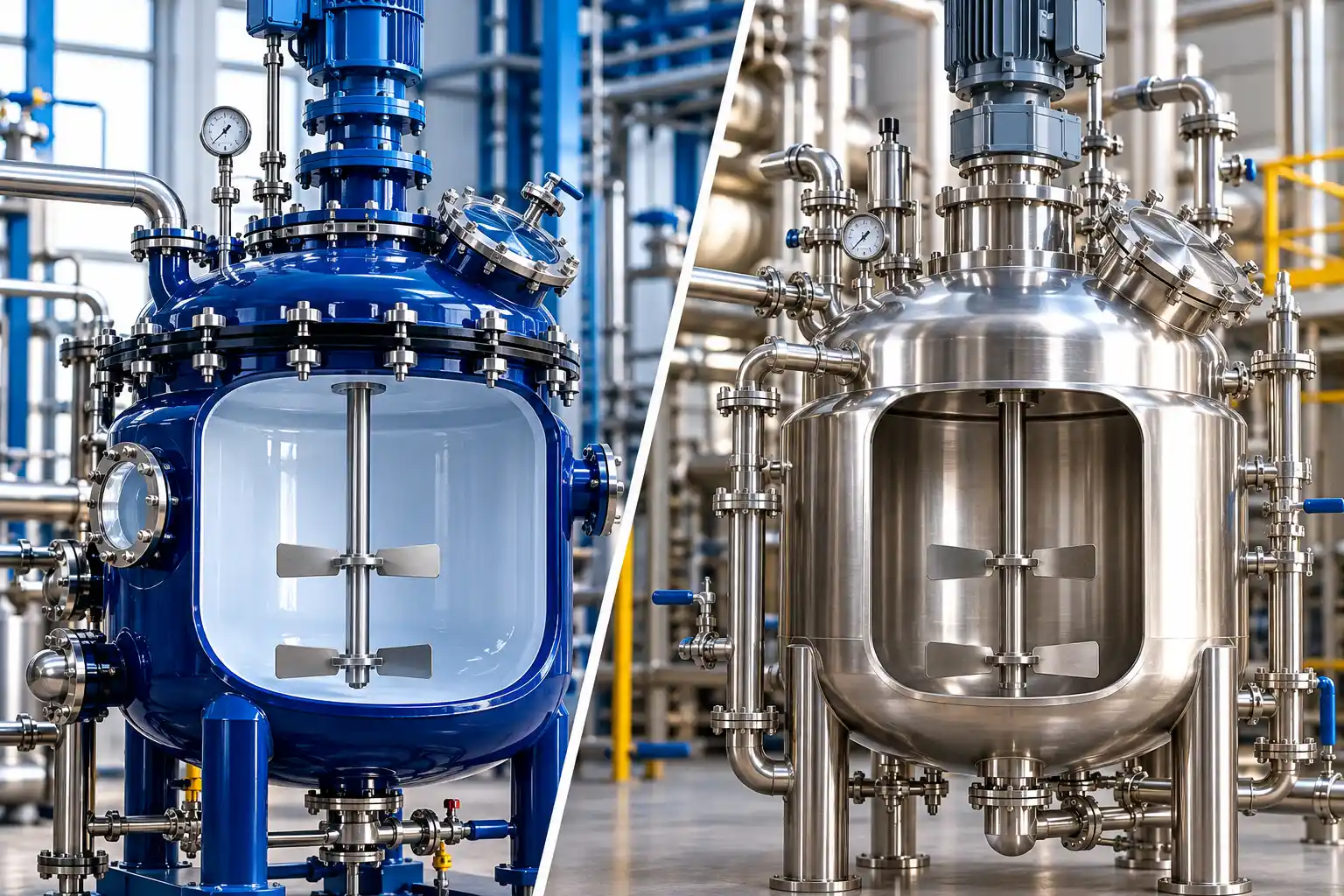
A glass-lined reactor is a highly specialized piece of chemical processing equipment designed to handle the most aggressive, highly acidic environments.
But how is it made? A glass-lined reactor is not made entirely of glass. It features a heavy-duty outer shell usually made of carbon steel. The inside of this steel shell is sprayed with a specially formulated glass frit (enamel). The vessel is then placed into a massive furnace and baked at extreme temperatures, typically between 800°C and 850°C.
This firing process fuses the glass directly to the steel matrix. The result is a composite industrial reactor vessel that provides the structural strength of metal with the unmatched chemical inertness of glass.
Key Features of a Glass-Lined Reactor:
- Inert Non-Stick Surface: The inner glass layer does not react with chemicals and prevents viscous materials from sticking to the walls.
- Zero Metal Leaching: Because the product never touches metal, there is no risk of heavy metal contamination.
- Smooth Finish: The ultra-smooth enamel is incredibly easy to clean, making it ideal for high-purity chemical processing.
What is a Stainless Steel Reactor?
A stainless steel reactor is an industrial mixing vessel constructed entirely from highly durable metal alloys. The most common grades used for stainless steel process equipment are 304 and 316L.
What makes stainless steel “stainless”? These metal alloys contain specific amounts of chromium, nickel, and (in the case of 316L) molybdenum. When exposed to oxygen, the chromium forms a microscopic, invisible layer on the surface of the metal called the “passive layer.” This passive oxide layer acts as a shield, preventing the underlying iron from rusting and giving the reactor excellent durability against various chemical agents.
Stainless steel process equipment is celebrated for being rugged, versatile, and highly thermally conductive.
Key Features of a Stainless Steel Reactor:
- High Tensile Strength: Metal can withstand heavy impacts, high pressures, and extreme vibrations.
- Superior Heat Transfer: Stainless steel conducts heat quickly, allowing for rapid heating and cooling of chemical batches.
- Highly Customizable: Unlike glass, stainless steel can be easily cut, welded, and modified on-site to add new baffles or agitators.
Detailed Comparison: Glass Lined vs Stainless Steel Reactor
To accurately evaluate which vessel is better for your facility, we must look at how each chemical reactor material behaves under intense industrial conditions.
1. Reactor Corrosion Resistance and Chemical Compatibility
Glass-Lined Reactors:
When evaluating reactor corrosion resistance in highly acidic environments, the glass-lined reactor is the undisputed champion. The glass enamel is virtually impervious to a wide spectrum of aggressive organic and inorganic acids, including hydrochloric acid, sulfuric acid, and nitric acid. It maintains this resistance even at elevated temperatures and high concentrations.
- The Catch: Glass-lined equipment has two major chemical enemies. First, it will be rapidly eaten away by hydrofluoric acid (HF) at any temperature. Second, it cannot withstand strong, hot alkalis (bases) like concentrated sodium hydroxide.
Stainless Steel Reactors:
Stainless steel offers fantastic chemical compatibility for a broad range of operations. It easily handles neutral solutions, organic solvents, mild bases, and weak acids. If your process requires Grade 316L, the added molybdenum provides extra protection against chloride-induced corrosion.
- The Catch: Stainless steel is vulnerable to strong mineral acids. If exposed to high concentrations of hydrochloric or sulfuric acid, the passive layer will break down, leading to pitting corrosion and stress corrosion cracking.
2. Temperature Resistance and Thermal Shock
Glass-Lined Reactors:
Glass-lined vessels typically operate safely between -20°C and 200°C. However, their biggest weakness is thermal shock. Glass and steel expand and contract at slightly different rates. If you introduce a freezing cold liquid into a hot glass-lined reactor, the sudden temperature drop (Delta T) will cause the glass lining to shatter, crack, or completely delaminate from the steel backing. Plant operators must strictly follow gradual heating and cooling curves.
Stainless Steel Reactors:
Stainless steel process equipment shines when it comes to temperature extremes. Standard vessels can easily handle cryogenic freezing (-196°C) up to scorching high temperatures (over 400°C). Furthermore, stainless steel is completely immune to thermal shock. You can rapidly heat or cool a batch without fear of fracturing the vessel walls.
3. Pressure Ratings and Handling
Glass-Lined Reactors:
Because the structural core is made from heavy carbon steel, a glass-lined reactor can handle standard internal pressures. However, because the glass lining is brittle, it cannot bend or flex. Excessive high-pressure applications can place microscopic stress on the glass enamel. Therefore, they are generally rated for moderate pressure environments (commonly up to 6 to 10 bar).
Stainless Steel Reactors:
Stainless steel is naturally ductile, meaning it can flex slightly under pressure without breaking. If your process involves high-pressure hydrogenation or pressurized gas reactions, a stainless steel reactor is the safer choice. Engineers can simply increase the wall thickness of the stainless steel to safely accommodate extreme burst pressures.
4. Mechanical Durability
Glass-Lined Reactors:
Mechanical durability is the primary drawback of glass-lined equipment. The inner glass surface is fragile. Dropping a wrench inside the tank during maintenance, overtightening a nozzle flange, or severe mechanical vibration from the agitator can chip the glass. Once a chip occurs, the exposed carbon steel will rust immediately when exposed to acids, ruining the batch and requiring immediate repair.
Stainless Steel Reactors:
Stainless steel is incredibly tough. It can endure heavy physical impacts, industrial vibrations, and rough handling. You never have to worry about a surface shattering. This makes stainless steel reactors highly reliable for heavy-duty, long-term use in demanding environments.
5. Cleaning and Contamination Considerations
Glass-Lined Reactors:
Because the glass surface is non-porous at a microscopic level, it offers a true “non-stick” environment. Sticky polymers and thick resins will not cling to the walls, making batch changeovers and cleaning incredibly fast. More importantly, glass does not leach any materials into the product. This makes glass-lined reactors mandatory for high-purity Active Pharmaceutical Ingredients (APIs) where even parts-per-million of metal contamination would cause a batch failure.
Stainless Steel Reactors:
Polished stainless steel is smooth, but it still features microscopic pores. Over time, products can build up, and the metal can suffer from surface scratching or “rouging” (a red surface rust common in pure water systems). However, stainless steel is perfectly suited for Automated Clean-In-Place (CIP) and Sterilize-In-Place (SIP) systems. As long as metal leaching is not a concern for your specific chemical reaction, stainless steel remains highly sanitary.
6. Maintenance Requirements
Glass-Lined Reactors:
Maintaining a glass-lined vessel requires specialized training. Plant technicians must routinely perform “spark testing”—running a high-voltage electrical wand over the glass surface to detect microscopic pinholes. If a small chip is found, it must be patched with a highly expensive tantalum plug. If the damage is too large to plug, the entire vessel must be shipped back to the manufacturer to be stripped and “re-glassed,” resulting in massive downtime.
Stainless Steel Reactors:
Maintenance for stainless steel process equipment is straightforward and highly accessible. Routine visual inspections are usually sufficient. To maintain corrosion resistance, operators occasionally perform a chemical “passivation” wash to restore the protective oxide layer. If a stainless steel reactor cracks or develops a leak, a certified welder can fix it directly on the factory floor, saving time and money.
Typical Applications: Which Industries Use Which?
Understanding the chemical reactor types used across different sectors can guide your reactor material selection.
When to Choose a Glass-Lined Reactor:
- Agrochemical Manufacturing: Processing harsh pesticides, herbicides, and fertilizers that utilize highly corrosive acids.
- High-Purity Pharmaceuticals: Manufacturing sensitive drugs and APIs where cross-contamination or metal leaching is strictly prohibited by GMP (Good Manufacturing Practices).
- Specialty Chemicals: Any chemical synthesis involving halogenated compounds (like chlorine or bromine).
- Polymerization Processes: Environments where a non-stick surface is required to keep thick polymers moving efficiently.
When to Choose a Stainless Steel Reactor:
- Food and Beverage Processing: Brewing beer, processing dairy, and formulating food additives where heavy CIP washdown cycles are used daily.
- Petrochemicals and Oil Refining: High-temperature, high-pressure environments, and solvent recovery systems.
- Cosmetics and Personal Care: Mixing highly viscous lotions, creams, shampoos, and soaps.
- General Chemical Processing: Any bulk chemical reaction involving neutral solutions, alkalis, mild acids, or organic solvents that demand rapid temperature shifts.
Limitations of Each Material
To fully understand a glass lined vs stainless steel reactor, you must also understand what they cannot do. No industrial reactor vessel is perfect for every scenario.
Limitations of Glass-Lined Reactors:
- Extreme Fragility: Highly susceptible to accidental mechanical damage (chipping) and thermal shock (shattering).
- Vulnerability to Bases: Cannot handle strong, hot alkalis or hydrofluoric acid (HF).
- Poor Heat Transfer Coefficient: Glass acts as a thermal insulator, meaning it takes much longer to heat up or cool down a batch compared to bare metal.
- Difficult Repairs: On-site repairs are limited; extensive damage requires costly, time-consuming re-glassing.
Limitations of Stainless Steel Reactors:
- Corrosion from Strong Mineral Acids: Highly vulnerable to severe pitting, rusting, and cracking when exposed to strong acids like Hydrochloric (HCl) or Sulfuric (H2SO4) acids.
- Product Adhesion: Sticky, viscous materials can stick to metal walls, requiring more aggressive physical cleaning.
- Metal Leaching Risk: Over time, trace amounts of nickel, iron, or chromium can leach into highly sensitive chemical batches, causing contamination.
Comparison Table: Glass Lined vs Stainless Steel Reactor
To simplify your chemical processing equipment research, we have created a quick-reference chart. Use this table from Mekantra Technologies to evaluate your needs at a glance.
| Feature / Specification | Glass-Lined Reactor | Stainless Steel Reactor |
|---|---|---|
| Primary Material Construction | Carbon steel shell fused with glass enamel | 304, 316L, or specialized Stainless Steel alloys |
| Reactor Corrosion Resistance | Excellent for strong acids (except HF). Poor for hot alkalis. | Good for alkalis, weak acids, and solvents. Poor for strong mineral acids. |
| Thermal Shock Resistance | Poor. Highly sensitive to sudden temperature changes (Delta T limits). | Excellent. Immune to thermal shock; allows rapid heating/cooling. |
| Mechanical Durability | Low. Brittle surface can chip from impact, dropped tools, or heavy vibration. | High. Rugged, ductile, and highly impact-resistant. |
| Heat Transfer Rate | Slower (Glass acts as a natural thermal insulator). | Faster (Metal is a strong thermal conductor). |
| Cleanability & Purity | Exceptional (Non-stick, ultra-smooth surface, zero metal leaching). | Very Good (Supports heavy CIP/SIP wash cycles, but may leach trace metals). |
| Repairability | Difficult. Requires specialized tantalum plugs or expensive factory re-glassing. | Easy. Can be welded, polished, and passivated directly on-site. |
| Pressure Handling | Moderate. Limited by the stress thresholds of the brittle glass lining. | High. Can be engineered with thicker walls for extreme internal burst pressure. |
Conclusion: Making the Right Reactor Material Selection
At the end of the day, answering the question of “glass lined vs stainless steel reactor: which is better?” comes down to the precise chemical and physical demands of your manufacturing process.
If your facility routinely handles highly aggressive mineral acids, works with halogenated compounds, or requires a completely inert, non-stick environment to prevent heavy metal contamination in pharmaceuticals, a glass-lined reactor is the absolute best option. You simply must ensure your team is trained to handle the equipment with care to avoid mechanical and thermal shock.
On the flip side, if your daily processes involve high pressures, extreme and rapid temperature variations, strong alkaline solutions, or if you require robust mechanical durability and easy on-site maintenance, a stainless steel reactor is the superior, most cost-effective choice.
Upgrade Your Chemical Processing Equipment with Mekantra Technologies
At Mekantra Technologies, we understand that investing in an industrial reactor vessel is a massive decision that impacts your entire supply chain. Selecting the right chemical reactor types ensures the safety of your operators, the high purity of your final product, and the long-term profitability of your plant operations.
Are you currently evaluating stainless steel process equipment or looking for expert guidance on reactor material selection for your next big project? We are here to help.
Visit Mekantra Technologies today to explore our comprehensive range of highly engineered industrial solutions designed to meet your exact process requirements. Let our experts help you build a safer, more efficient, and more productive processing facility.

Mekantra Engineering Team
The technical voice of Mekantra. Our team consists of sourcing specialists, mechanical engineers, and logistics experts dedicated to providing transparent insights and high-performance solutions for the global manufacturing sector.
Mekantra Engineering Team
The technical voice of Mekantra. Our team consists of sourcing specialists, mechanical engineers, and logistics experts dedicated to providing transparent insights and high-performance solutions for the global manufacturing sector.