Sour Gas Control Valves: Material Selection
Summary:
“Sour gas streams containing hydrogen sulfide (H₂S) present severe corrosion, sulfide stress cracking (SSC), and hydrogen embrittlement risks to control valves. This guide breaks down NACE MR0175/ISO 15156 material compliance, valve body metallurgy, and trim selection for severe refinery service.”
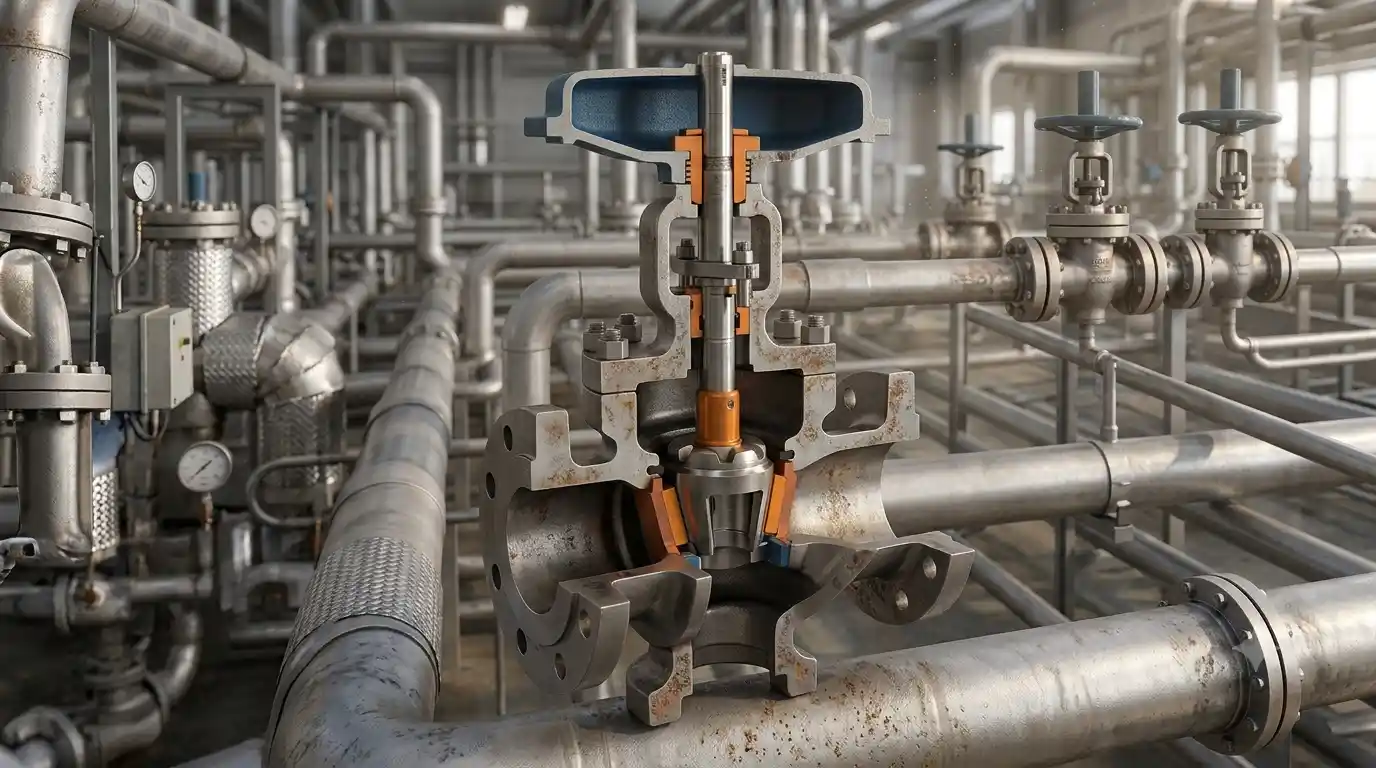
Operating control valves in sour gas environments is one of the most demanding challenges in oil refining and upstream processing. When process streams contain hydrogen sulfide (H₂S), standard materials degrade rapidly, risking severe leaks, catastrophic mechanical failure, and unscheduled plant shutdowns.
Selecting the right metallurgy requires balancing pressure ratings, temperature limits, process chemistry, and compliance with industry standards like NACE MR0175/ISO 15156 and NACE MR0103/ISO 17945.
What Makes Sour Gas Hazardous to Control Valves?
A gas stream is classified as “sour” when the partial pressure of H₂S exceeds 0.05 psia (0.3 kPa). In wet conditions, H₂S dissolves in free water, creating a highly corrosive environment that attacks metal components through three primary failure mechanisms:
- Sulfide Stress Cracking (SSC): Brittle failure occurring under tensile stress in high-strength or high-hardness alloys exposed to wet H₂S.
- Hydrogen-Induced Cracking (HIC): Internal cracking caused by atomic hydrogen diffusing into the steel lattice, trapping gas in microscopic voids and forming pressure blisters.
- Stress Corrosion Cracking (SCC): Synergistic cracking driven by the combined effects of tensile stress, H₂S, elevated temperatures, and trace chlorides.
Key Rule: Uncontrolled hardness accelerates hydrogen embrittlement. Standard carbon steels often fail rapidly in sour environments unless properly heat-treated and hardness-restricted.
Governing Metallurgy Standards: NACE MR0175 vs. NACE MR0103
Specifying materials for sour gas control valves requires clear alignment with the appropriate industry framework:
- NACE MR0175 / ISO 15156 (Upstream): Governs oilfield equipment, offshore platforms, wellheads, and gas processing plants. It establishes strict environmental limits based on H₂S partial pressure, pH, temperature, and chloride concentrations.
- NACE MR0103 / ISO 17945 (Downstream): Applies to petroleum refineries, hydrotreaters, sour water strippers, and amine units. It focuses heavily on stress relief, post-weld heat treatment (PWHT), and maximum hardness thresholds.
Under both standards, standard metallic materials must meet strict hardness limits—typically a maximum of 22 HRC (Rockwell C) for carbon and low-alloy steels to maintain ductility and resist hydrogen damage.
Valve Body & Bonnet Material Selection
The valve body and bonnet form the primary pressure boundary. Material selection depends on operating temperature, fluid acidity, and chloride content.
| Process Environment | Temperature Range | Recommended Body Material | Key NACE Compliance Requirement |
| Mild Sour Service (H₂S < 100 ppm) | -29°C to 425°C | Carbon Steel (ASTM A216 WCB/WCC) | Normalized or Annealed, Hardness ≤ 22 HRC |
| Low-Temp Sour Service | -46°C to 340°C | Low-Temp CS (ASTM A352 LCC) | Charpy V-Notch Impact Tested, PWHT |
| Corrosive Sour Service (H₂S + Chlorides) | -40°C to 260°C | Stainless Steel (ASTM A351 CF8M / 316L) | Solution Annealed, Hardness ≤ 22 HRC |
| Severe High-Pressure Sour | -40°C to 300°C | Duplex SS (ASTM A890 Grade 4A / 2205) | PREN ≥ 34, Ferrite content 35–55% |
| Extreme Acid Gas / Ultra-Sour | -50°C to 400°C | Inconel 625 / Hastelloy C-276 Forgings | Solid Nickel Alloy or Full Weld Overlay |
Valve Trim Selection: Plugs, Seats, Cages & Stems
Control valve trim components endure extreme mechanical stresses, fluid shear, and high pressure drops, making them vulnerable to erosion-corrosion alongside chemical attack.
1. Valve Stems
The stem transmits high actuator forces and must resist both bending fatigue and SSC.
- Standard Sour Service: Solution heat-treated 316 Stainless Steel (up to moderate pressure).
- High-Differential Pressure: Inconel 718 (UNS N07718) or Monel K-500, double-aged and solution heat-treated for maximum tensile strength while maintaining NACE hardness limits.
2. Plugs, Seats, and Cages
Erosion can strip away protective oxide layers, exposing fresh metal to sour corrosion.
- Standard Trim: 316 Stainless Steel with Stellite 6 hardfacing on seating surfaces to prevent wire-drawing and galling.
- Anti-Cavitation / High-Pressure Drop: Full solid cobalt alloy (Stellite) or tungsten carbide inserts inside multi-stage cage trims to dissipate energy safely.
Gaskets, Stem Packing, and External Fasteners
A control valve’s non-metallic seals and external bolting must also be rated for severe service to prevent fugitive emissions or structural frame failure.
- Stem Packing: Live-loaded PTFE V-ring packing sets for process temperatures up to 200°C. For higher temperatures, high-purity die-formed flexible graphite sets with corrosion inhibitors are required.
- Body Gaskets: Spiral-wound 316SS or Inconel 625 gaskets filled with flexible graphite, complete with an inner retaining ring to prevent gasket buckling.
- External Bolting: Standard ASTM A193 B7 high-strength bolts are prone to rapid SSC if exposed to even trace H₂S leaks. Sour applications require ASTM A193 Grade B7M bolts (hardness capped at 22 HRC) or Grade B8M stainless steel bolting.
Engineering Sizing & Selection Checklist
Before finalizing control valve specifications for sour gas service, verify the following engineering parameters:
- [ ] Calculate Partial Pressure: Confirm H₂S partial pressure (P_H₂S = Total Pressure × Mole Fraction H₂S).
- [ ] Verify Heat Treatment: Ensure heat treatment records (PWHT, Solution Anneal) are included in the Material Test Reports (MTRs).
- [ ] Confirm Hardness Testing: Request 100% hardness testing verification (Rockwell C / Vickers) on all wetted metallic components.
- [ ] Assess Pressure Drop Ratio (x_T): Select multi-stage anti-cavitation trim if flashing or cavitation risk is present in wet H₂S streams.
- [ ] Inspect Fasteners: Verify external body-to-bonnet bolting strictly complies with ASTM A193 B7M standards.
Partnering with Mekantra Technologies
Selecting the proper metallurgy for sour gas applications requires deep technical expertise and strict compliance oversight. Mekantra Technologies provides high-reliability, NACE MR0175/MR0103 compliant severe-service control valves engineered for optimal performance in demanding oil refinery and gas processing environments.
Contact the technical engineering team at Mekantra Technologies to discuss your project specifications and equipment sourcing requirements.
Frequently Asked Questions (FAQs)
What defines a gas stream as “sour” in control valve applications?
A gas stream is classified as sour service when the partial pressure of Hydrogen Sulfide (H₂S) exceeds 0.05 psia (0.3 kPa) in upstream operations or specified thresholds in downstream refining. When moisture is present, H₂S forms an acidic environment that induces severe cracking mechanisms such as Sulfide Stress Cracking (SSC) and Hydrogen-Induced Cracking (HIC) in standard alloys.
What is the maximum allowable hardness for carbon steel valves under NACE MR0175?
Under NACE MR0175 / ISO 15156 (and NACE MR0103 for refining), the maximum hardness for carbon and low-alloy steel valve components (including parent metal, welds, and heat-affected zones) is restricted to 22 HRC (250 HV). Keeping hardness below this limit ensures the material maintains sufficient ductility to resist hydrogen embrittlement and catastrophic cracking.
Why is 17-4 PH Stainless Steel restricted in severe sour gas valve trims?
While 17-4 PH Stainless Steel offers high mechanical strength, its microstructure becomes highly susceptible to Sulfide Stress Cracking (SSC) in sour environments unless subjected to specialized double-aging heat treatments (e.g., H1150M). For high-differential pressure or severe sour service, engineers specify Inconel 718 or Monel K-500 trims, which offer superior yield strength alongside strict NACE compliance.
Which valve body materials are recommended for sour gas containing high chlorides?
When sour gas streams contain both H₂S and high chloride concentrations, standard carbon steels and 316 SS face risks of pitting and Chloride Stress Corrosion Cracking (SCC). In such environments, Duplex Stainless Steel (UNS S31803 / 2205) or Super Duplex (25Cr) are recommended due to their high Pitting Resistance Equivalent Number (PREN ≥ 34). For extreme acid gas applications, solid Inconel 625 or Hastelloy C-276 construction is required.
Can standard ASTM A193 B7 body-to-bonnet bolting be used on sour gas control valves?
No. Standard ASTM A193 B7 bolts have a high hardness rating, making them extremely prone to rapid brittle failure from Sulfide Stress Cracking (SSC) if exposed to fugitive H₂S leaks. Sour service control valves require ASTM A193 Grade B7M bolting (hardness capped at 22 HRC) or Grade B8M stainless steel fasteners to ensure external structural safety.

Mekantra Engineering Team
The technical voice of Mekantra. Our team consists of sourcing specialists, mechanical engineers, and logistics experts dedicated to providing transparent insights and high-performance solutions for the global manufacturing sector.
Mekantra Engineering Team
The technical voice of Mekantra. Our team consists of sourcing specialists, mechanical engineers, and logistics experts dedicated to providing transparent insights and high-performance solutions for the global manufacturing sector.