
Summary
“Choosing the right cutting fluids for hardened steel is a critical decision that directly impacts tool life, surface finish, and operational efficiency. This guide breaks down the four main types of fluids straight oils, soluble oils, semi-synthetics, and synthetics and provides a framework for selecting the best option based on material hardness, machining operation, and specific application needs. By understanding the balance between cooling and lubrication, machine shops can optimize performance and profitability.”
Think about the high-performance hydraulic disc brakes on a bicycle or a race car. The brake fluid’s job isn’t just to transfer force from the lever to the caliper; it’s also to manage the immense heat generated by friction without boiling or degrading. In the world of high-stakes machining, cutting fluids play a remarkably similar, yet even more complex, role. When your tool bites into a piece of hardened steel above 45 HRC, you’re entering a realm of extreme temperatures and pressures.
Just like that brake system, your success hinges on a fluid. Selecting the right cutting fluids isn’t just a supply-chain choice; it’s a fundamental engineering decision that separates a profitable run from a pile of scrap and broken tools.
The Unique Challenge: Why Machining Hardened Steel is Different
Before we can select a fluid, we must respect the material. Hardened steel, typically defined as steel heat-treated to a Rockwell Hardness (HRC) of 45 or greater, is fundamentally different to machine than its softer counterparts.
Machining this material introduces a set of intense challenges:
- Extreme Heat Generation: The force required to shear a chip from hardened steel generates an incredible amount of localized heat at the cutting edge often exceeding 1,000°C (1,832°F). This heat is the primary enemy of tool life.
- High Cutting Forces: The material’s resistance to deformation places immense pressure on the cutting tool’s edge, increasing the risk of chipping, fracturing, or rapid wear.
- Rapid Tool Wear: A combination of intense heat, pressure, and the abrasive nature of carbides within the steel (like chromium carbides) leads to accelerated abrasive wear, crater wear, and flank wear on expensive tooling like Carbide, CBN (Cubic Boron Nitride), or Ceramic inserts.
- Risk of Thermal Shock: Rapidly heating and then quenching the cutting tool with a poorly chosen coolant can cause microscopic cracks, leading to catastrophic and premature tool failure.
The right cutting fluids are your first line of defense against these forces, tasked with managing this brutal environment.
The Dual Role of Cutting Fluids: More Than Just a Coolant
Every cutting fluid must perform two primary functions: cooling and lubrication. The secret to machining hardened steel lies in understanding and mastering the balance between these two roles, as they are often mutually exclusive.
1. Cooling (Heat Dissipation)
Cooling is the fluid’s ability to pull heat away from the cutting zone (the tool-workpiece interface) and the workpiece itself.
- Why it Matters: Effective cooling prevents the tool tip from reaching its critical temperature, where it softens and fails. It also maintains the dimensional stability of the workpiece, preventing thermal expansion that could ruin tight tolerances.
- What Excels at Cooling: Water. It has a high specific heat capacity, allowing it to absorb large amounts of thermal energy. Fluids with a higher water content, like synthetics and semi-synthetics, are therefore superior coolants.
2. Lubrication (Friction Reduction)
Lubrication is the fluid’s ability to create a thin, high-pressure film between the chip and the tool face, reducing friction.
- Why it Matters: Good lubrication lowers cutting forces, which reduces heat generation at its source. It prevents a “built-up edge” (BUE), where workpiece material welds itself to the tool, and is directly responsible for achieving a superior surface finish.
- What Excels at Lubrication: Oil. Mineral, vegetable, or ester-based oils provide the best boundary lubrication under the extreme pressures seen in hard machining.
For hardened steel, you are rarely just cooling or just lubricating. You are performing a delicate balancing act. A high-speed grinding operation might prioritize cooling, while a low-speed, high-pressure tapping operation demands maximum lubricity.
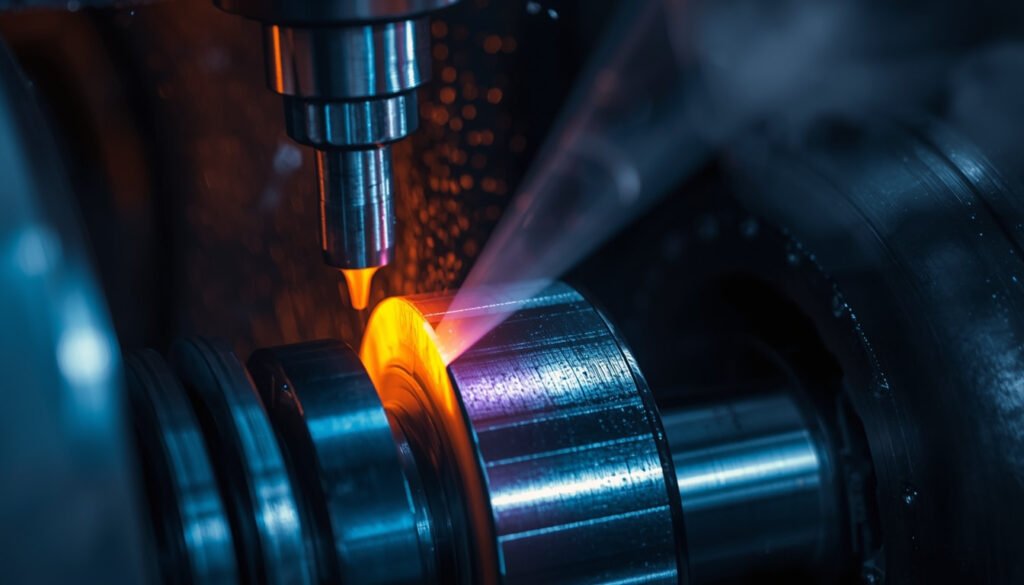
A Deep Dive into the Types of Right Cutting Fluids
Understanding the four main families of cutting fluids is the cornerstone of making an informed choice. Each has a distinct profile of pros and cons tailored for specific applications.
1. Straight Oils (Neat Oils)
As the name implies, these are non-emulsifiable oils, typically based on mineral, vegetable, or synthetic ester oils, and are used undiluted.
- Composition: Petroleum or bio-based oils, often fortified with extreme pressure (EP) additives like chlorine and sulfur.
Pros:
- Unmatched Lubricity: Provides the best possible lubrication, drastically reducing friction and extending tool life in high-pressure, low-speed operations.
- Excellent Surface Finish: The high lubricity leads to a cleaner shear and a smoother finish.
- Inherent Corrosion Protection: The oil naturally coats and protects the machine and workpiece from rust.
Cons:
- Poor Cooling: Oil is a terrible heat conductor compared to water.
- Fire Hazard: The oil mist can be flammable at high temperatures.
- Operator Environment: Can create a smoky, misty, and slippery work environment, posing health and safety concerns.
Best For: Low-speed, high-pressure operations on very hard materials (>60 HRC) like threading, tapping, broaching, and deep-hole drilling (gun drilling).
2. Soluble Oils (Emulsions)
These are the most common fluids in general machine shops. They consist of a mineral oil base mixed with emulsifiers and additives, designed to be diluted in water.
Composition: Typically 60-85% oil, forming a milky white emulsion when mixed with water at concentrations of 5-10%.
Pros:
- Good All-Around Balance: Offers a competent blend of both cooling (from the water) and lubrication (from the oil).
- Versatile: Can be used for a wide range of materials and operations.
- Cost-Effective: Generally less expensive than synthetics or semi-synthetics.
Cons:
- High Maintenance: Prone to bacterial and fungal growth, requires regular concentration checks, and can be “dirty,” leaving a sticky residue.
- Moderate Lubricity: Doesn’t offer the pure lubricity of a straight oil.
Best For: General-purpose turning and milling of hardened steels in the 45-55 HRC range where a good balance is needed and high-pressure coolant is available.
3. Semi-Synthetic Fluids
A hybrid solution, semi-synthetics contain a smaller amount of mineral oil than soluble oils, creating a translucent emulsion when mixed with water.
Composition: A mix of 5-30% mineral oil, synthetic lubricants, and additives in a water base.
Pros:
- Enhanced Cooling: The higher water content gives it better cooling properties than soluble oils.
- Cleaner Operation: Resists bacterial growth better and leaves less residue than soluble oils.
- Rejects Tramp Oil: The formulation allows tramp oils (like hydraulic or way lube leakage) to be skimmed off more easily.
Cons:
- Reduced Lubricity: Offers less lubrication than a soluble oil, though this can be offset with chemical additives.
Best For: High-speed milling, turning, and grinding of hardened steel. It’s an excellent choice for shops looking for a cleaner, higher-performance alternative to soluble oils.
4. Full Synthetic Fluids
Synthetics contain no petroleum oil. They are chemical solutions mixed with water, appearing transparent (often with a dye) when diluted.
Composition: Polymers and chemical compounds dissolved in water.
Pros:
- Superior Cooling: The best-in-class for heat dissipation due to the high water content and specific chemical properties.
- Excellent Cleanliness & Sump Life: Completely rejects tramp oil and is highly resistant to microbial growth, leading to the longest sump life.
- Unmatched Visibility: The transparent fluid allows operators to clearly see the cutting zone.
Cons:
- Lowest Lubricity: Provides lubrication through chemical means rather than an oil film, which may be insufficient for high-pressure operations.
- Material Compatibility: Can be aggressive on certain machine seals, paints, and polycarbonate windows.
Best For: High-velocity grinding operations where heat is the number one enemy and surface integrity is paramount. Also used in high-speed machining with CBN or ceramic tooling where thermal shock must be minimized.
Key Factors for Selecting the Right Cutting Fluids
With the types defined, use this framework to narrow down your choice:
- Material Hardness (HRC): As a rule of thumb, as HRC increases, the need for lubricity and extreme pressure performance rises. For steels >60 HRC, straight oils or highly fortified semi-synthetics often become necessary.
- Machining Operation: This is perhaps the most important factor.
- Grinding: Demands cooling. Heat checking is the biggest risk. Synthetics are the top choice.
- High-Speed Milling/Turning: Requires a balance tilted towards cooling. Semi-synthetics and soluble oils (with high-pressure delivery) are ideal.
- Low-Speed Turning/Milling: Requires a balance tilted towards lubrication. Rich soluble oils or semi-synthetics work well.
- Tapping/Threading/Broaching: Demands extreme lubrication. This is the domain of straight oils or highly concentrated, specialized emulsions.
- Tooling Material: Ceramic and CBN tools are extremely hard but can be brittle and sensitive to thermal shock. A consistent, high-volume flow of a fluid with excellent cooling properties (synthetics or semi-synthetics) is crucial to prevent cracking.
- Coolant Delivery System: Do you have a standard flood coolant system or a high-pressure coolant (HPC) system (1000+ psi)? HPC can physically blast chips away and force a lower-lubricity fluid (like a synthetic) into the cutting zone, making it behave like a higher-lubricity fluid.
- Health, Safety, and Environment: Consider local regulations (VOCs), operator sensitivity, and fluid disposal costs. Bio-based straight oils and cleaner semi-synthetics are gaining popularity for these reasons.
The Unsung Heroes: Additives That Make the Difference
The base fluid is only part of the story. Chemical additives are what elevate a good fluid to the right cutting fluids for a tough job.
- Extreme Pressure (EP) Additives: These are essential for hardened steel. Chlorine and sulfur-based additives react with the tool and workpiece under intense heat and pressure to form a sacrificial lubricating film that prevents welding.
- Anti-Weld Additives: Similar to EP additives, these form a barrier to prevent the chip from welding to the tool.
- Corrosion Inhibitors: Protect the machine tool and the finished part from rust, which is critical for water-based fluids.
- Biocides & Fungicides: Added to water-miscible fluids (soluble, semi-synthetic, synthetic) to prevent bacterial and fungal growth, which cause foul odors and fluid degradation.
Conclusion: A Strategic Decision for Peak Performance
Selecting the right cutting fluids for hardened steel is not a matter of picking the most expensive or the most popular option. It is a strategic analysis of your material, your operation, and your machine’s capabilities. A grinder needs the superior cooling of a synthetic. A tap needs the uncompromising lubricity of a straight oil. For the vast space in between, a high-quality semi-synthetic or soluble oil, managed properly and delivered with adequate pressure, often hits the sweet spot.
By moving beyond the mindset of “coolant” and embracing the science of fluid dynamics, heat management, and boundary lubrication, you can transform a challenging job into a predictable, precise, and profitable process.