Used Textile Machinery: Complete Inspection Guide
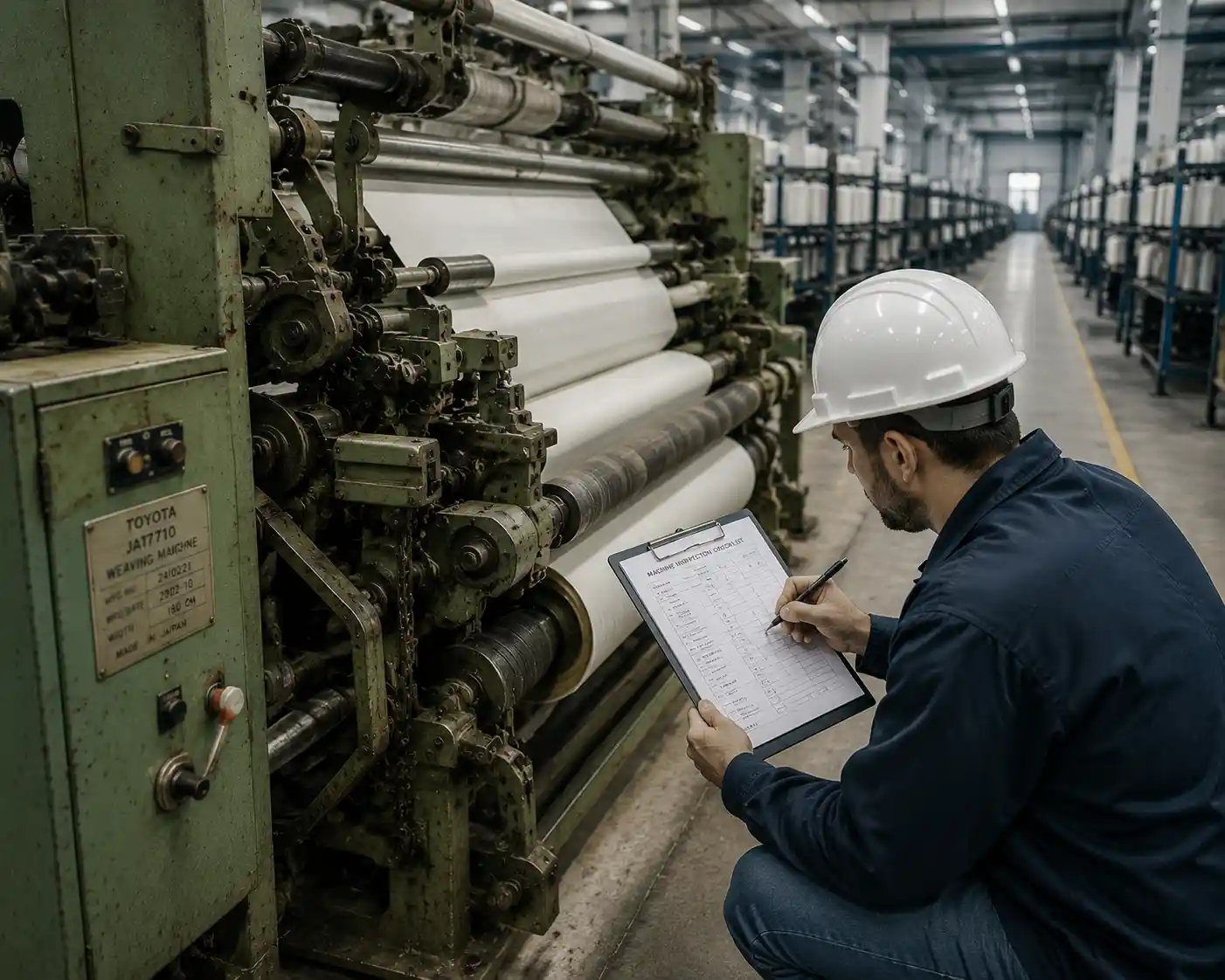
Buying used textile machinery can be a practical way for textile manufacturers to expand production capacity without the high capital cost of brand-new equipment. However, the value of a second-hand machine depends on its actual condition, maintenance history, performance, energy use, and remaining service life.
A machine with an attractive price can quickly become expensive if it requires major repairs, has obsolete controls, or cannot maintain consistent production quality. A proper textile machinery inspection helps buyers identify these risks before making an investment.
Why Used Textile Machinery Requires a Technical Inspection
The purchase price is only one part of the cost of industrial equipment. Used machinery may have thousands of operating hours, worn mechanical components, outdated electronics, or a history of repairs that is not immediately visible.
This is why buyers should never evaluate second hand textile machinery based only on photographs, manufacturing year, or price.
A technical inspection helps determine whether the machine can meet your required production speed, output quality, energy efficiency, and reliability. It can also reveal upcoming repair costs that should be considered before negotiating the final price.
For textile mills, the objective should not simply be finding the cheapest equipment. The goal is to find machinery that offers the best balance between acquisition cost, condition, performance, and remaining useful life.
13 Things to Check Before Buying Used Textile Machinery
A structured inspection makes it easier to compare different used textile machines for sale and identify problems before the equipment reaches your facility.
1. Verify the Manufacturing Year and Machine Identity
Start with basic machine identification.
Check the:
- Manufacturer
- Model number
- Serial number
- Manufacturing year
- Machine nameplate
- Rated production capacity
- Working width
- Installed configuration
Compare this information with the seller’s documents and technical specifications.
Pay particular attention to the serial number and nameplate. Missing, damaged, or altered identification plates can make it difficult to confirm the machine’s actual age and specifications.
However, manufacturing year should not be used alone to judge condition. An older machine that received regular preventive maintenance may be in better operating condition than a newer machine that ran continuously with poor maintenance.
2. Check Operating Hours
Operating hours provide a better picture of machine usage.
Ask the seller for total operating hours and, where possible, verify them through the machine controller or production counter.
Also ask how the equipment was operated:
- One, two, or three shifts per day
- Average daily production hours
- Long periods of inactivity
- Type of material processed
- Previous production environment
High operating hours do not automatically make a machine unsuitable. They simply increase the importance of inspecting wear components and reviewing maintenance history.
Operating hours should always be evaluated together with the machine’s physical condition.
3. Inspect Bearings Carefully
Bearings are critical to rotating textile machinery and can provide valuable clues about overall mechanical condition.
During operation, listen for unusual grinding, humming, or knocking sounds. Inspect bearing areas for excessive heat, vibration, lubrication problems, or visible shaft movement.
Warning signs include:
- Excessive vibration
- Abnormal bearing noise
- Overheating
- Shaft play
- Damaged bearing housings
- Poor lubrication
- Oil or grease contamination
A worn bearing may appear to be a relatively small problem, but continued operation can damage shafts, housings, and other connected components.
4. Test Motors and Drive Systems
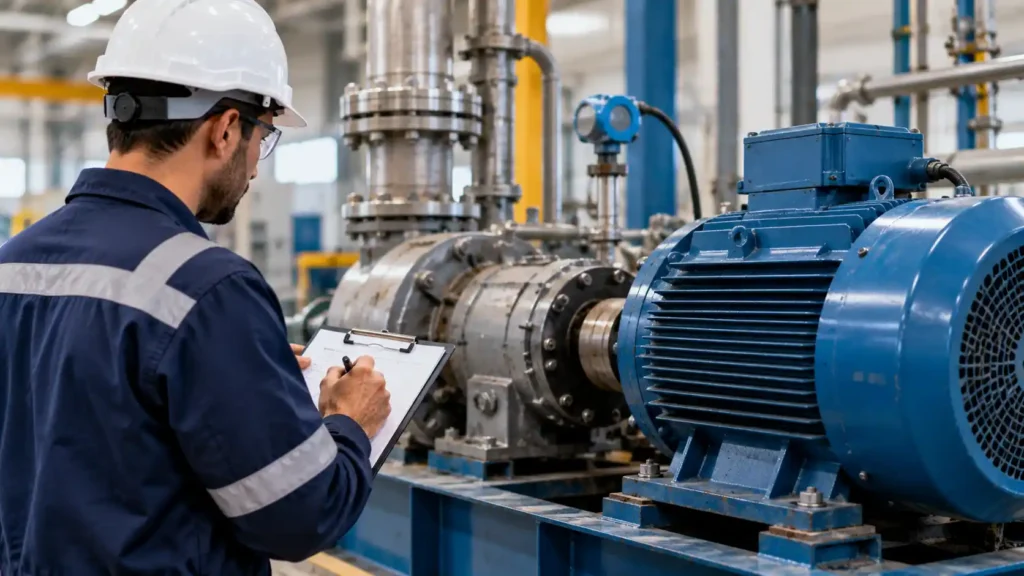
Motors should be inspected under actual operating load whenever possible.
Check motor temperature, vibration, current draw, mounting condition, and unusual noise. Inspect connected belts, pulleys, couplings, servo drives, and variable-frequency drives (VFDs).
Ask whether motors have previously been repaired, rewound, or replaced.
A motor that operates normally while the machine is empty may behave differently under full production load. This is why a production test is more useful than simply switching the machine on.
5. Examine Gearboxes and Mechanical Transmission
Gearboxes and transmission systems can become expensive repair points on older machinery.
Inspect for:
- Oil leaks
- Abnormal gear noise
- Excessive backlash
- Worn shaft seals
- Lubricant contamination
- Shaft misalignment
- Excessive vibration
- Damaged couplings
Run the equipment at different operating speeds when possible.
Noise or vibration that increases with machine speed may indicate bearing wear, gear damage, imbalance, or alignment problems.
Buyers evaluating drive systems, gearboxes, shafts, and other industrial components should also consider the broader requirements of mechanical machinery when estimating repair and integration costs.
6. Inspect Loom-Specific Components
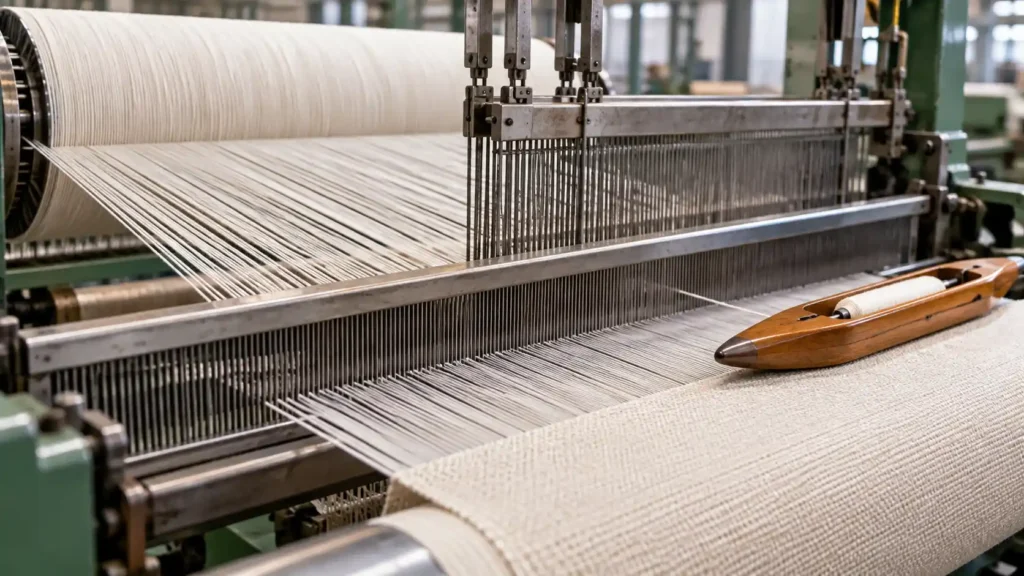
When evaluating a used weaving loom, general mechanical inspection is not enough. Components directly involved in fabric formation must also be checked.
Depending on the loom type, inspect:
- Reed condition
- Heddle or heald frames
- Warp control
- Weft insertion system
- Let-off mechanism
- Take-up mechanism
- Yarn guides
- Tension control
- Sensors
- Rapier, air-jet, or projectile system
- Main frame stability
Pay close attention to yarn-contact surfaces. Worn or damaged guides can cause yarn breakage and reduce fabric quality.
Run the loom near its expected production speed and check whether tension, vibration, and fabric formation remain stable.
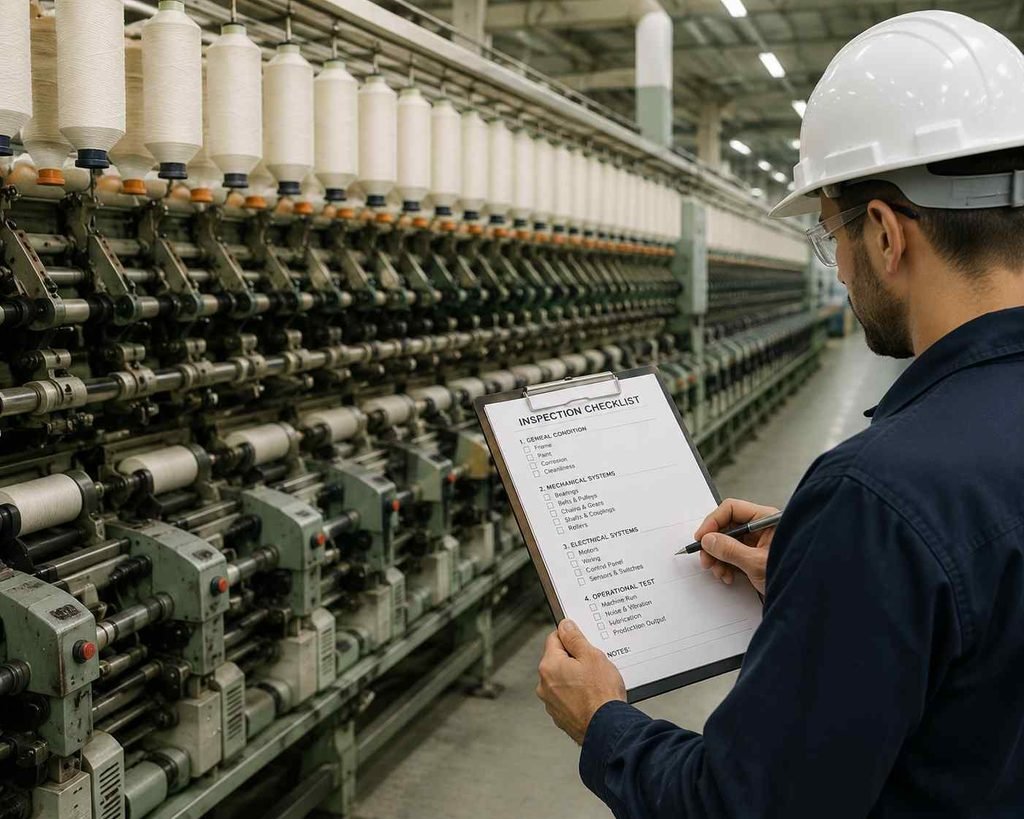
7. Test Electronic Controllers and Sensors
Modern textile machinery relies heavily on electronic controls.
Inspect the:
- PLC
- HMI
- Sensors
- Encoders
- Servo drives
- VFDs
- Control panels
- Wiring
- Safety switches
- Emergency-stop circuits
Do more than confirm that the HMI screen powers on.
Operate different machine functions through the controller and check whether sensors, alarms, speed controls, and safety systems respond correctly.
Intermittent electrical faults can be difficult and expensive to diagnose after installation.
8. Confirm PLC and Software Availability
PLC availability is especially important when purchasing older machinery.
A mechanically strong machine can still become difficult to operate if its controller is obsolete and replacement modules are unavailable.
Before buying, ask:
- Is the PLC model still supported?
- Are replacement modules available?
- Is a backup of the PLC program available?
- Are passwords provided?
- Is the HMI program backed up?
- Is special OEM software required?
- Are electrical schematics included?
If a discontinued PLC fails after installation, the buyer may need to replace or retrofit the entire control system.
Include this potential cost in the purchase decision.
9. Verify Spare-Parts Availability
Before purchasing any used spinning machinery, weaving equipment, knitting machine, or finishing system, confirm that critical replacement parts can still be sourced.
Check availability for:
- Bearings
- Motors
- Sensors
- Electronic cards
- PLC modules
- Belts
- Gearbox components
- Encoders
- Loom-specific wear parts
Consider both OEM parts and qualified aftermarket alternatives.
A low-priced machine with unavailable critical parts can create much higher long-term downtime than a more expensive machine with strong parts support.
10. Review Maintenance and Repair Records
Maintenance records provide valuable information about how the previous owner treated the equipment.
Request records for:
- Preventive maintenance
- Major breakdowns
- Bearing replacements
- Motor repairs
- Gearbox repairs
- Controller replacements
- Calibration
- Lubrication
- Service visits
- Major overhauls
Look for repeated failures of the same component. Frequent replacement of bearings, motors, or electronic modules may indicate an underlying mechanical or electrical problem.
Missing maintenance records do not automatically mean that the machine is unsuitable, but they increase uncertainty. Buyers should perform a more detailed inspection when reliable service history is unavailable.
11. Run a Production Test
A production test is one of the most important steps in any textile machine buying guide.
Whenever possible, test the machine using material similar to what you intend to process.
Do not rely only on an empty or no-load demonstration.
During the test, measure or observe:
- Production speed
- Machine stability
- Unexpected stops
- Noise
- Vibration
- Operating temperature
- Material waste
- Output consistency
- Alarm frequency
For weaving equipment, inspect the fabric produced during the test. For spinning machinery, evaluate yarn consistency and production stability.
A successful production test provides stronger evidence of machine condition than photographs or a short startup video.
Used Textile Machinery Inspection Checklist
| Inspection Area | What to Check | Warning Signs | Recommended Action |
|---|---|---|---|
| Machine identity | Model, serial number, year | Missing machine data | Verify before purchase |
| Operating history | Hours and shifts | Unknown history | Increase inspection depth |
| Bearings | Noise, heat and play | Grinding or vibration | Estimate replacement cost |
| Motors | Temperature and current | Overheating | Perform load test |
| Gearboxes | Oil, noise and backlash | Leakage or excessive play | Detailed inspection |
| PLC & controls | Functions and backup | Obsolete hardware | Verify support |
| Spare parts | OEM/aftermarket supply | Discontinued components | Calculate future risk |
| Maintenance | Service records | Missing history | Investigate further |
| Production | Speed and stability | Frequent stops | Perform live test |
| Energy | Power consumption | Excessive consumption | Compare operating cost |
| Output | Quality and waste | Inconsistent output | Test representative material |
12. Measure Energy Consumption
Older textile equipment may have an attractive purchase price but consume considerably more electricity, compressed air, water, or heat than expected.
Measure energy use during normal production rather than relying only on the motor’s nameplate rating.
Where possible, calculate:
Energy Efficiency = kWh Consumed ÷ Units of Production
Also evaluate supporting utilities such as compressed air for air-jet looms and heating requirements for dyeing or finishing equipment.
For U.S. textile mills operating equipment for multiple shifts, even a relatively small efficiency difference can affect long-term operating costs.
13. Evaluate Output Quality and Remaining Service Life
The final inspection should answer two important questions:
Can the machine produce the required quality today, and how long can it reasonably continue doing so?
Inspect actual production for:
- Yarn consistency
- Fabric defects
- Tension variation
- Width variation
- Surface defects
- Waste levels
- Reject rates
- Production consistency
Remaining useful life should not be estimated from manufacturing year alone.
Consider the machine’s age, operating hours, maintenance quality, component wear, spare-parts support, production stability, and current mechanical condition together.
New vs Used vs Refurbished Textile Machinery
Not every textile manufacturer has the same investment priorities. Comparing the three main purchasing options can help buyers select equipment that matches their budget and risk tolerance.
| Factor | New Machinery | Used Machinery | Refurbished Machinery |
|---|---|---|---|
| CAPEX | Highest | Lowest | Medium |
| Technical Risk | Lowest | Higher/Variable | Medium |
| Lead Time | Often longer | Often shorter | Medium |
| Warranty | Usually strongest | Limited or none | Supplier-dependent |
| Technology | Latest | Usually older | Older/upgraded |
| Inspection Need | Moderate | Very high | High |
| Best For | New plants & critical lines | Budget-focused expansion | Cost/risk balance |
Used machinery can be especially attractive when a manufacturer needs additional capacity without investing in a completely new production line.
However, its value depends heavily on inspection quality.
Working with experienced textile machinery suppliers can help buyers evaluate equipment specifications, condition, production requirements, and sourcing risks before committing to a machine.
What U.S. Textile Buyers Should Check Before Importing Used Machinery
U.S. buyers purchasing machinery internationally should evaluate more than mechanical condition.
Confirm the machine’s electrical requirements, including:
- Voltage
- Frequency
- Phase
- Motor specifications
- Drive compatibility
- Control-system requirements
Also review safety guarding, emergency-stop systems, electrical documentation, operating manuals, and installation requirements for the intended facility.
Before calculating the final investment, include the cost of:
- Dismantling
- Rigging
- Crating
- International freight
- Insurance
- Customs duties and applicable fees
- Inland transportation
- Installation
- Electrical modifications
- Commissioning
- Initial spare parts
Buyers should also verify applicable U.S. workplace safety and electrical requirements for their specific installation rather than assuming that an imported machine is automatically suitable for operation in a U.S. facility.
Calculate the Real Cost Before Calling It a Bargain
The selling price alone does not determine whether used textile machinery is a good investment.
A better calculation is:
Real Acquisition Cost = Purchase Price + Inspection + Dismantling + Freight + Duties/Fees + Refurbishment + Installation + Commissioning + Initial Spare Parts
For example, a lower-priced machine that needs major electrical upgrades, new bearings, gearbox repairs, and an obsolete PLC replacement may ultimately cost more than a better-maintained machine with a higher initial price.
Buyers should therefore compare total acquisition and operating costs rather than purchase prices alone.
Used Textile Machinery Risk Matrix
| Machine Condition | Spare Parts | Production Test | Buyer Risk |
|---|---|---|---|
| Good | Available | Passed | Low |
| Good | Limited | Passed | Medium |
| Average | Available | Passed | Medium |
| Average | Limited | Inconsistent | High |
| Poor | Limited | Failed/Unavailable | Very High |
The matrix should not replace a professional inspection, but it provides a simple framework for comparing potential purchases.
Red Flags When Buying Second-Hand Textile Machinery
Be cautious when you find:
- Missing or altered identification plates
- Seller unwilling to allow an inspection
- No live production test
- Heavy oil leakage
- Excessive gearbox or bearing noise
- High frame vibration
- Frequent electrical faults
- Unsupported PLC hardware
- Missing technical manuals
- Missing electrical diagrams
- Discontinued critical spare parts
- Production below expected specifications
- Poor output quality
- Unexplained major repairs
- An unusually low price without a clear reason
One warning sign may not necessarily make a machine a bad purchase. Multiple red flags, however, should trigger a deeper technical inspection and cost assessment.
Why the Textile Machinery Supplier Matters
A reliable textile equipment supplier should provide more than a machine listing and selling price.
Buyers should look for suppliers that can support machine identification, technical specifications, condition verification, inspection access, production testing, spare-parts information, dismantling, loading, documentation, and logistics coordination.
Mekantra Technologies sources new and used textile manufacturing equipment across spinning, weaving, knitting, dyeing, finishing, printing, and related production processes. Its textile machinery sourcing approach includes equipment inspection and technical verification before delivery.
This is particularly important for international buyers who may not be able to inspect every potential machine personally.
Inspect the Machine, Not Just the Price
Buying used textile machinery can provide significant value when the equipment has verified condition, reliable performance, available spare parts, reasonable energy consumption, and sufficient remaining service life.
The cheapest machine is not automatically the best investment.
A successful purchase requires buyers to evaluate mechanical wear, motors, gearboxes, bearings, controls, PLC support, maintenance history, production performance, output quality, and the full cost of bringing the equipment into operation.
For manufacturers considering a used weaving loom, used spinning machinery, or another textile production system, Mekantra Technologies can help source machinery according to technical and production requirements.
Before making your next equipment investment, define your required capacity, specifications, utilities, and production goals and request a technical quote to identify suitable machinery for your operation.

Mekantra Engineering Team
The technical voice of Mekantra. Our team consists of sourcing specialists, mechanical engineers, and logistics experts dedicated to providing transparent insights and high-performance solutions for the global manufacturing sector.
Mekantra Engineering Team
The technical voice of Mekantra. Our team consists of sourcing specialists, mechanical engineers, and logistics experts dedicated to providing transparent insights and high-performance solutions for the global manufacturing sector.