Wheel Loaders vs Skid Steers – Which Offers Better Versatility?
Quick Summary
When comparing Wheel Loaders vs. Skid Steers, the key to choosing the right machine lies in understanding your primary tasks. Skid steers offer unmatched versatility for a wide variety of tasks in confined spaces, acting like a job-site Swiss Army knife. In contrast, wheel loaders provide superior power, speed, and efficiency for high-volume material handling and loading operations, offering a different, more specialized form of versatility.”
On any bustling construction or landscaping site, two machines are constantly in motion, lifting, carrying, and loading: the nimble skid steer and the powerful wheel loader. They can sometimes be seen doing similar jobs, which leads to a critical question for any fleet manager or contractor: which one is the smarter investment?
The debate over Wheel Loaders vs. Skid Steers isn’t just about size; it’s a strategic decision that hinges on one crucial word: versatility. But what does “versatility” truly mean on your job site? Is it the ability to do many different things, or the ability to do one thing exceptionally well in various conditions? Let’s load up the facts and find out.
Defining the Contenders: The Core Mechanics
Before diving into a head-to-head battle, it’s essential to understand what makes each machine unique. Their fundamental design dictates their strengths, weaknesses, and ideal applications.
The Skid Steer Loader: The Agile All-Rounder
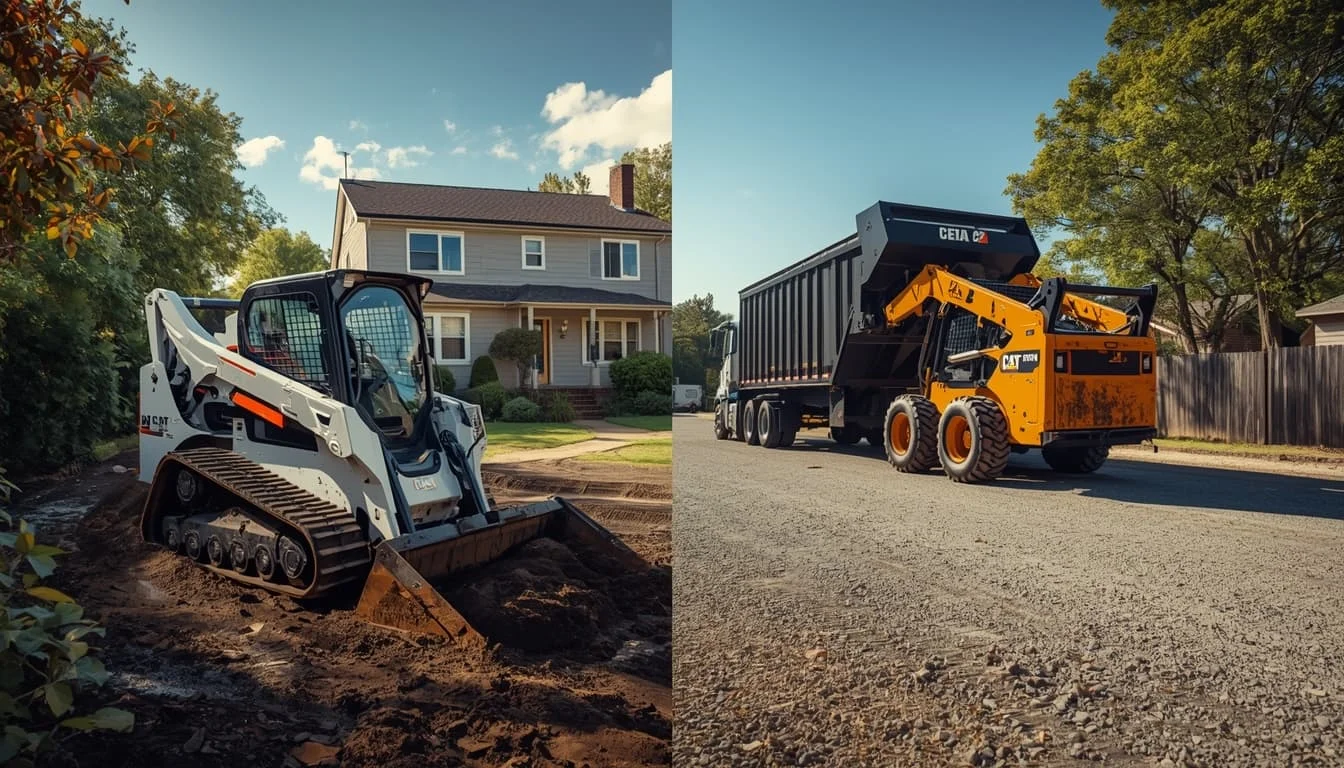
A skid steer is a compact, rigid-frame machine with lift arms used to attach a wide variety of tools. Its defining feature is its unique steering system. The wheels on each side are locked in synchronization, and the machine turns by “skidding” speeding up the wheels on one side while slowing or reversing the wheels on the other. This allows for an incredible zero-degree turning radius, meaning it can pivot within its own footprint.
- Key Identifier: Four wheels (or two tracks on a Compact Track Loader/CTL) that do not turn; the machine pivots.
- Common Lift Paths:
- Radial Lift: The arms swing out in an arc, providing excellent forward reach at mid-height, ideal for digging and pushing.
- Vertical Lift: Uses a more complex linkage to lift the load straight up, providing better height and capacity at full extension, perfect for loading trucks and placing pallets.
The Wheel Loader: The Material Moving Powerhouse
A wheel loader, also known as a front-end loader or bucket loader, is a larger machine that steers via an articulating frame. The front and rear axles are joined by a massive central pivot. When the operator turns the wheel, the entire front half of the machine swings left or right. This design provides a smoother ride, better stability with heavy loads, and less ground disturbance.
- Key Identifier: Articulated steering (the machine bends in the middle).
- Primary Function: To scoop, carry, and load bulk materials like gravel, sand, dirt, and snow into trucks or hoppers with speed and efficiency.
Head-to-Head Comparison: The Ultimate Spec Showdown
A side-by-side analysis reveals the fundamental trade-offs between these two material handlers. This comparison focuses on a large skid steer versus a compact wheel loader, the most common point of overlap.
| Specification | Skid Steer Loader | Compact Wheel Loader | Job Site Implication |
| Maneuverability | Excellent (Zero-turn radius) | Good (Articulated steering) | Skid steer is unbeatable in tight, confined spaces. |
| Lift Capacity | Lower (Tipping load is a key limit) | Higher (More stable with heavy loads) | Wheel loader is superior for lifting and carrying heavy pallets or full buckets. |
| Lift Height | Good (Especially with vertical lift) | Excellent | Wheel loaders can more easily clear the sides of high-sided dump trucks. |
| Speed & Cycle Times | Slower travel speed | Faster travel speed | Wheel loader is much faster for “load and carry” cycles across larger sites. |
| Operator Visibility | Good, but arms can obstruct side view | Excellent (High, centered cab) | Wheel loader operators have a commanding, 360-degree view, enhancing safety. |
| Ground Impact | High (Skidding tears up turf) | Low (Wheels roll through turns) | Wheel loader is far gentler on finished surfaces like grass, asphalt, and pavers. |
| Attachments | Immense Variety | Good Variety | Skid steer has a larger ecosystem of specialized attachments for diverse tasks. |
| Operating Cost | Higher tire wear, moderate fuel use | Lower tire wear, higher fuel use | The cost of tire replacement is a significant long-term expense for skid steers. |
Breaking Down Versatility: More Than Just Attachments
This is the core of the Wheel Loaders vs. Skid Steers debate. Both use a universal quick-attach system, but they leverage that versatility in fundamentally different ways.
Skid Steer’s Versatility: The “Task Diversity” Approach
The skid steer’s versatility lies in its ability to perform a vast number of different tasks. It’s the ultimate utility player. On a single residential construction project, a skid steer with the right attachments can:
- Grade the site with a 4-in-1 bucket.
- Drill holes for fence posts with an auger.
- Demolish an old concrete patio with a hydraulic hammer.
- Sweep the street with a broom attachment.
- Move pallets of sod with pallet forks.
- Grind stumps with a stump grinder attachment.
For a contractor who needs to do a little bit of everything in a small area, the skid steer’s task diversity is unbeatable. Its compact size allows it to get into backyards and through gates where a wheel loader simply cannot go.

Wheel Loader’s Versatility: The “High-Volume” Approach
The wheel loader’s versatility is defined by its efficiency and power in material handling applications. It may not have as many niche attachments as a skid steer, but it excels at moving large quantities of any material, making it incredibly versatile for high-volume work. Its advantages include:
- Superior Loading: Faster cycle times and higher lift capacity make it dramatically more efficient for loading dump trucks.
- Better Load and Carry: Higher travel speeds and a smoother ride mean it can move material across a large site (like an aggregate yard or large farm) much faster and with less operator fatigue.
- Enhanced Visibility & Safety: The elevated, central cab position gives the operator a clear view of the work area, which is crucial for safety when working around ground personnel and other equipment.
- Reduced Surface Damage: On projects where the ground surface must be preserved (landscaping, asphalt lots), the articulated steering prevents the destructive scuffing caused by skid steers.
A wheel loader is versatile because it can move massive amounts of snow with a snow pusher, then switch to pallet forks to unload a truck, and then use its bucket to load a hopper all with superior speed and capacity.
Job Site Scenarios: Putting Theory into Practice
Let’s apply this knowledge to real-world scenarios.
Choose a Skid Steer When:
- The Job Site is Tight: Interior demolition, residential landscaping, narrow urban repairs.
- The Tasks are Highly Varied: You need to switch between digging, drilling, breaking, and sweeping frequently.
- Maneuverability is Paramount: Working in and around existing structures or obstacles.
- The Budget is Tighter: Skid steers generally have a lower initial acquisition cost than a comparable compact wheel loader.
Choose a Wheel Loader When:
- The Primary Task is Loading Trucks: At quarries, recycling centers, or large excavation sites.
- You’re Moving Bulk Material Across a Distance: “Load and carry” applications on farms, lumber yards, or large commercial sites.
- Surface Care is a Priority: Working on finished lawns, expensive pavers, or asphalt lots.
- Operator Comfort and Visibility are Key: For long shifts where productivity and safety are maximized by a better operator environment.
The Financial Equation: ROI and Total Cost of Ownership (TCO)
A smart decision goes beyond the sticker price.
- Acquisition Cost: Skid steers typically have a lower upfront purchase price. However, a premium vertical-lift CTL can approach the cost of a small, compact wheel loader.
- Fuel Consumption: Wheel loaders, being larger and more powerful, generally consume more fuel per hour. However, their efficiency can mean they finish a job faster, potentially balancing out the total fuel cost for a specific task.
- Tire Wear: This is a huge, often underestimated cost. The scuffing action of a skid steer is brutal on tires, leading to frequent and expensive replacements, especially when working on hard surfaces like concrete or asphalt. The rolling action of a wheel loader’s tires results in a much longer lifespan.
- Maintenance: Both require regular maintenance, but the larger components on a wheel loader can sometimes carry a higher price tag for replacement.
The ROI calculation depends entirely on your business. For a landscaper, the skid steer’s ability to complete five different jobs on one site provides immense ROI. For an aggregate supplier, the wheel loader’s ability to load 20% more trucks per day is where the real profit is made.
The Game-Changer: The Compact Wheel Loader (CWL)
In recent years, the compact wheel loader (CWL) has emerged as a powerful contender, blurring the lines in the Wheel Loaders vs. Skid Steers debate. CWLs offer a hybrid solution:
- Articulated steering for low ground impact.
- Better visibility and a more comfortable cab than most skid steers.
- Higher lift capacity and reach than a similarly sized skid steer.
- A smaller footprint and tighter turning radius than a standard wheel loader.
For contractors in applications like snow removal, landscaping, and nurseries, the CWL often hits the sweet spot, providing the material handling power of a loader with some of the agility of a skid steer.
Final Verdict: Which Machine Truly Offers Better Versatility?
The answer is clear: it depends on your definition of “versatility.”
If your business thrives on task diversity performing many different jobs from demolition to drilling in tight, constrained environments then the skid steer is the undisputed champion of versatility. Its massive ecosystem of attachments and zero-turn agility make it the ultimate job-site multi-tool.
However, if your business depends on high-volume efficiency moving large amounts of material quickly, safely, and with minimal surface damage then the wheel loader offers superior versatility within that domain. Its speed, power, and operator comfort make it the master of loading, carrying, and handling bulk materials.
Ultimately, the smartest contractors don’t ask which machine is better; they ask which machine will make them more money on the jobs they do most often. By analyzing your core business, you can confidently choose the machine that will be the most versatile and profitable asset in your fleet.

Mekantra Engineering Team
The technical voice of Mekantra. Our team consists of sourcing specialists, mechanical engineers, and logistics experts dedicated to providing transparent insights and high-performance solutions for the global manufacturing sector.
Mekantra Engineering Team
The technical voice of Mekantra. Our team consists of sourcing specialists, mechanical engineers, and logistics experts dedicated to providing transparent insights and high-performance solutions for the global manufacturing sector.