Best Construction Machinery for Modern Projects
Summary
The right construction machinery directly impacts project ROI reducing labor hours, cutting material waste, and speeding up delivery timelines. This guide covers the key equipment categories every project manager and procurement team needs to know before sourcing heavy machinery for a modern construction site.
Construction delays cost the global industry an estimated $1.6 trillion annually, and a significant share of those delays trace back to one avoidable problem: the wrong machinery deployed at the wrong stage of a project. Choosing the right construction machinery for modern projects is not just a procurement decision it is a strategic one.
1. Earthmoving Equipment: The Foundation of Every Build
No construction project begins without moving earth. Earthmoving machinery handles excavation, grading, leveling, and material transport the baseline tasks that prepare a site for everything that follows.
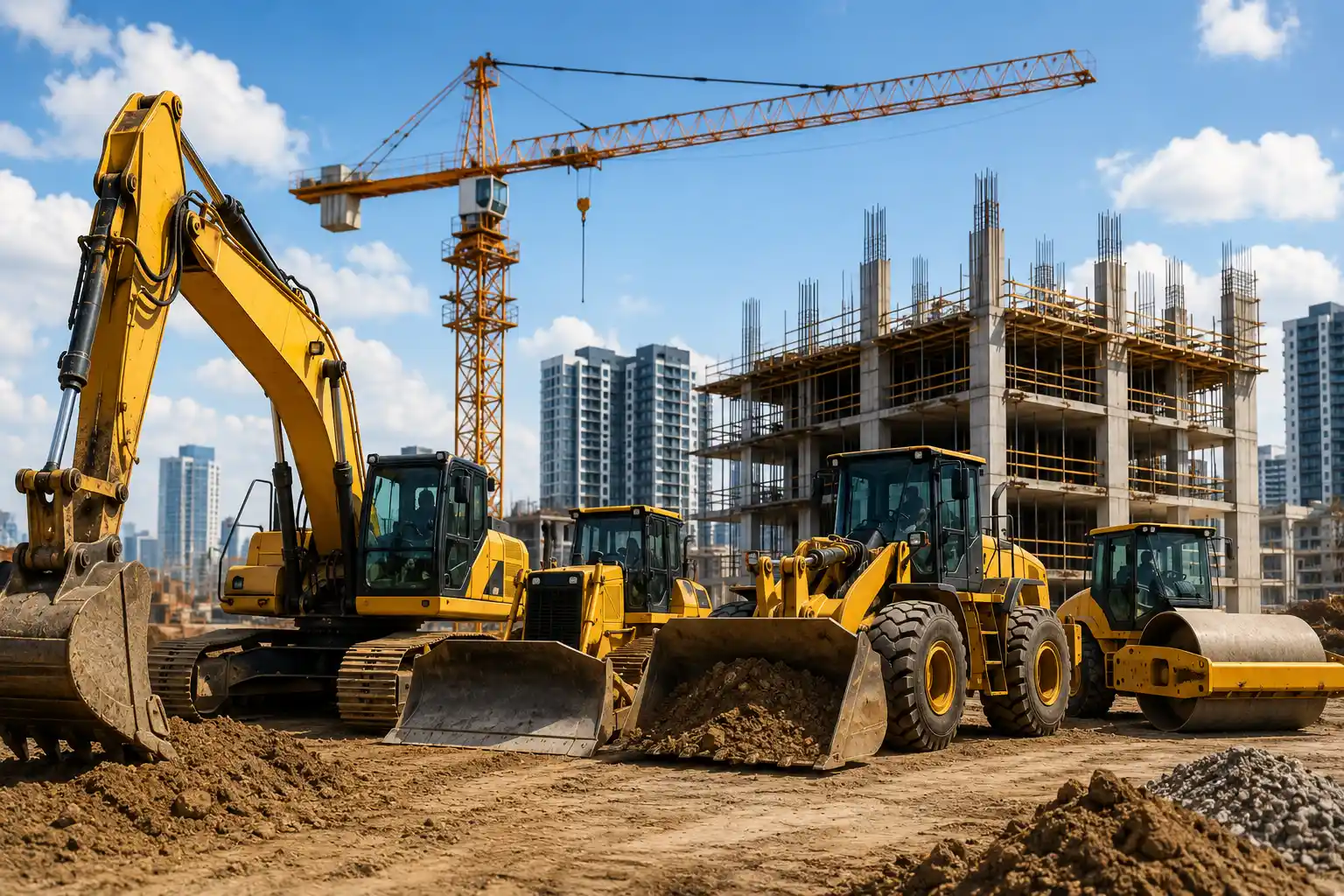
The three machines that handle the majority of earthmoving work on modern sites are excavators, bulldozers, and wheel loaders. Each serves a distinct function, and using the wrong one for a task wastes both fuel and labor hours.
| Machine | Primary Use Case | Typical Load / Capacity | Best Project Type |
| Hydraulic Excavator | Digging, trenching, demolition | 0.5 – 4.0 m³ bucket | Civil, infrastructure, mining |
| Bulldozer | Land clearing, grading, pushing material | Up to 40 tons push force | Site preparation, road base |
| Wheel Loader | Loading, material transport, stockpiling | 1.5 – 5.0 m³ bucket | Quarries, road projects, logistics |
| Backhoe Loader | Digging + loading (dual function) | 0.3 – 1.0 m³ (rear bucket) | Urban builds, utilities, drainage |
| Motor Grader | Fine grading, road surface leveling | 3.7 – 7.3 m blade width | Road construction, airport runways |
Key specs to evaluate: digging depth (m), bucket capacity (m³), engine power (kW), and operating weight. Hydraulic excavators with a digging depth of 5–7 m are standard for most civil projects, while heavy-duty models can reach beyond 10 m for deep foundation work.
2. Lifting and Material Handling Machinery
Once foundations are in place, vertical construction begins and that requires reliable lifting machinery. Cranes, hoists, and forklifts handle the movement of structural steel, precast panels, concrete elements, and heavy materials at height.
Tower cranes are the backbone of high-rise and large commercial builds. A standard flat-top tower crane offers a lifting capacity of 6–12 tonnes at radius, with jib lengths reaching 60–80 m. Mobile cranes offer flexibility for projects that require repositioning, with all-terrain models handling loads from 50 to 1,200+ tonnes.
- Tower crane: lifting height up to 200+ m, ideal for high-rise residential and commercial projects
- Mobile crane (all-terrain): load capacity 50–1,200 t, suited for bridge construction and industrial plant builds
- Telescopic forklift (telehandler): reach up to 17 m, essential for material staging and precast installation
- Overhead gantry crane: used in prefabrication yards and industrial facilities for precision heavy lifts
When selecting a crane, match the maximum lift radius and load chart to your site plan. Undersized cranes create bottlenecks; oversized ones inflate operating costs.
3. Concrete and Paving Machinery for Modern Sites
Concrete work accounts for a substantial portion of material costs on most construction projects. The speed and quality of concrete placement depend directly on the machinery used to mix, transport, and pour it.
| Machine | Output / Capacity | Fuel Consumption | Key Application |
| Concrete Batching Plant | 30–240 m³/hr | 20–45 L/hr (diesel) | Large infrastructure, commercial slabs |
| Truck-Mounted Concrete Mixer | 6–12 m³ per load | 25–35 L/100 km | On-site pours, residential builds |
| Concrete Pump (boom) | Up to 180 m³/hr | 30–50 L/hr | High-rise, bridge decks, tunnels |
| Road Paver (asphalt) | 100–1,000 t/hr output | 15–40 L/hr | Highways, airport runways, urban roads |
| Vibratory Compactor / Roller | 1,500–3,000 m²/hr | 10–20 L/hr | Road base, embankments, parking lots |
For large pours, a stationary concrete pump with a boom reach of 40–60 m eliminates the need for multiple truck movements across the site, cutting cycle time significantly. On road projects, combining a paver with a tandem vibratory roller ensures uniform compaction and surface quality from the first pass.
4. Foundation and Drilling Equipment
Foundation work determines the structural integrity of the entire project. No matter how well a building is designed above ground, a weak foundation leads to long-term settlement, cracking, and potential failure. Foundation machinery handles piling, drilling, and soil compaction below grade.
- Hydraulic piling rig: drives precast concrete or steel piles to depths of 30–80 m; essential for soft or unstable soil conditions
- Rotary drilling rig (bored pile): drills large-diameter shafts for deep foundation columns in high-load structures
- Vibratory pile driver: installs sheet piles and H-piles quickly in granular soils; commonly used for retaining walls and cofferdams
- Trencher: cuts narrow trenches for drainage pipes, electrical conduits, and utility lines with precision and speed
- Soil compactor (plate compactor / rammer): used for backfill compaction in confined areas and trench reinstatement
Foundation machinery selection depends on geotechnical site data specifically the soil bearing capacity, groundwater level, and pile design loads from the structural engineer. Always reference the site investigation report before specifying foundation equipment.
5. How to Choose the Right Construction Machinery
Every site is different. A machine that works perfectly on a highway project may be completely wrong for a congested urban build. Effective machinery selection requires matching equipment capabilities to four core project variables.
| Selection Factor | Why It Matters | Key Questions to Ask Supplier |
| Project type & scope | Determines machine categories and fleet size needed | What project types has this model been used on? |
| Site conditions | Soil type, terrain, and access affect machine performance | What ground bearing pressure does this unit require? |
| Load & output requirements | Dictates capacity specs undersizing causes delays | What is the rated payload and maximum output per hour? |
| Compliance & certification | Required for project approval and site safety | Does the machine hold CE marking and ISO 9001 certification? |
| Fuel & operating cost | Impacts total project cost over the equipment’s runtime | What is the fuel consumption rate at full load (L/hr)? |
| Spare parts availability | Breakdowns cost more when parts take weeks to arrive | Are OEM-standard parts available locally or via fast freight? |
Key Specs to Check Before Procurement
Before signing any purchase or lease agreement, verify these technical parameters against your project’s engineering requirements:
- Engine power output (kW or hp) must meet the duty cycle demands of the application
- Hydraulic system pressure (bar) critical for excavators, cranes, and piling rigs
- Operating weight (tonnes) affects ground pressure, transport logistics, and crane requirements
- Digging depth or lifting height (m) must match the deepest or highest point in the project scope
- Fuel tank capacity and consumption rate (L/hr) impacts shift planning and daily operating cost
- Certifications: CE marking, ISO 9001, and emissions compliance (Tier 4 / Stage V)
Rent vs Buy: Cost Considerations
For projects under six months, renting construction machinery is typically more cost-effective. Ownership makes sense when the equipment will be in active use across multiple consecutive projects. Factor in maintenance costs (typically 10–15% of purchase price annually), operator training, insurance, and storage when calculating total ownership cost. For long-term fleet planning, direct factory procurement with a verified supplier offers the best balance of cost and quality control.
6. Machinery Safety and Compliance Standards
Construction machinery operating on commercial and infrastructure projects must meet internationally recognized safety and emissions standards. Compliance is not optional it affects project insurance, site approval, and operator liability.
| Standard | Applies To | What It Verifies |
| CE Marking (EU/EEA) | All machinery sold or operated in European markets | Mechanical safety, design integrity, operator protection |
| ISO 9001:2015 | Manufacturer quality management | Consistent production quality and process control |
| ISO 3471 / ROPS | Excavators, bulldozers, loaders | Rollover protection structure integrity |
| Tier 4 Final / Stage V | Diesel-powered equipment | Exhaust emissions PM, NOx, and HC limits |
| OSHA 1926 (US) | Construction site machinery and operations | Operator certification, load charts, inspection records |
| EN 13000 (Cranes) | Mobile and tower cranes | Structural load calculations, rated capacity verification |
When sourcing machinery internationally, always request CE certificates and ISO documentation before shipment. Non-compliant equipment can be refused at customs or rejected by site safety officers, creating costly delays.
7. How Mekantra Technologies Sources Construction Machinery
Sourcing construction machinery from overseas suppliers carries real risks: inaccurate specs, production delays, and quality gaps that only show up after the equipment arrives on site. Mekantra Technologies eliminates those risks by operating directly with verified manufacturers and handling the full procurement process.
The Mekantra sourcing process covers four stages: requirements review, factory-direct quoting, on-site pre-shipment inspection, and managed global freight. Every machine is physically tested before it leaves the factory. Technical data sheets and CE/ISO documentation are provided as standard with every order.
- Direct factory access: no middlemen, no markup you pay manufacturer rates
- Pre-shipment inspection: technical spec verification before crating
- Global freight management: shipping and customs handled end-to-end
- OEM-standard spare parts: stocked and available for fast dispatch
- Quote turnaround: detailed pricing delivered within 24–48 hours
Whether you need a single hydraulic excavator or a full fleet of earthmoving and lifting equipment, Mekantra Technologies provides a direct line to factory-grade construction machinery with the documentation and logistics support your project requires.
Final Takeaway
Construction machinery selection is a technical decision with direct consequences on project schedule, safety, and cost. Match each machine to your site conditions, verify specs against your engineering requirements, and confirm compliance certifications before procurement.
The categories covered in this guide, earthmoving, lifting, concrete, foundation, and road machinery, represent the core equipment fleet for most modern construction projects. Use the comparison tables above as a starting reference, and work with a verified supplier who can back every spec with factory documentation and on-site inspection.

Mekantra Engineering Team
The technical voice of Mekantra. Our team consists of sourcing specialists, mechanical engineers, and logistics experts dedicated to providing transparent insights and high-performance solutions for the global manufacturing sector.
Mekantra Engineering Team
The technical voice of Mekantra. Our team consists of sourcing specialists, mechanical engineers, and logistics experts dedicated to providing transparent insights and high-performance solutions for the global manufacturing sector.