Buy Machinery from China: Guide to Customs, FAT & Specs
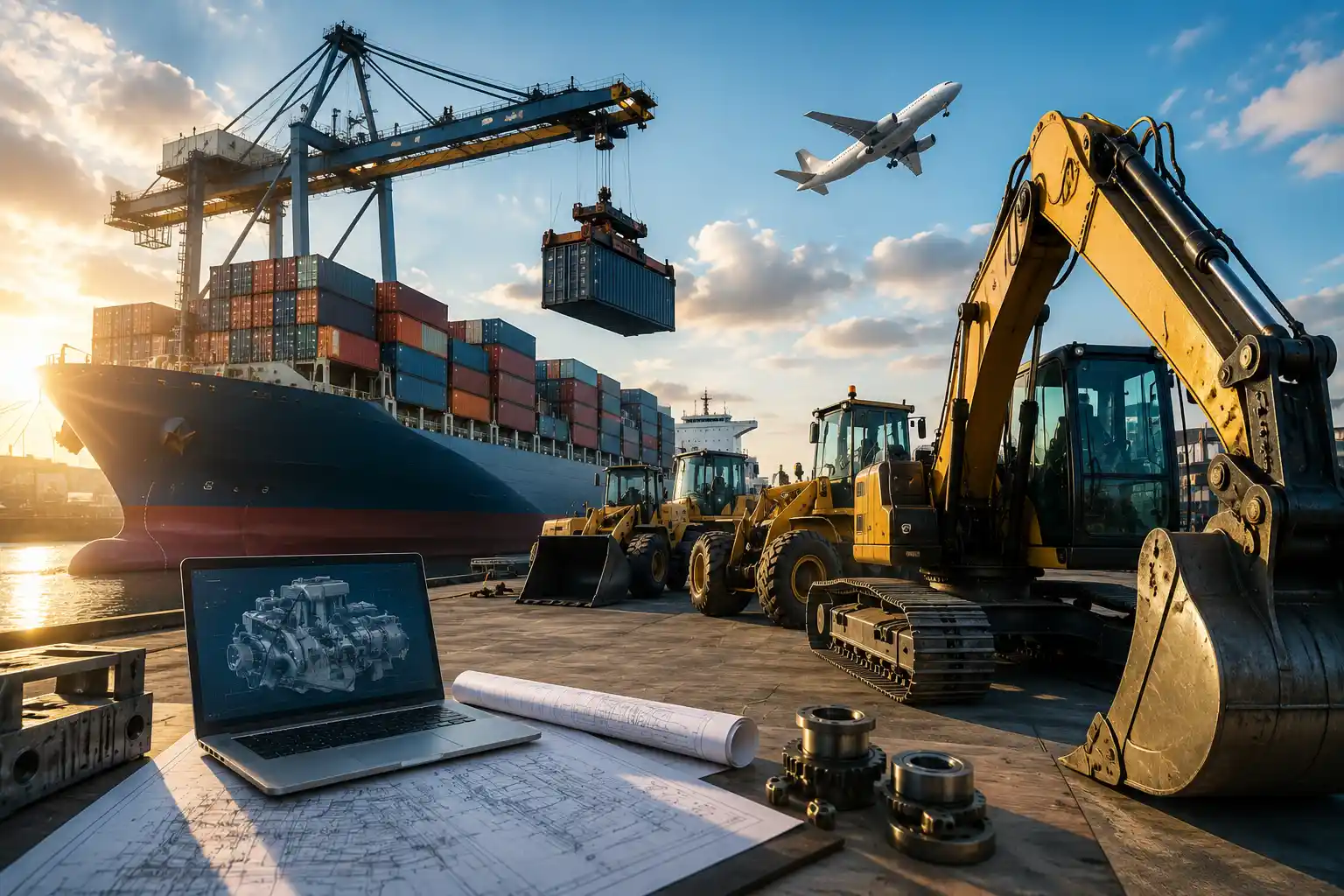
Buying industrial machinery from Chinese manufacturers can reduce equipment capital expenditures by 30% to 50% compared to Western alternatives. However, capturing those cost savings requires strict oversight. Importing machinery into the United States involves navigating complex federal regulations, Section 301 tariffs, strict electrical safety compliance, and overseas quality verification.
Without a structured procurement framework, US buyers risk severe project delays, expensive port detention fees, or receiving equipment that fails US workplace safety standards. This guide provides US plant managers, procurement teams, and business owners with an actionable blueprint for sourcing, vetting, inspecting, and importing heavy equipment and industrial machinery from China.
1. Strategic Sourcing: Finding & Vetting Qualified Chinese Machinery Manufacturers
Finding a machine supplier in China requires looking beyond marketplace listings on platforms like Alibaba or Made-in-China. Many listed entities are trading companies or brokers rather than original equipment manufacturers (OEMs).
Identifying Factory Direct vs. Trading Companies
To ensure product quality and technical support, work directly with true manufacturers who maintain in-house machining, fabrication, and assembly lines.
- Verify Business Licenses (营业执照): Request the supplier’s Chinese business license and cross-reference their registered business scope on the Chinese National Enterprise Credit Information Publicity System. The business scope must explicitly list “Manufacturing” (制造) or “Production” (生产), not just “Sale” (销售) or “Trade” (贸易).
- Evaluate Factory Assets: Direct factories invest heavily in capital assets like CNC machining centers, laser cutters, robotic welding bays, and dedicated testing floors. Trading companies typically operate out of commercial office buildings.
- Review Technical Expertise: Direct factory engineering teams can answer detailed structural, electrical, and mechanical customization questions without long delays. Trading companies usually act as intermediaries, delaying responses to technical inquiries.
On-Site Audit Protocols & Third-Party Verification
Before issuing a deposit or signing a purchase contract, conduct a formal supplier audit using an independent third-party inspection agency (e.g., SGS, TÜV Rheinland, or Bureau Veritas) or an onshore sourcing partner.
- Quality Management Systems (QMS): Verify ISO 9001:2015 certification by checking registration numbers with issuing accreditation bodies.
- Manufacturing Capacity & Tooling: Confirm factory throughput capacity, raw material inventory control, welding standards, and calibration schedules for precision measuring tools.
- Live Video Audits: Require a live video walkthrough of active production lines, focusing on raw material processing, assembly bays, and the factory’s quality testing setup.
2. Engineering & Technical Specs: Adapting Machinery for the US Market
Industrial machinery built for domestic use in China or Europe will not run on standard US industrial power grids without modifications. Adapting equipment to US electrical and mechanical standards before export prevents costly field retrofits.
Electrical & Power Compatibility (Phase, Voltage & Frequency)
China’s standard industrial power supply operates at 380V / 3-Phase / 50Hz. US manufacturing facilities typically run on 480V / 3-Phase / 60Hz or 208V / 3-Phase / 60Hz.
- Motors & Transformers: Electric motors designed for 50Hz run 20% faster on a 60Hz supply, causing excessive heat, accelerated wear, and premature motor failure. Require 60Hz-rated motors or appropriately sized Variable Frequency Drives (VFDs).
- Control Panel Compliance: Enforce Underwriters Laboratories (UL 508A) or CSA standards for control panels. US OSHA inspectors and commercial insurance policies often require UL-listed electrical panels.
- Safety & Wiring Color Coding: Demand wiring color-coded to National Electrical Code (NEC) standards (e.g., green/yellow for ground, black/red/blue for ungrounded AC phase conductors) and clear English labeling on all terminal blocks.
Software, PLC & Component Standardization
Proprietary or region-locked machinery components cause long operational downtime if parts break down.
- PLC & HMI Standards: Require widely supported programmable logic controller (PLC) brands such as Siemens, Allen-Bradley (Rockwell Automation), or Schneider Electric. Ensure human-machine interfaces (HMIs) feature clean, native English translation without system-level Chinese characters.
- Non-Proprietary Off-the-Shelf Parts: Mandate standard commercial off-the-shelf (COTS) components for high-wear mechanical parts, pneumatic cylinders, hydraulic valves, and sensors. Ensure these parts match US vendor catalogs (e.g., McMaster-Carr, Grainger, Parker Hannifin).
3. Calculating True Landed Cost: US Duties, Tariffs & Hidden Fees
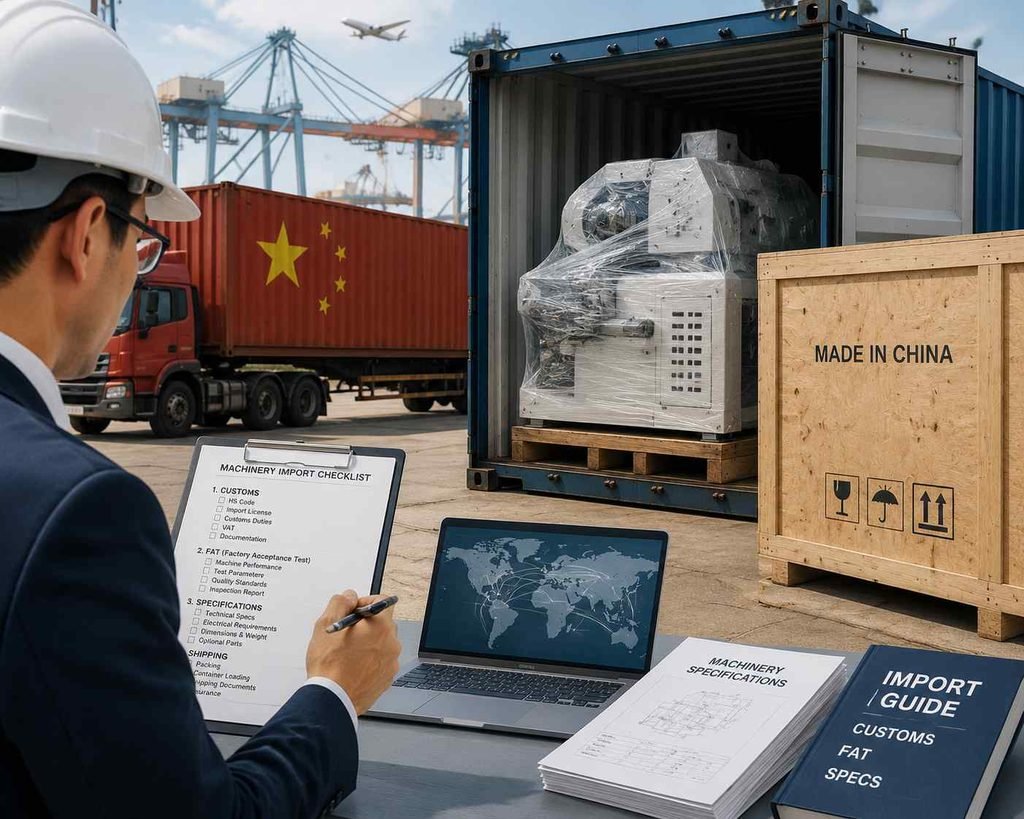
Evaluating a machine based solely on its Free on Board (FOB) price creates misleading financial expectations. The true Landed Cost includes factory costs, overseas freight, US Customs duties, tariff surcharges, and local port handling fees.
Understanding the US Duty & Tariff Stack
US Customs and Border Protection (CBP) calculates import duties based on the Harmonized Tariff Schedule (HTS) code assigned to the machine. Importers must account for several fee layers:
- MFN Base Duty Rate: Standard duty rates for industrial machinery under HTS Chapters 84 and 85 typically range between 1.5% and 3.5%.
- Section 301 Tariffs: Most industrial equipment originating from China remains subject to Section 301 trade tariffs, adding an extra 7.5% to 25% (or higher) duty stack on top of the base MFN rate.
- Merchandise Processing Fee (MPF): An ad valorem fee of 0.3464% of the entered value (minimum $33.58, maximum capped at $651.50 per entry).
- Harbor Maintenance Fee (HMF): A 0.125% fee on the total cargo value for ocean freight arriving at US ports.
US Machinery Import Landed Cost Calculation Matrix
Below is a financial calculation for an industrial packing machine with an FOB invoice price of $50,000 under HTS 8422.30:
| Cost Component | Rate / Basis | Amount (USD) |
| Factory Purchase Price (FOB Value) | Base Machinery Cost | $50,000.00 |
| Ocean Freight & Marine Insurance | 40ft High-Cube Container | $4,500.00 |
| Base MFN Duty (HTS 8422.30) | 2.5% of FOB Value | $1,250.00 |
| Section 301 Tariff (China Origin) | 25.0% of FOB Value | $12,500.00 |
| Merchandise Processing Fee (MPF) | 0.3464% (Capped at $651.50) | $173.20 |
| Harbor Maintenance Fee (HMF) | 0.125% of Cargo Value | $62.50 |
| Customs Brokerage & Filing Fees | Flat Service Fee | $450.00 |
| Port Handling (DTHC) & Drayage | Port to Factory Transit | $1,200.00 |
| Total Estimated Landed Cost | FOB + Logistics + Duties + Fees | $70,135.70 (+40.27%) |
4. Contracts, Payment Terms & Risk Mitigation
Protect your capital by setting clear purchase terms and structuring milestone payments that tie disbursements to verified quality checks.
Structuring Milestone Payments
Never pay 100% upfront via Telegraphic Transfer (T/T). Implement a milestone payment framework in your Bilingual Sales Contract (English and Chinese):
- 30% Down Payment: Released upon contract execution and engineering drawing sign-off.
- 40% Progress Payment: Released only after successful Factory Acceptance Testing (FAT) and third-party inspection sign-off at the factory.
- 30% Final Balance: Released upon receipt of the clean Bill of Lading (B/L) or successful Site Acceptance Testing (SAT) at your US facility.
For high-value machinery purchases exceeding $100,000, use an Irrevocable Letter of Credit (L/C) payable at sight against clean shipping and inspection documents.
Incoterms Selection: FOB vs. DDP
Selecting the correct Incoterm determines liability, insurance coverage, and control over ocean logistics.
Incoterms Comparison for Machinery Importers
| Incoterm | Ocean Freight Responsibility | US Customs & Tariff Payment | Best Suited For |
| FOB (Free on Board) | US Buyer | Managed by Buyer’s US Freight Forwarder | Recommended. Gives the importer full control over shipping schedules, cargo insurance, and customs clearance. |
| DDP (Delivered Duty Paid) | Chinese Supplier | Managed by Supplier’s Logistics Partner | First-time buyers seeking a turnkey delivery. (Ensure supplier uses a licensed US Customs broker). |
| CIF (Cost, Insurance & Freight) | Chinese Supplier | Managed by US Buyer | Not Recommended. Suppliers often use low-cost ocean carriers and pass high Destination Terminal Handling Charges (DTHC) to the buyer. |
5. Quality Control: Factory Acceptance Testing (FAT) & Pre-Shipment Inspection
Fixing technical issues after a machine arrives at a US facility is expensive and time-consuming. Enforce a thorough pre-shipment inspection process while the machine is still on the factory floor.
Establishing the FAT Protocol
A formal Factory Acceptance Test (FAT) verifies operational performance against contract specifications.
- Dry Run Testing: Run the machine continuously for 2 to 4 hours without raw materials to monitor motor temperatures, pneumatic pressures, and electrical stability.
- Full-Load Production Run: Supply actual raw material samples to run the machine under 100% full production speed for 4 to 8 hours. Measure production tolerances, output speed, reject rates, and noise levels.
- Safety Interlock Testing: Test all emergency stop (E-stop) buttons, optical light curtains, interlocked safety doors, and fault alarm systems.
Export Packaging Standards (Preventing Corrosion & Transit Damage)
Ocean freight transits take 20 to 35 days, exposing machinery to high humidity, salty sea air, and rough movement.
- Vapor Corrosion Inhibitor (VCI): Machine beds, unpainted steel surfaces, and exposed shafts must be coated with anti-rust oil, wrapped in VCI film, and vacuum-sealed with desiccant bags.
- ISPM 15 Compliant Crating: Wood packaging, skids, and bracing must comply with ISPM 15 standards. Ensure solid wood crating carries legible heat-treatment (HT) stamps to prevent US Customs re-export orders.
- Internal Container Securing: Machinery inside ocean containers must be anchored to floor D-rings using steel wire ropes, turnbuckles, and heavy-duty chocks.
Pre-Shipment Inspection Checklist
| Inspection Category | Requirement / Standard | Verification |
| Power & Electrical | Phase matching (480V/60Hz), grounding circuits, UL-rated panel components | [ ] Pass / Fail |
| Dimensional Accuracy | Matches approved technical drawings within ±0.5mm tolerance | [ ] Pass / Fail |
| Continuous Load Test | 4-hour continuous run with zero overheating, leaks, or electrical trips | [ ] Pass / Fail |
| Safety Mechanisms | Emergency E-stops, safety guards, and interlocks fully operational | [ ] Pass / Fail |
| Software & HMI | English interface, unlocked PLC access, complete wiring diagrams included | [ ] Pass / Fail |
| Rust Protection & Packaging | VCI vacuum sealed, desiccant packs inside, ISPM 15 stamped wooden crate | [ ] Pass / Fail |
6. Logistics, US Customs Clearance & Post-Delivery Setup
Completing logistics and customs documentation on time prevents port detention and demurrage charges.
Crucial Customs Documentation & ISF Filing
Your US Customs Broker needs complete import documentation before your shipment arrives at the port of entry:
- Importer Security Filing (ISF 10+2): Must be transmitted to US Customs at least 24 hours before cargo is loaded onto the vessel at the Chinese port of origin. Late filings carry automated $5,000 penalties per violation.
- Commercial Invoice & Packing List: Accurately detailed with itemized machinery components, serial numbers, net/gross weights, and individual value breakdowns.
- Bill of Lading (B/L): Ocean transport document issued by the carrier.
- HTS Code Self-Declaration: Work with your customs broker to verify the proper 10-digit HTS code to ensure correct duty payment.
Installation, Commissioning & Maintenance Agreements
Once the machinery arrives at your US facility:
- Site Acceptance Testing (SAT): Conduct installation checks alongside facility engineers to confirm performance matches the initial FAT benchmark.
- Spare Parts Inventory: Negotiate a critical spare parts package (e.g., replacement sensors, heating elements, blades, seal kits) to be packed directly inside the machine crate.
- Service Support: Secure a 12-to-24-month warranty requiring the manufacturer to dispatch replacement parts via express air freight (DHL/FedEx) within 48 hours.
Conclusion: Streamline Your Machinery Sourcing Pipeline
Buying machinery from China offers substantial cost advantages for US industrial operations. However, long-term ROI depends on systematic vendor evaluation, rigorous electrical standard verification, disciplined FAT testing, and precise landed-cost management.
Partnering with an experienced industrial sourcing team eliminates procurement risks. Mekantra Technologies helps US companies manage technical sourcing, vendor vetting, engineering oversight, and import compliance ensuring your machinery arrives on time, on budget, and fully compliant with US operational standards.
Frequently Asked Questions (FAQ)
Is it safe to buy machinery from China?
Yes, buying machinery from China can be safe if you choose a verified supplier, check factory details, review product specifications, and use proper quality inspection before shipment.
How can I find a reliable machinery supplier in China?
You can find reliable suppliers by checking manufacturer experience, certifications, customer reviews, factory videos, product samples, and verifying their production capability.
What types of machinery can I import from China?
China manufactures a wide range of machinery, including industrial machines, packaging machines, CNC machines, construction equipment, agricultural machinery, and customized production equipment.
How much does it cost to import machinery from China?
The total cost depends on machine type, supplier price, shipping method, customs duties, taxes, and installation requirements. A complete cost calculation should include all import expenses.
How long does it take to import machinery from China?
The import timeline usually depends on manufacturing time, inspection, shipping method, and customs clearance. Most orders can take several weeks from production to delivery.

Mekantra Engineering Team
The technical voice of Mekantra. Our team consists of sourcing specialists, mechanical engineers, and logistics experts dedicated to providing transparent insights and high-performance solutions for the global manufacturing sector.
Mekantra Engineering Team
The technical voice of Mekantra. Our team consists of sourcing specialists, mechanical engineers, and logistics experts dedicated to providing transparent insights and high-performance solutions for the global manufacturing sector.