Digital Textile Printing vs Rotary Screen: Mill Buyer Guide
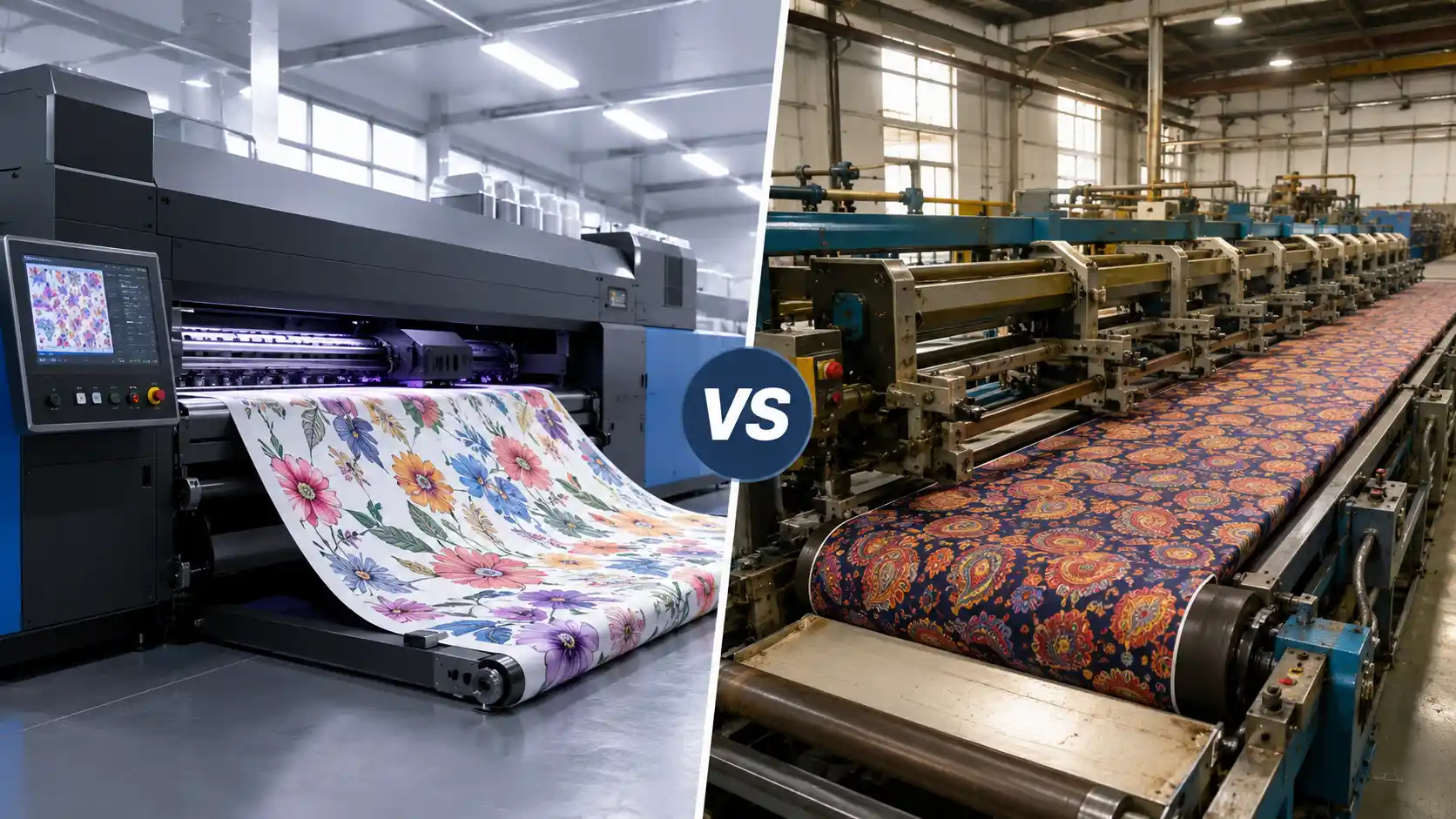
Choosing the right machinery for an industrial dyeing and finishing facility directly dictates your mill’s operational efficiency, profit margins, and environmental compliance. For U.S. textile plants facing high labor rates, increasing municipal water costs, and stringent EPA wastewater discharge standards under the Clean Water Act, selecting between Digital Textile Printing (industrial inkjet) and Rotary Screen Printing (continuous cylinder application) is one of the most critical CapEx decisions you will make.
Executive Summary & Quick Reference
If your facility is evaluating equipment options, the core trade-off comes down to setup overhead vs. consumable costs:
- Rotary Screen Printing offers unmatched speed and lower dye paste costs for long, continuous production runs (>3,000 meters). However, it requires significant setup time, high water consumption for screen wash-downs, and expensive photo-engraving prep.
- Digital Textile Printing eliminates physical screens, reducing setup waste, setup labor, and water usage by up to 65%. It offers higher margins for short-to-medium runs (<1,500 meters) and fast-turnaround collections, though per-liter ink costs are higher.
Technical Overview: How the Technologies Compare
Understanding the fluid dynamics and mechanical differences between these systems helps evaluate their operational costs.
                      +-----------------------------------+
                      |   FABRIC SUBSTRATE PREPARATION   |
                      +-----------------+-----------------+
                                        |
                   +--------------------+--------------------+
                   |                                         |
                   v                                         v
   +-------------------------------+         +-------------------------------+
   | ROTARY SCREEN PRINTING LINE   |         | DIGITAL INKJET PRINTING LINE  |
   +-------------------------------+         +-------------------------------+
   | 1. Separate Screen Engraving  |         | 1. RIP Software Color Process |
   |    (1 Screen per Color)       |         | 2. Piezoelectric Drop-on-     |
   | 2. Color Kitchen Dye Mix      |         |    Demand Application         |
   | 3. High-Volume Paste Transfer |         | 3. Direct-to-Fabric Inkjet    |
   | 4. Heavy Post-Wash & Steam    |         | 4. Inline Dry/Fixation        |
   +---------------+---------------+         +---------------+---------------+
                   |                                         |
                   v                                         v
   +-------------------------------+         +-------------------------------+
   | High Water & Paste Discharge  |         | Minimal Water & Zero Paste    |
   | Wastewater Treatment (ETP)    |         | Direct-to-Substrate Output    |
   +---------------+---------------+         +-------------------------------+
1. Rotary Screen Printing
Rotary screen printing uses seamless nickel mesh cylinders engraved with specific patterns. Formulated dye paste is pumped inside the rotating cylinder, where an internal squeegee blade forces the paste through micro-perforations onto the moving fabric web below.
- Color Handling: Each color requires a separate engraved cylinder (typically 6 to 12 colors, up to 24 on specialized lines).
- Fixation & Washing: Requires extensive post-print steaming and multi-stage washing ranges to strip unfixed thickeners, urea, and residual dyestuffs.
2. Digital Textile Printing
Digital textile printing uses high-density piezoelectric drop-on-demand (DoD) printhead arrays. Microscopic droplets of water-based inks (pigment, reactive, disperse, or acid) fire directly onto pre-treated fabrics without mechanical contact.
- Color Handling: Uses process color mixing (CMYK + extended gamut like Orange, Violet, Green, Grey) to create millions of shades digitally from a single file.
- Fixation & Washing: Water-based pigment ink systems dry inline with hot air, eliminating post-printing washing stages entirely.
1. Water Consumption & Wastewater Impact
Water utility costs and Effluent Treatment Plant (ETP) capacity are top operational concerns for U.S. dyehouses. Conventional printing lines consume large volumes of water during pattern changeovers, squeegee cleaning, and post-fixation rinsing.
WATER CONSUMPTION COMPARISON (Liters per Kg of Printed Fabric)
----------------------------------------------------------------------
Rotary Screen Printing : [====================================] 200 L/kg
Digital Inkjet Printing : [============] 65 L/kg  (67% Reduction)
----------------------------------------------------------------------
Rinsing and Wash-Down Cycles
When changing colorways or designs on a rotary printer, screens, pumps, supply lines, and color kitchens must be flushed. A standard 8-color design change generates 300 to 800 gallons of contaminated wash-down water loaded with synthetic thickeners and unfixed dyes.
Digital printers use automated printhead purging and wiping routines that use under 2 to 5 gallons of flushing fluid per maintenance cycle.
ETP and Compliance Management
Rotary screen printing produces high Biological Oxygen Demand (BOD) and Chemical Oxygen Demand (COD) effluent loads due to starches and alginates in the print paste. Digital pigment systems operate virtually waterless post-printing, requiring only hot-air curing (150°C to 170°C / 300°F to 340°F) via a stenter frame or inline calender.
| Environmental Metric | Rotary Screen Printing | Digital Textile Printing | Operational Impact |
| Water Intensity | 180 – 220 L/kg fabric | 60 – 80 L/kg fabric | Digital saves ~65% water |
| Wastewater Generation | High BOD/COD wash-down stream | Negligible (Pigment) / Low (Reactive) | Reduces ETP load and compliance risk |
| Chemical Waste | Residual paste left in pipes/screens | Near-zero ink waste in supply lines | Digital reduces chemical loss |
| Energy Consumption | High (large drying ovens + steamers) | Moderate (compact hot-air curing) | 30% – 40% thermal energy savings |
2. Setup Speed, Lead Times, and Fabric Scrap
For U.S. manufacturers competing on quick delivery and local supply chain agility, setup speed is just as important as production speed.
Screen Engraving vs. RIP Processing
- Rotary Screen: Preparing a design requires photo-engraving nickel screens, exposing UV emulsion, laser engraving, mounting end rings, and setting alignment. This prep phase takes 3 to 10 days and adds material costs before printing a single meter.
- Digital Printing: Design files (TIFF, PSD, PDF) pass through Raster Image Processing (RIP) software with custom ICC color profiles in minutes.
PRODUCTION SETUP TIMELINE
----------------------------------------------------------------------
ROTARY SCREEN: [Engraving: 2-5 Days] -> [Mounting: 2 hrs] -> [Color Mix: 1 hr] -> [Run]
DIGITAL INKJET: [RIP File: 15 mins] ---------------------------------------------> [Run]
----------------------------------------------------------------------
Registration Waste
Aligning 12 rotary cylinders on a continuous press requires running fabric through the line to verify pattern repeat accuracy. A typical setup consumes 30 to 100 meters of greige or prepared-for-print (PFP) fabric in registration waste alone. Digital printers align nozzle firing electronically, resulting in zero registration fabric scrap.
3. Financial Cost Analysis & Break-Even Run Lengths
Choosing between systems comes down to pattern order volumes. Digital printing features low fixed setup costs paired with higher per-liter ink costs. Rotary screen printing requires heavy upfront setup costs, but uses low-cost bulk dye paste.
Cost Structure Breakdown
- Fixed Setup Costs: Rotary screens cost roughly $300 to $600 per engraved cylinder, plus color kitchen labor. Digital file prep costs are near zero.
- Variable Consumable Costs: Digital textile inks cost $18 to $35 per liter, compared to bulk formulated rotary dye paste at $2 to $5 per kilogram.
UNIT COST vs. RUN LENGTH (METERS)
----------------------------------------------------------------------
Cost/Meter ($)
  ^
$8|  \ Digital Inkjet (High Ink Cost, Zero Setup)
  |   \
$4|    \------- Break-Even Threshold (~1,200 to 1,500m)
  |     \----------------------------------------------
$1|       \___________ Rotary Screen (High Setup, Low Paste Cost)
  +------------------------------------------------------------>
  0        500       1,000      2,000     3,000     5,000+ Meters
Calculating Your Break-Even Point
For a typical 8-color design on 100% woven cotton:
- Runs Under 1,200 Meters: Digital printing offers a lower total cost per meter by eliminating screen engraving and registration scrap.
- Runs Between 1,200 and 3,000 Meters: The transition zone. The decision depends on color coverage, local labor costs, and municipal water fees.
- Runs Exceeding 3,000 Meters: Rotary screen printing maintains a lower unit-cost advantage due to inexpensive bulk paste.
4. Design Capability and Print Quality
Halftones and Tonal Transitions
Rotary screen printing is limited by physical screen mesh counts (typically 125 to 155 mesh). Printing fine photographic gradients, realistic shadows, or micro-patterns is constrained by mechanical moiré risks and screen overlap limits.
Digital printheads operate at resolutions of 600 dpi to 1200 dpi, firing drop sizes from 3 to 18 picoliters. This enables smooth tonal ramps, complex photo designs, and fine geometric detail without color bleeding.
COLOR & DETAIL CAPABILITY
----------------------------------------------------------------------
Rotary Screen  : Limited to Screen Count (Max 12-24 Discrete Colors)
Digital Inkjet : Infinite Tonal Spectrum (Process Gamut Mixing)
----------------------------------------------------------------------
5. Comprehensive Comparison Matrix
This overview details key operational factors for mill equipment buyer evaluations.
| Operational Factor | Rotary Screen Printing | Digital Textile Printing | Strategic Fit |
| Ideal Order Volume | Bulk orders (> 3,000 meters) | Short to mid-runs (1 to 2,000 meters) | Order profile dependent |
| Max Production Speed | High (40 – 90 meters/minute) | Moderate to High (10 – 60 m/min single pass) | High-volume continuous lines |
| Water Usage per Kg | ~200 Liters | ~65 Liters | Digital wins on sustainability |
| Design Color Limit | Max 12–24 discrete colors | Unlimited (Process CMYK + Spot) | Digital wins on design complexity |
| Lead Time to First Meter | 2 to 4 Weeks (Screen making) | Under 1 Hour | Digital wins on fast delivery |
| Capital Investment | $800k – $2.5M per line | $300k – $1.5M per press | Lower initial entry cost for digital |
| Ink/Dye Cost per m² | Very Low ($0.20 – $0.60/m²) | Moderate to High ($1.20 – $3.50/m²) | Rotary wins on long runs |
| Pattern Repeat Size | Fixed by cylinder circumference | Continuous / Variable length | Digital wins on pattern size |
6. The Hybrid Plant Layout: Maximizing Capital ROI
Modern textile plants rarely rely on a single technology. Instead, leading facilities use a hybrid production model to optimize machinery utilization and margins:
                  +-----------------------------------+
                  |      INCOMING CLIENT ORDERS       |
                  +-----------------+-----------------+
                                    |
            +-----------------------+-----------------------+
            |                                               |
            v                                               v
+-------------------------------+               +-------------------------------+
| SHORT RUNS & SAMPLING (<1,500m)|               | HIGH-VOLUME BULK (>3,000m)    |
+---------------+---------------+               +---------------+---------------+
                |                                               |
                v                                               v
+-------------------------------+               +-------------------------------+
|  DIGITAL INKJET PRESSES       |               |  ROTARY SCREEN PRINTING LINES |
|  - Fast Turnaround            |               |  - Ultra-Low Unit Dye Cost    |
|  - Zero Screen Prep           |               |  - Continuous High Speed      |
|  - Reduced Water/Effluent     |               |  - Deep Penetration Solid Dyes|
+-------------------------------+               +-------------------------------+
- Digital Lines for Sampling and Short-Runs: Assign digital presses to rapid sampling, micro-collections, custom short-runs, and complex multi-color patterns.
- Rotary Lines for High-Volume Basics: Reserve rotary lines for continuous solid shades, simple geometric patterns, white discharge prints, and orders exceeding 5,000 meters.
- Lower Screen Room Overhead: Offloading short-run work to digital equipment cuts low-margin screen engraving, freeing up rotary presses for uninterrupted bulk runs.
Conclusion & Strategic Recommendations
Selecting the right equipment comes down to your plant’s order mix, local utility costs, and turn-around demands:
- Invest in Digital Textile Printing if your mill manages frequent design changes, high water utility rates, short-run apparel orders, or needs to meet strict municipal wastewater limits.
- Maintain Rotary Screen Equipment if your revenue relies on large-scale continuous runs of uniform patterns (such as home furnishings or uniform fabrics) where low unit-dye cost drives profitability.
Combining digital inkjet systems with automated water management and high-efficiency washing ranges enables modern textile operations to cut overall water use while protecting output and profitability.
FAQs
Which printing technology is better for small-run apparel orders in the USA?
Digital textile printing is ideal for small runs under 1,500 meters because it eliminates physical screen engraving costs and reduces setup time to minutes.
How much water does digital textile printing save compared to rotary screen printing?
Digital inkjet systems reduce water consumption by roughly 65% by replacing heavy multi-stage screen wash-downs and paste cleaning with automated digital printhead purging.
What is the break-even run length between digital and rotary screen printing?
The financial break-even point typically falls between 1,200 and 1,500 meters, below which digital is cheaper and above which rotary screen printing maintains lower unit costs.
How do US mills manage wastewater compliance when using rotary screen printing?
Mills use Effluent Treatment Plants (ETPs) to handle high BOD and COD loads generated by synthetic thickeners and unfixed dye paste wash-down streams.
Can digital textile printers match the production speed of continuous rotary screen lines?
Rotary screens still achieve higher continuous linear speeds (up to 90 meters per minute), whereas high-speed single-pass digital presses range between 10 and 60 meters per minute.

Mekantra Engineering Team
The technical voice of Mekantra. Our team consists of sourcing specialists, mechanical engineers, and logistics experts dedicated to providing transparent insights and high-performance solutions for the global manufacturing sector.
Mekantra Engineering Team
The technical voice of Mekantra. Our team consists of sourcing specialists, mechanical engineers, and logistics experts dedicated to providing transparent insights and high-performance solutions for the global manufacturing sector.