Hot Rolling vs Cold Rolling: Steel Process Guide
Summary:
“Understanding the journey of steel from a molten state to a finished product requires knowledge of metallurgy. This guide breaks down the physical and mechanical differences between hot and cold rolling processes, detailing the exact machinery required for each manufacturing stage.”
When studying the lifecycle of modern steel manufacturing, the melting stage is only the beginning. If you have already explored the operational differences between EAF vs Blast Furnaces, you understand how raw materials like iron ore and scrap metal are converted into molten steel. Once this liquid metal is cast into solid, semi-finished shapes such as thick slabs, blooms, or billets it must undergo extensive physical transformation before it can be used in construction, automotive, or consumer industries.
To transform a thick, heavy slab of raw steel into a usable sheet, coil, or structural beam, the metal must pass through heavy-duty steel processing machinery. This secondary stage of manufacturing is governed by two primary mechanical methods: hot rolling and cold rolling.
The decision between hot rolling vs cold rolling completely dictates the final mechanical properties, dimensional tolerance, and surface finish of the metal. In this comprehensive technical guide, Mekantra Technologies explains the metallurgical science behind these processes, provides a head-to-head comparison, and breaks down the exact steel rolling mill equipment required to operate these facilities.
The Metallurgical Foundation: Recrystallization Temperature
Before exploring the machinery, engineers and plant managers must understand the core physical difference between hot rolled vs cold rolled steel. The entire distinction relies on a metallurgical concept known as the recrystallization temperature.
When steel is formed, it consists of microscopic crystal grains. The recrystallization temperature is the precise thermal point at which these deformed grains are entirely replaced by a new, stress-free set of grains. For most structural carbon steels, this temperature falls between 1,700°F and 1,850°F (926°C to 1,010°C).
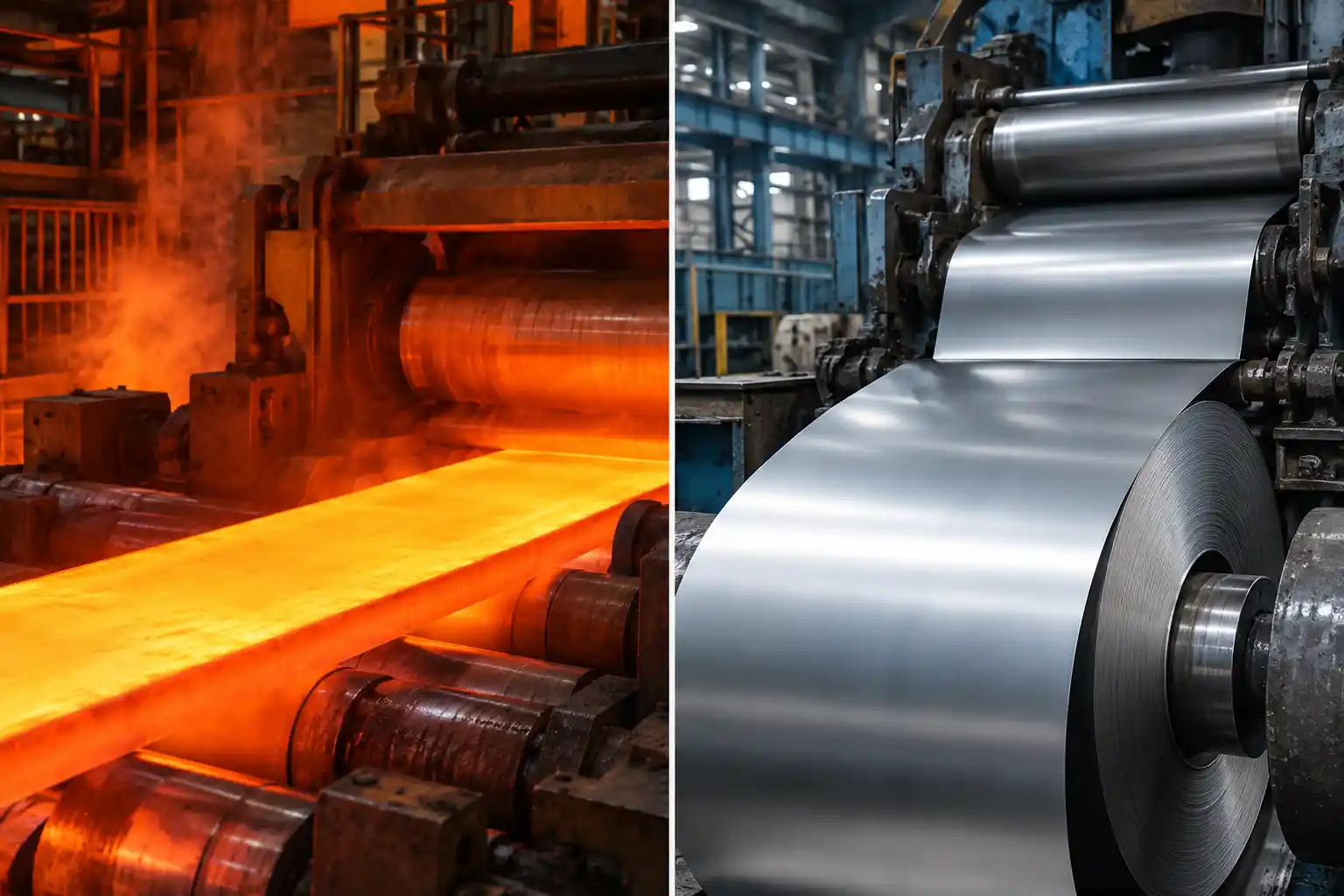
- Hot Rolling is performed at extreme temperatures above the recrystallization point. Because the metal is heated past this threshold, the grain structure is continuously broken down and reformed as the steel is compressed. This makes the steel highly plastic and malleable, allowing massive reductions in thickness with relatively low mechanical force.
- Cold Rolling is performed below the recrystallization temperature, typically at normal room temperature. Because the steel has already cooled, its crystalline structure is locked in place. Shaping it requires immense mechanical pressure. As the cold steel is compressed, its grains are permanently elongated and flattened. This phenomenon, known as “work hardening” or “strain hardening,” drastically increases the strength and hardness of the final product.
The Hot Rolling Process: Heavy Infrastructure and Volume
A hot rolling mill is engineered for sheer volume, speed, and massive physical scale. The primary objective is to take a continuous-cast steel slab (which can be up to 10 inches thick) and flatten it into a long, thin strip, or shape it into structural profiles like I-beams, H-beams, and railroad tracks.
Because the steel is red-hot, it offers very little resistance to the rollers. This allows manufacturers to achieve drastic shape changes in just a few passes. However, manipulating metal at temperatures exceeding 1,200°C requires extremely robust thermal and metal processing equipment.
Essential Hot Rolling Mill Equipment
Setting up a complete hot rolling production line requires a synchronized sequence of specialized machines. The standard plant layout includes:
1. Reheating Furnace
Hot rolling cannot begin until the steel slab is uniformly heated. The raw slabs are fed into a walking-beam or pusher-type reheating furnace. These massive furnaces use natural gas or fuel oil to heat the steel to approximately 1,200°C (2,200°F). Uniform heating is critical; if the core of the slab is colder than the surface, the metal will roll unevenly, causing internal stress and machinery damage.
2. Descaling Unit
When steel is heated to 1,200°C in an oxygen-rich environment, a thick, flaky layer of iron oxide known as mill scale forms rapidly on the surface. If this scale is left on the steel, the rollers will press it directly into the metal, ruining the surface finish and compromising structural integrity. To prevent this, the slab passes through a descaling unit. High-pressure water jets, operating at 150 to 250 bar, blast the red-hot steel, fracturing and washing away the scale immediately before rolling.
3. Rolling Stands (Roughing and Finishing)
This is the heart of the rolling mill machinery. The mechanical compression happens in two distinct phases:
- Roughing Stands: The heated slab makes its first passes through heavy-duty, heavily grooved rollers. These stands perform the “heavy lifting,” rapidly reducing the thickness of the slab by several inches in just a few back-and-forth passes.
- Finishing Stands: Once the slab is thinned down, it enters a tandem line of 5 to 7 synchronized finishing stands. The steel strip passes continuously through these rollers at high speeds, progressively flattening down to its final target thickness (gauge).
4. Cooling System
As the steel exits the final finishing stand, it is traveling at incredibly high speeds down a long runout table. Here, a laminar cooling system utilizes precision water curtains to drop the temperature of the steel at a highly controlled rate. This engineered cooling phase dictates the final microstructure of the steel (such as the ratio of ferrite to pearlite). Note: The rapid quenching of red-hot steel generates vast amounts of steam and metallic particulate matter. Implementing robust Industrial Air Filtration systems is mandatory to protect machinery and ensure plant worker safety.
5. Down-Coilers
At the very end of the runout table, heavy-duty down-coilers catch the fast-moving steel strip. These massive rotating mandrels wind the hot steel into tight, heavy coils weighing up to 30 tons. Tightly winding the steel helps it retain its remaining heat, allowing it to cool slowly and evenly in the storage yard before shipping or further processing.
The Cold Rolling Process: Precision and Strength
While a hot rolling mill starts with a raw cast slab, a cold rolling mill uses the hot-rolled coil as its starting raw material. The primary goal of a cold mill is not mass shape reduction, but refinement. Cold rolling improves the surface finish, enforces micrometer-level dimensional tolerances, and significantly increases the tensile and yield strength of the steel.
Because cold rolling does not involve extreme heat, the steel does not shrink after it is rolled. This allows for absolute dimensional precision. However, forcing cold, solid steel to compress requires exceptionally powerful and precise steel production equipment.
Essential Cold Rolling Mill Equipment
The cold rolling sequence is highly systematic, focusing on chemical cleaning, extreme mechanical pressure, and thermal recovery.
1. Pickling Line
Hot-rolled steel naturally cools in the open air, which causes a new layer of rough, blue-grey scale to form on the surface. Before cold rolling can occur, this scale must be completely removed; otherwise, it would cause friction, surface gouging, and catastrophic damage to the expensive cold rollers. The coil is unspooled and run continuously through a pickling line a series of long tanks filled with heated hydrochloric or sulfuric acid. The acid dissolves the iron oxide, leaving a bare, clean, and smooth metal surface.
2. Cold Rolling Stands
Once the steel is washed, dried, and oiled (to prevent flash rusting), it enters the heavy-duty cold rolling stands. Depending on the plant’s capacity, this is done using one of two setups:
- Reversing Mills: A single, incredibly powerful rolling stand. The steel is passed forward, stopped, and passed backward through the same rollers multiple times. The roller gap is tightened after each pass until the exact thickness is achieved.
- Tandem Mills: Used for continuous, high-volume production. A tandem mill consists of 4 to 6 rolling stands placed in a row. The steel strip passes through all stands in a single, continuous run, with each stand progressively reducing the thickness.
3. Annealing Furnace
As mentioned earlier, rolling cold steel causes severe work-hardening. The grains of the steel are crushed and elongated, making the metal incredibly strong but dangerously brittle. If a manufacturer tried to stamp or bend this steel, it would crack. To restore formability, the steel must be annealed. The coils are placed in batch annealing furnaces or run through continuous annealing lines. They are heated to sub-critical temperatures in an inert, oxygen-free atmosphere (usually hydrogen or nitrogen) to relieve internal stresses and allow the grains to recrystallize without melting.
4. Skin-Pass Mill
After annealing, the steel is soft and ductile, but it is susceptible to localized stretching defects known as “stretcher strains.” To prevent this, the steel goes through a skin-pass mill (also known as temper rolling). This is a final, very light rolling pass that reduces the thickness by only 0.5% to 2%. This light compression locks in the material’s yield point, ensures absolute flatness, and imparts the final surface texture whether that is a mirror-bright polish or a matte finish designed to hold paint.
5. Finishing Line
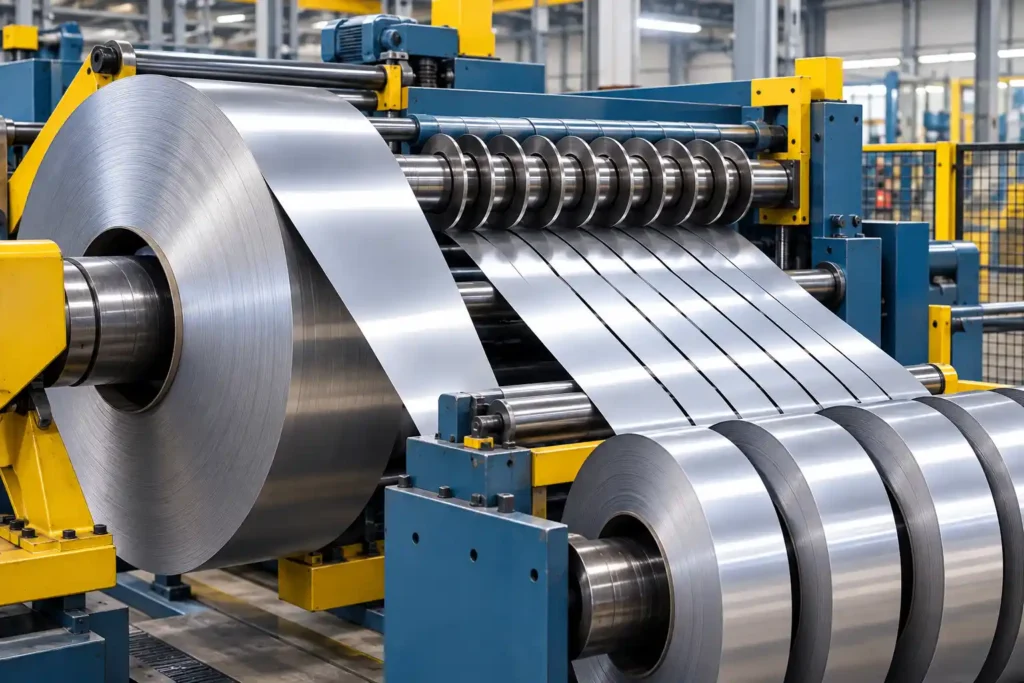
The final stage utilizes various types of Mechanical Machinery to prepare the steel for the end customer. Wide coils may be sent through slitting machines to be cut into narrow strips, or passed through shear lines to be cut into precise, flat rectangular sheets. Often, the steel is routed to a galvanizing line where it receives a protective coating of zinc to prevent corrosion.
Head-to-Head Comparison: Hot Rolling vs Cold Rolling
To clearly illustrate how these two manufacturing lines differ in an industrial setting, refer to the detailed technical comparison table below:
| Technical Parameter | Hot Rolling Mill Process | Cold Rolling Mill Process |
|---|---|---|
| Processing Temperature | > 1,700°F (926°C) | Room Temperature |
| Surface Finish | Rough, scaled, oxidized (blue-grey) | Smooth, polished, clean, oily |
| Dimensional Tolerance | Loose (metal shrinks as it cools) | Exacting (micrometer precision) |
| Production Speed | Very fast (high volume mass production) | Slower (requires multiple tight passes) |
| Energy Consumption Focus | High thermal energy (gas/fuel for heating) | High mechanical energy (electricity for rolling) |
| Mechanical Properties | Ductile, tough, low internal stress | High tensile strength, high hardness |
| Plant CAPEX Requirement | Exceptionally high (massive thermal infrastructure) | High (requires heavy motors and acid lines) |
| Cost of Final Product | Lower (less processing time) | Higher (value-added secondary processing) |
1. Surface Finish and Aesthetics
Because hot-rolled steel is heated and cooled in ambient air, oxidation is unavoidable. The result is a rough, scaled surface that is purely functional. It is ideal for structural applications where aesthetics are irrelevant. Conversely, cold-rolled steel is chemically pickled and rolled completely smooth. It is the material of choice for consumer-facing products that require painting, powder coating, or plating.
2. Dimensional Accuracy and Tolerances
Physics dictates that materials expand when heated and contract when cooled. When hot steel is rolled to a specific thickness, it will inevitably shrink slightly as it cools on the storage yard. This thermal contraction makes it impossible to guarantee micrometer-level accuracy in a hot rolled product. Because cold rolling is performed at room temperature, it experiences zero thermal shrinkage, yielding a product with perfect, uniform dimensions from edge to edge.
3. CAPEX, OPEX, and Energy Consumption
Building a new rolling facility represents a massive capital expenditure (CAPEX). A hot rolling plant requires a much larger physical footprint to accommodate massive reheating furnaces, extended runout tables, and heavy water-cooling infrastructure. The operating expenses (OPEX) are heavily tied to the thermal fuel (natural gas) required to keep furnaces at 1,200°C.
Cold rolling facilities, while still highly expensive, rely primarily on electrical OPEX to drive the massive high-torque motors required to force cold metal through tight gaps.
End-Use Applications: Which Steel Does Your Market Need?
Choosing which steel processing machinery to invest in depends entirely on the industries your plant intends to supply.
Hot Rolled Steel Applications:
Due to its toughness, affordability, and high volume availability, hot-rolled steel is the backbone of heavy industry. It is primarily used where precision shapes are less important than structural integrity.
- Construction (I-beams, H-beams, channel steel)
- Shipbuilding and heavy naval plates
- Railway tracks and train components
- Large-diameter industrial pipes and tubes
- Agricultural equipment frames
Cold Rolled Steel Applications:
Due to its flawless surface finish, increased strength, and exact dimensional tolerances, cold-rolled steel is a premium product used in high-end manufacturing.
- Automotive manufacturing (car body panels, chassis components)
- Home appliances (refrigerators, washing machines, ovens)
- Metal furniture and office filing cabinets
- Aerospace and precision engineering components
- Electrical enclosures and computer hardware
Optimizing Your Steel Plant with the Right Machinery
The transition from raw, molten metal to a precision-engineered steel sheet is a complex marvel of modern engineering. Whether a facility operates a hot rolling line to mass-produce heavy structural beams, or a cold rolling line to create flawless automotive panels, the reliability of the steel processing machinery is the single most important factor in plant profitability.
Modern rolling mills require exact engineering, robust automation, heavy-duty wear components, and rigorous maintenance schedules to reduce downtime and maximize yield. From advanced reheating furnaces and high-pressure descaling units to precision skin-pass mills and pickling lines, every single piece of equipment plays a vital role in the global steel supply chain.
If you are currently evaluating plant upgrades, expanding your metallurgical capabilities, or exploring the technical specifications of Iron & Steel Processing Equipment, understanding the distinct operational and physical demands of hot rolling vs cold rolling is the critical first step in facility design.
For more technical insights on metallurgy, foundry operations, and advanced industrial machinery, continue exploring Mekantra Technologies’ comprehensive manufacturing resources.

Mekantra Engineering Team
The technical voice of Mekantra. Our team consists of sourcing specialists, mechanical engineers, and logistics experts dedicated to providing transparent insights and high-performance solutions for the global manufacturing sector.
Mekantra Engineering Team
The technical voice of Mekantra. Our team consists of sourcing specialists, mechanical engineers, and logistics experts dedicated to providing transparent insights and high-performance solutions for the global manufacturing sector.