Laser Cutting vs Plasma Cutting: How Do the Processes Differ?
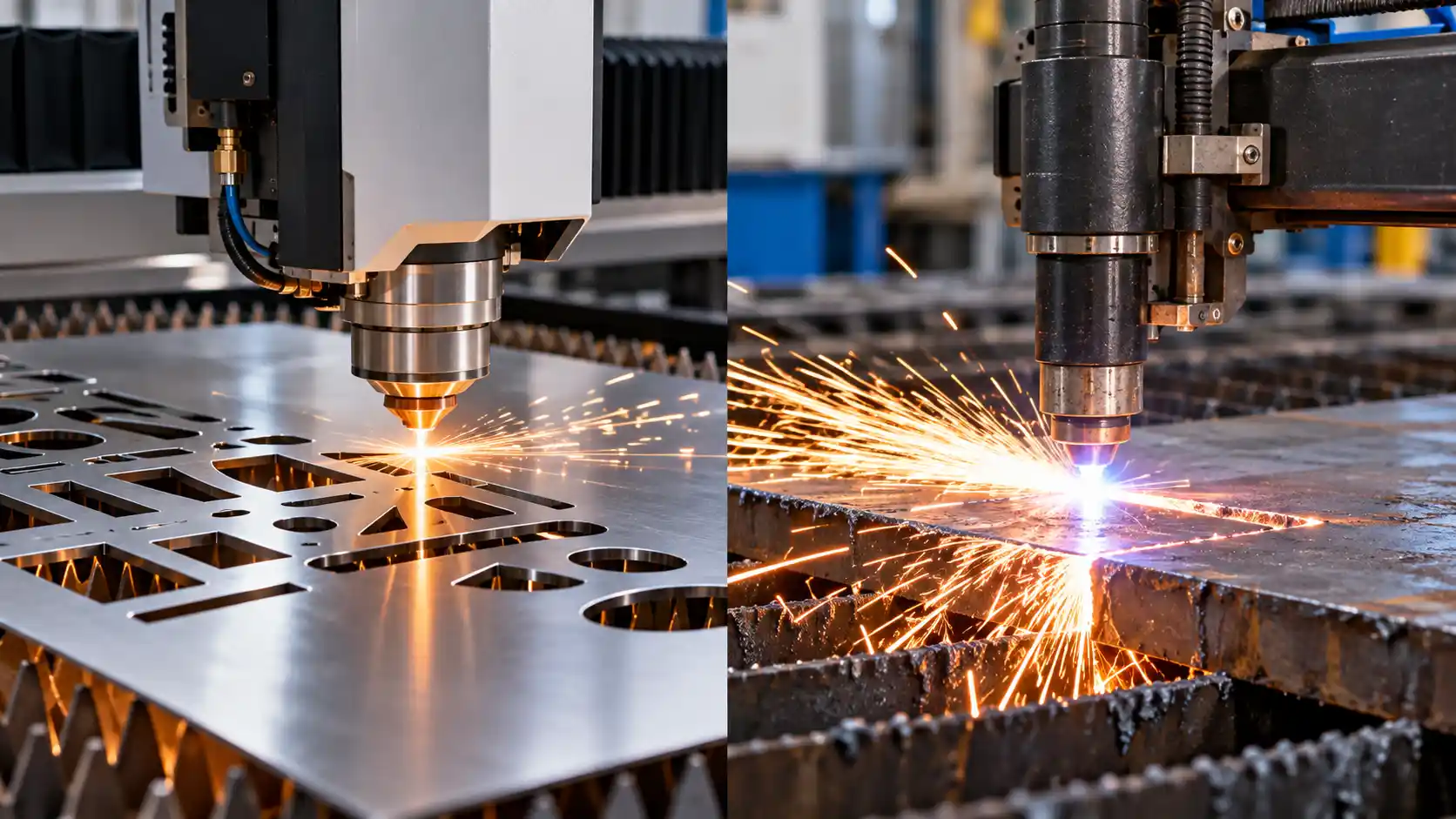
Laser cutting and plasma cutting are two widely used thermal cutting processes in modern metal fabrication. Both use concentrated energy to cut material, but they work differently and offer distinct advantages in precision, cutting thickness, speed and operating costs.
Understanding laser cutting vs plasma cutting helps manufacturers choose equipment that matches their production requirements. Laser cutting is commonly preferred for detailed parts, narrow cuts and high dimensional accuracy. Plasma cutting is often suitable for thicker conductive metals, structural components and fabrication jobs where cutting capacity and equipment cost are important considerations.
The right choice depends on material type, thickness, part design, required edge quality, production volume and the total cost of operating the machine.
How Does Laser Cutting Work?
Laser cutting uses a concentrated beam of light to heat a small area of material until it melts, vaporizes or reacts with the cutting process. A CNC controller guides the laser head along a programmed path to produce the required shape.
Industrial laser cutting systems commonly use fiber lasers for metal fabrication. CO₂ lasers are also used in certain applications, including some metal and non-metal cutting tasks.
During cutting, an assist gas helps remove molten material from the cut area. The gas and cutting parameters depend on the material, thickness and machine configuration.
Laser Cutting Accuracy and Edge Quality
One of the main advantages of laser cutting is its ability to produce narrow cuts and detailed shapes. A focused beam concentrates energy into a small area, allowing the machine to follow intricate contours and create relatively fine features.
Laser cutting is often used for:
- Sheet-metal components with detailed outlines.
- Enclosures, brackets and precision parts.
- Decorative metal panels.
- Components requiring narrow kerfs and consistent dimensions.
- Production jobs involving repeated complex shapes.
The actual accuracy depends on the laser source, machine mechanics, material properties, cutting parameters and calibration. Heat can still affect the cut edge, especially when settings are unsuitable or the material is difficult to process.
Materials and Thickness for Laser Cutting
Industrial laser cutting is commonly used with carbon steel, stainless steel, aluminium and other compatible metals. The machine’s laser power and configuration determine which materials and thicknesses it can process effectively.
Fiber laser systems are widely used for sheet metal and can also cut thicker sections when equipped with suitable power and process settings. However, the maximum rated thickness does not necessarily indicate the thickness a manufacturer can cut economically while meeting strict quality requirements.
Material reflectivity, thermal conductivity, surface condition and assist-gas selection can also influence performance.
How Does Plasma Cutting Work?
Plasma cutting uses an electrical arc to ionize gas and create a high-temperature plasma stream. This stream melts electrically conductive metal, while the gas flow removes molten material from the cut.
A plasma torch contains consumable components that help generate and direct the plasma. In CNC plasma cutting, a controller moves the torch according to a programmed design, allowing operators to produce repeated shapes and components.
Plasma cutting is commonly used for carbon steel, stainless steel, aluminium and other electrically conductive materials. It is particularly useful in fabrication environments that handle plate, structural sections and industrial metal components.
Plasma Cutting Thickness and Speed
Plasma cutting can process relatively thick conductive metals, depending on the power source, torch, gas system and material. Industrial systems vary significantly in their recommended cutting ranges and maximum severance capabilities.
A machine may be capable of separating a thick plate without being able to produce a clean, accurate production edge at that thickness. Buyers should therefore distinguish between recommended production capacity and maximum severance thickness.
Plasma cutting can also be fast when processing suitable materials, especially in applications involving thicker metal sections. Actual cutting speed depends on material thickness, amperage, torch distance, gas settings and the required edge quality.
Edge Quality and Material Compatibility
Plasma cutting typically produces a wider kerf than a comparable precision laser process. The cut edge may show more taper, dross or heat-affected material, depending on the machine and settings.
For many structural and general fabrication applications, this level of finish is acceptable. Some parts may require grinding or additional machining before assembly.
Plasma cutting requires electrically conductive material. It is not suitable for cutting wood, acrylic or other non-conductive materials in the same way that certain laser systems can process them.
Laser Cutting vs Plasma Cutting: Comparison Table
The main differences become clearer when both processes are compared across technical and commercial factors.
| Factor | Laser Cutting | Plasma Cutting |
|---|---|---|
| Cutting method | Focused laser beam | Ionized gas and electrical arc |
| Typical strength | Fine detail and narrow cuts | Cutting conductive metal plate |
| Accuracy | Generally higher for precision sheet-metal work | Suitable for many general fabrication tolerances |
| Kerf width | Usually narrower | Usually wider |
| Edge quality | Often cleaner on suitable materials and settings | May require more edge cleanup |
| Thickness capability | Depends on laser power, material and required quality | Often advantageous for thicker conductive plate |
| Cutting speed | Excellent for many thin-sheet applications | Effective for a wide range of plate-cutting jobs |
| Material compatibility | Metals and some non-metals, depending on laser type | Electrically conductive materials |
| Heat-affected zone | Often relatively small | Can be larger, depending on settings |
| Equipment investment | Can be higher for high-performance systems | Often lower for comparable general plate-cutting capacity |
| Operating requirements | Laser power, assist gas, optics and extraction | Electrical power, compressed gas, consumables and extraction |
| Common applications | Precision sheet metal and detailed components | Structural steel and general metal fabrication |
These are general tendencies rather than universal rules. Modern high-definition plasma systems can produce excellent results, while laser performance varies by source, power, material and machine design.
Cutting Accuracy and Kerf Width
Cutting accuracy refers to how closely the finished part matches its required dimensions. Kerf width is the width of material removed during cutting.
Laser cutting commonly produces a narrow kerf, which supports fine features and closely spaced parts. This can be beneficial when manufacturers need precise openings, small contours or detailed sheet-metal components.
Plasma cutting usually creates a wider kerf and may produce more edge taper, particularly when cutting thicker material or operating outside the recommended parameters. These characteristics can affect dimensional tolerances and the amount of finishing required.
However, the final result depends on more than the cutting method. CNC motion accuracy, machine rigidity, material flatness, thermal distortion, calibration and operator settings all influence the finished part.
Manufacturers should compare sample cuts and documented machine capabilities against their actual tolerance requirements before purchasing equipment.
Cutting Speed and Maximum Material Thickness
Cutting speed changes with material type and thickness. Thin sheet metal may be processed very quickly by a suitable laser system, while plasma can be effective for thicker conductive plate.
A useful comparison must consider both speed and the required finished quality. A machine that cuts rapidly but leaves an edge requiring extensive grinding may not deliver the best overall production time.
For thickness selection, review the manufacturer’s recommended cutting charts rather than relying only on maximum advertised capacity. Consider the material grade, thickness range, expected production volume and required edge finish.
For example, a manufacturer producing thin stainless-steel panels with small holes may benefit from laser cutting. A fabrication shop cutting thicker carbon-steel plates into structural brackets may find plasma cutting more practical.
Operating Costs and Energy Requirements
The purchase price is only one part of the cost of a metal cutting system. Manufacturers should evaluate electricity, consumables, gases, maintenance, labor, extraction equipment and finishing requirements.
Laser Cutting Costs
Laser systems may require a higher initial investment, particularly for high-power industrial equipment. Operating expenses can include electrical consumption, assist gas, optics or protective components, extraction and routine servicing.
However, laser cutting may reduce secondary finishing and material waste in suitable applications. These savings depend on the part design, nesting efficiency, machine utilization and cutting settings.
Plasma Cutting Costs
Plasma systems can have a lower initial equipment cost for many general metal-cutting applications. Operating expenses include electricity, compressed gas where applicable, electrodes, nozzles, shields and other consumables.
Consumable life depends on operating conditions, cutting settings and maintenance. Edge cleanup and secondary machining may also add cost when tighter tolerances are required.
How to Compare Total Cost
Before choosing a machine, estimate the cost per finished part rather than comparing equipment prices alone.
Include:
- Equipment purchase and installation.
- Electricity and assist gases.
- Consumables and replacement parts.
- Operator and maintenance labor.
- Material utilization and scrap.
- Edge finishing and secondary machining.
- Expected production volume and machine utilization.
A lower-cost machine may be the better choice for simple, thick-plate work. A more expensive laser system may offer better value for high-volume precision parts when its speed, accuracy and reduced finishing requirements justify the investment.
Applications in Metal Fabrication
Both cutting methods play important roles in CNC metal cutting and industrial fabrication, but they are often selected for different jobs.
Common Laser Cutting Applications
Laser cutting is frequently used for sheet-metal enclosures, electrical cabinets, appliance components, precision brackets, decorative panels and parts with complex outlines.
It is particularly useful when narrow kerfs, fine details and repeatable dimensions are important. Manufacturers producing many different small components may also benefit from the flexibility of CNC programming.
Common Plasma Cutting Applications
Plasma cutting is widely used for structural steel components, machine bases, thick plate, brackets, heavy fabrication and repair work.
It is useful where materials are relatively thick and conductive, and where the required tolerance can be achieved without the higher investment associated with some laser systems.
For manufacturers exploring automated metal-cutting equipment, CNC machines provide a relevant starting point for researching CNC machinery options.
When Should You Choose Laser or Plasma Cutting?
The best process depends on the parts you produce and the results your customers require.
Choose laser cutting when:
- Parts contain small holes, intricate contours or fine details.
- Narrow kerfs and high dimensional accuracy are important.
- You process a high volume of sheet-metal components.
- Edge quality and reduced finishing are major priorities.
- The material and thickness suit the available laser system.
Choose plasma cutting when:
- You frequently cut thick, electrically conductive metal.
- Structural components and plate fabrication dominate production.
- General fabrication tolerances are acceptable.
- Initial equipment investment is an important constraint.
- Your production process can accommodate plasma consumables and any necessary edge finishing.
Some manufacturers use both technologies. A laser machine can handle detailed sheet-metal components, while a plasma table processes heavier plates. This approach allows each system to perform the jobs for which it is best suited.
Frequently Asked Questions
Is laser cutting more accurate than plasma cutting?
Laser cutting generally offers higher precision and narrower kerfs for suitable sheet-metal applications. However, the actual accuracy depends on the machine, material, thickness and cutting parameters.
Can plasma cutting cut thicker metal than laser cutting?
Plasma systems are often well suited to thicker conductive plate. High-power laser systems can also cut substantial thicknesses, so the practical limit depends on equipment specifications and required edge quality.
Which cutting method is cheaper?
Plasma cutting often has a lower initial equipment cost for general plate fabrication. Laser cutting may offer better overall value for precision work if it reduces finishing time, scrap and production labor.
Can laser and plasma machines cut stainless steel?
Yes. Both processes can cut stainless steel when the equipment and settings are suitable. The choice depends on thickness, edge quality, production speed and cost requirements.
Which process is better for CNC metal cutting?
Neither process is best for every application. Laser cutting often suits precision sheet-metal work, while plasma cutting is frequently chosen for thicker conductive metals and general fabrication.
Conclusion
Laser cutting and plasma cutting use different methods to remove metal, and each offers practical advantages. Laser cutting is commonly preferred for precision parts, narrow kerfs and detailed sheet-metal work. Plasma cutting is often attractive for thicker conductive metals, structural fabrication and applications where equipment investment is a major consideration.
The right choice depends on material, thickness, tolerance, edge quality, production volume and total operating cost. Manufacturers should evaluate real cutting samples and machine specifications before investing in equipment.
Explore Mekantra Technologies
Explore Mekantra Technologies for information about industrial machinery and CNC equipment sourcing.

Mekantra Engineering Team
The technical voice of Mekantra. Our team consists of sourcing specialists, mechanical engineers, and logistics experts dedicated to providing transparent insights and high-performance solutions for the global manufacturing sector.
Mekantra Engineering Team
The technical voice of Mekantra. Our team consists of sourcing specialists, mechanical engineers, and logistics experts dedicated to providing transparent insights and high-performance solutions for the global manufacturing sector.