Modular Oil Refinery vs Conventional Plant: Buyer’s Guide
Summary:
“Choosing between a modular refinery and a conventional plant depends on processing scale, feedstock geographic dispersion, and capital access. For niche regional markets, remote extraction sites, and fast-track projects, modular systems offer superior lifecycle economics and operational flexibility.”
The global oil downstream sector is experiencing a major capital re-allocation. For decades, petroleum refining relied almost exclusively on central, multi-billion-dollar refineries designed to process between 100,000 and 500,000+ barrels per day (BPD). While these megascale facilities deliver low unit costs at high volumes, their extreme capital intensity ($3B to $15B+), long 3-to-7-year construction schedules, and heavy debt requirements create substantial financial vulnerability in fluctuating crude markets.
Today, independent refiners, energy producers, and industrial project developers across North America are increasingly selecting the modular oil refinery as an agile alternative. By transferring more than 85% of fabrication work to factory-controlled manufacturing environments, skid-mounted modular refinery technology cuts upfront capital expenditure, dramatically speeds up deployment, and provides long-term operational flexibility.
Defining the Engineering Architectures
To make an informed procurement decision, project stakeholders must evaluate the fundamental structural differences between off-site modular fabrication and on-site conventional construction:
Modular Oil Refinery Systems
A small scale oil refinery or mini oil refinery is engineered as factory-built, skid-mounted process modules. Major equipment systems including Crude Distillation Units (CDU), Vacuum Distillation Units (VDU), electrostatic desalters, hydrotreaters, heat exchangers, and catalytic reformers are completely fabricated, piped, wired, instrumented, and quality-tested inside a specialized factory before transport. Once shipped to the project site, these pre-commissioned modules are anchored to pre-poured concrete slabs and linked via standardized flange and utility hookups.
Conventional Stick-Built Refineries
Traditional refining facilities are engineered and constructed entirely on-site. Raw structural steel, unformed piping, unmounted pressure vessels, and loose electrical infrastructure are shipped directly to the field. Specialized trade labor must then erect, fit, weld, wire, and test all systems from scratch. This exposes the project schedule to weather disruptions, local skilled labor shortages, structural delays, and complex civil engineering challenges.
Economic Tipping Points: When Does Modular Make Sense?
Evaluating a modular crude oil refinery against a conventional plant requires analyzing the Time-Value of Money (TVM) and cash flow acceleration.
A modular approach shifts the financial risk profile completely. Instead of committing billions of dollars upfront prior to generating initial revenue, refiners can deploy a 5,000 to 15,000 BPD mini oil refinery for $20M to $80M. Achieving first production within 12 to 18 months generates immediate cash flow that can directly finance subsequent expansion phases.
Modular plants make compelling economic sense when:
- Target throughput is under 30,000 BPD per train.
- Immediate regional fuel demand allows premium localized pricing.
- Access to capital favors lower upfront debt with phased growth.
- The processing site is located in remote, landlocked, or infrastructure-constrained regions.
- Local field labor costs are prohibitively high or qualified skilled trades are scarce.
Direct Parameter Comparison: 12 Critical Factors
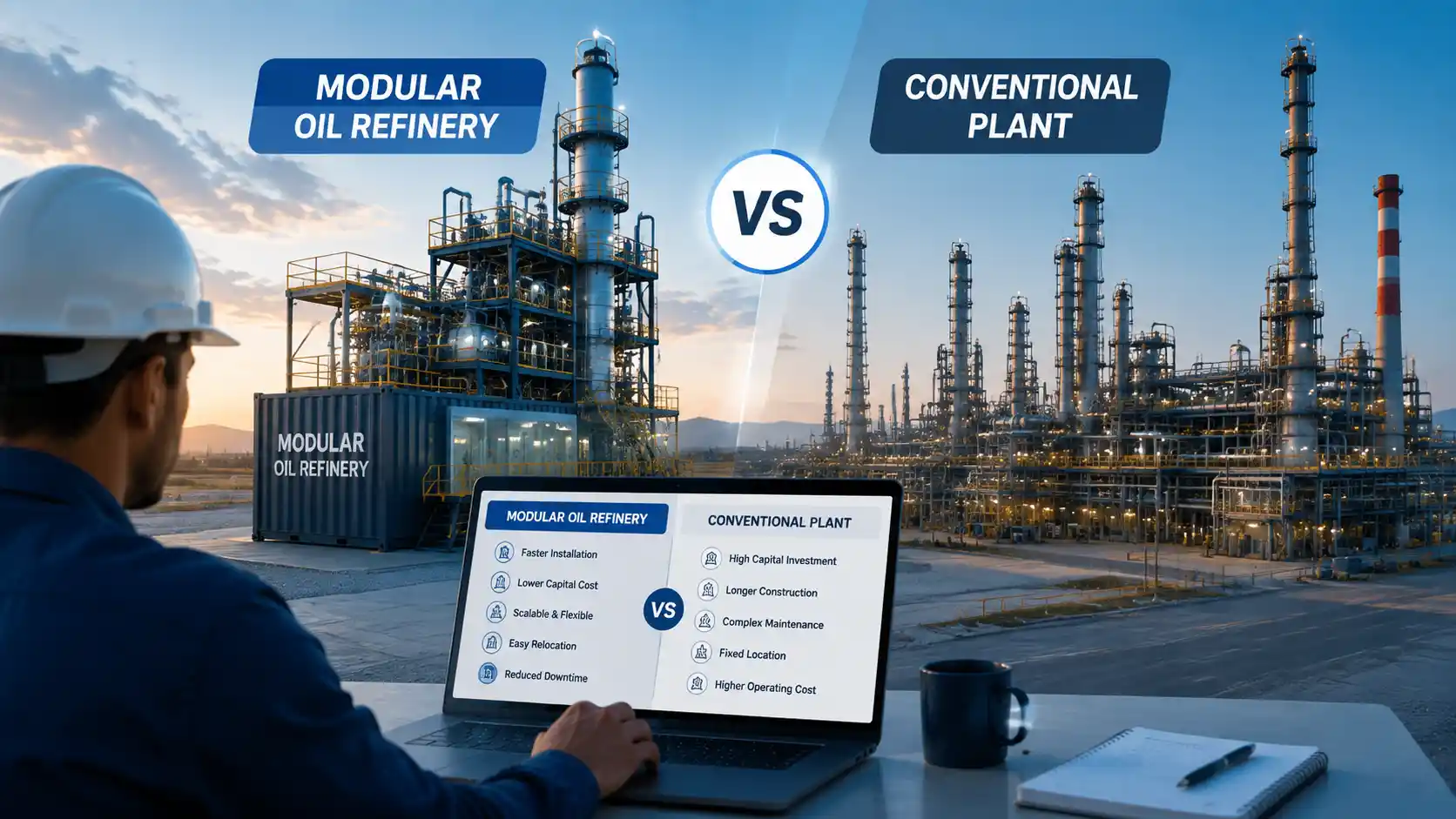
| Evaluation Factor | Modular Oil Refinery | Conventional Refinery |
| 1. Initial CAPEX | Lower initial capital outlay ($15M – $150M typical) | Massive upfront investment ($3B – $15B+) |
| 2. Construction Period | 12 to 18 months from design to commissioning | 36 to 84 months for engineering, civil, and field build |
| 3. Processing Capacity | 1,000 to 30,000 BPD per modular processing train | 100,000 to 500,000+ BPD centralized throughput |
| 4. Expansion Potential | Highly scalable; add parallel skids as demand grows | Requires major turnarounds, retrofits, and civil work |
| 5. Site Preparation | Compact footprint (<10 acres); basic foundation slabs | Large land footprint (100+ acres); extensive civil piling |
| 6. Transportation | Transported via standard ISO containers and flatbeds | Complex logistical transport of raw materials and heavy items |
| 7. On-Site Installation | Fast-track assembly; plug-and-play connections | Labor-intensive field welding, wiring, and structural erection |
| 8. Feedstock Flexibility | Optimized for targeted crude slates (light/medium API) | Complex conversion units handle heavy, high-sulfur crudes |
| 9. Utility Infrastructure | Low draw; integrates self-contained utility skids | Heavy infrastructure demands; dedicated power utility plants |
| 10. Operational Staffing | Lean team (10–25 per shift); high PLC/SCADA automation | Extensive workforce of engineers, operators, and safety crews |
| 11. Maintenance Profile | Pre-tested skid units; quick modular component swaps | Plant-wide turnarounds and lengthy scheduled shutdowns |
| 12. Remote Deployment | Excellent mobility; ideal for wellhead/isolated sites | Limited to established industrial hubs and pipeline centers |
Detailed In-Depth Factor Breakdown
1. Initial CAPEX & Financial Risk
Off-site skid manufacturing delivers predictable cost control. Building process units within a controlled factory environment avoids field labor overruns, material waste, and delay penalties. Because total initial capital exposure is reduced by 30% to 50% compared to equivalent small stick-built designs, operators lower their debt-service burdens and achieve faster break-even periods.
2. Construction Timeline & Fast-Track Delivery
Modular execution relies on parallel processing paths. While factory technicians fabricate, pipe, and instrument process skids, on-site civil contractors clear land and pour concrete slabs simultaneously. This parallel execution cuts project delivery times to 12–18 months, compared to 36–84 months for conventional builds, accelerating market entry by up to 4 years.
3. Footprint & Civil Site Engineering
Conventional facilities require extensive site clearing, mass earthworks, deep structural piling, and massive concrete foundations to support heavy, loose equipment. A modular plant condenses processing equipment onto structural steel frames, requiring only level ground, reinforced pad foundations, and basic containment bunds drastically paring civil engineering expenses.
4. Transportation & Field Logistics
Modular systems are engineered to international transport limits (ISO container frames and standard heavy-haul trailer dimensions). Sub-assemblies, including pre-piped heat exchangers, pump skids, and electrical control centers, move efficiently via established truck, rail, and sea transport networks without requiring specialized route clearances.
5. Installation & Field Assembly Work
Field labor for conventional refineries carries high safety overhead and weather risk. Modular systems arrive on site pre-wired, pre-piped, and factory hydrotested. On-site contractors simply position the skids on concrete pads, bolt mechanical flanges together, run interconnecting utility lines, and wire central control cables.
6. Feedstock & Processing Capability
Conventional megascale plants integrate expensive conversion units such as Fluid Catalytic Crackers (FCC), Hydrocrackers, and Delayed Cokers allowing them to refine low-grade, heavy, high-sulfur crudes into high-value light products. Standard modular configurations are optimized for light-to-medium sweet crudes (API gravity > 30°). However, advanced mini refinery equipment now includes modular hydrotreaters, vacuum columns, and catalytic reformers to process sour feedstocks and produce EPA-compliant Ultra-Low Sulfur Diesel (ULSD).
7. Staffing & Digital Automation
Operating a large conventional refinery requires hundreds of specialized personnel per shift. Modular facilities leverage modern Programmable Logic Controller (PLC) networks and SCADA control rooms. A fully operational 10,000 BPD modular facility can be safely run by a shift team of 10 to 15 operators, reducing long-term Operational Expenditure (OPEX).
Operational Capacity Scenarios
To select the right architecture, evaluate how your project aligns with these real-world capacity scenarios:
Scenario A: Small-Scale Field-Side Refining (1,000 – 5,000 BPD)
- Target Environment: Stranded oil fields, shale basins (e.g., Permian, Bakken), or wellheads lacking pipeline connections.
- Optimal Choice: Modular Oil Refinery.
- Strategic Value: Trucking unrefined crude over long distances eats into profit margins. Placing a small modular processing unit at the wellhead converts raw crude directly into usable diesel for field operations, generators, and local sales, instantly monetizing stranded production.
Scenario B: Regional Fuel Independence (10,000 – 30,000 BPD)
- Target Environment: Landlocked inland markets, regional distribution nodes, or island economies.
- Optimal Choice: Phased Modular Expansion.
- Strategic Value: Displaces expensive imported refined fuels. Operators can install a 10,000 BPD distillation train immediately to capture local market share, then add hydrotreating or catalytic reforming modules as fuel quality standards and capital reserves grow.
Scenario C: Remote-Site Industrial Applications
- Target Environment: Isolated mining operations, agricultural hubs, or off-grid logging facilities.
- Optimal Choice: Modular System.
- Strategic Value: Self-contained skid units with integrated diesel generation and water management provide reliable, independent fuel security without requiring connection to regional utility grids.
Scenario D: Megascale Export Refining (100,000+ BPD)
- Target Environment: Deepwater ports and global petroleum commodity trading hubs.
- Optimal Choice: Conventional Refinery.
- Strategic Value: When processing massive daily volumes of heavy crude for global export markets, conventional megastructures provide the lowest unit processing cost per barrel.
Critical Modular Equipment & System Integration
A high-performing modular plant relies on industrial-grade equipment designed for heavy continuous duty:
- Crude Distillation Units (CDU) & Vacuum Distillation Units (VDU): Primary thermal separation towers designed to split crude into precise boiling-point fractions (naphtha, kerosene, diesel, and heavy residue).
- Electrostatic Desalters: Critical pre-treatment systems that extract inorganic salts, suspended solids, and entrained water from raw crude to protect downstream heat exchangers and distillation columns from rapid corrosion.
- Heat Exchangers & Thermal Reactors: Heavy-duty shell-and-tube heat exchangers engineered to optimize heat integration and maintain system thermal efficiency.
- Fractionation Columns & Pressure Vessels: Custom vessels engineered to ASME Section VIII standards to handle elevated operating pressures and temperatures.
- Emissions Control & Industrial Filtration Infrastructure: Environmental safety requires robust air management. Integrating reliable Industrial Air Filtration systems protects plant personnel and ensures process vapors, VOCs, and fine particulates are safely captured and remediated.
When sourcing heavy process systems, partnering with an established refinery equipment supplier ensures all skid assemblies strictly adhere to API, ASME, and OSHA engineering standards.
Equipment Procurement & Machinery Quality
Procuring reliable process equipment is essential to preventing unplanned downtime and extending equipment operational life.
Sourcing heavy-duty Mechanical Machinery from distillation column internals to high-pressure pump skids requires strict metallurgical standards (such as 316L stainless steel, duplex alloys, or chrome-moly steel) to resist severe H₂S and naphthenic acid corrosion.
Working directly with a proven provider of complete Oil Refinery Equipment allows project owners to source integrated, factory-tested skid lines from crude desalters to final fuel blending units ensuring full system compatibility across the facility.
Strategic Buyer’s Decision Framework
Use this evaluation checklist to guide your preliminary project planning:
- Volume Requirements:
- Is your required throughput under 30,000 BPD? -> Choose Modular.
- Is your required throughput over 100,000 BPD? -> Choose Conventional.
- Target Time-to-Market:
- Do you need operational cash flow within 12–18 months? -> Choose Modular.
- Can your financial structure support a 3-to-7-year construction horizon? -> Choose Conventional.
- Site & Infrastructure Logistics:
- Is the site remote, off-grid, or land-constrained? -> Choose Modular.
- Does the site feature deepwater ports and major crude pipeline connections? -> Choose Conventional.
- Capital Allocation Strategy:
- Do you prefer starting small and expanding in phases? -> Choose Modular.
- Do you have access to multi-billion-dollar sovereign or institutional debt? -> Choose Conventional.
Conclusion & Action Plan
Modular oil refining technology offers a proven, capital-efficient framework for modern downstream project development. By reducing upfront CAPEX, shortening deployment timelines to 12–18 months, and offering flexible, plug-and-play scalability, modular refineries represent the most versatile approach for agile energy producers and regional fuel suppliers.
Partner with Mekantra Technologies
Whether you are planning a new modular refining project, expanding existing capacity, or procuring individual heavy process skids, Mekantra Technologies delivers industrial equipment built to strict global standards.
- Explore our full portfolio of Oil Refinery Equipment.
- Discover our heavy-duty Mechanical Machinery.
- Protect your plant operations with advanced Industrial Air Filtration systems.
Ready to advance your project engineering?
Submit your specifications or Request Technical Quote today to connect with our engineering specialists and receive a detailed proposal tailored to your operational requirements.

Mekantra Engineering Team
The technical voice of Mekantra. Our team consists of sourcing specialists, mechanical engineers, and logistics experts dedicated to providing transparent insights and high-performance solutions for the global manufacturing sector.
Mekantra Engineering Team
The technical voice of Mekantra. Our team consists of sourcing specialists, mechanical engineers, and logistics experts dedicated to providing transparent insights and high-performance solutions for the global manufacturing sector.